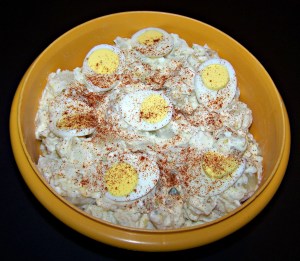
Cooking Techniques: Potato Salad

website potato salad

“I’m turning into you!”

A couple of weeks ago, my oldest was home from college, so I asked her to help me at a concert my middle child was performing in. At the end of the concert she came to me in the concession kitchen and said, “I’m turning into you! I just did a sweep of the auditorium, cleaning up everyone else’s trash, and now I’m behind the counter serving cake to everyone!”

A parent who overheard my daughter’s remarks, commented on what she had said, and it sparked a conversation among a few parents about the types of folks who helped behind the scenes. At one point, someone said, “No one thinks much about the custodian until he’s out sick, and the trash isn’t emptied.”

I was reminded of that comment this weekend as I prepared food for a cookout we were going to have. I had asked my middle child what she thought I should make to go with the burgers, hot dogs and chicken, and she replied, “Potato salad.” Her answer surprised me because she doesn’t like potato salad.

When I questioned her about her reply, she said, “It’s a barbecue. If you don’t have potato salad, people will ask where it is.” As I thought about what she said, I realized, she was right. No one has ever asked me to actually make potato salad, but there have definitely been plenty of times when I’ve had a barbecue without potato salad where someone has said something like, “Oh, no potato salad, huh?”

It may be because people are just used to potato salad being at barbecues. It may be because potatoes have always been a tasty complement to meat, which is what usually serves as the main course at barbecues. Whatever the reason, potato salad is the humble dish, which like the sick custodian is usually only noticed if it’s missing.

Potato salad, however, is a dish which folks should consider with more thought. Potatoes are high in fiber if you eat the skin, have nutrients like potassium and vitamin C, and are a good source of complex carbs. Potato salad in particular is nice because it can be inexpensively made, easily stretched to feed a crowd, and can be made in a variety of ways to suit different tastes. Potato salad is also very allergy friendly because unless you’re allergic to potatoes, how you choose to dress it and what additions you add can easily be done around any food allergies you might have.

Potato Salad Tips:

1. Type of potato: The choices abound for potato salad. Traditionally, potatoes are categorized as starchy (think Idaho potatoes), waxy (think red potatoes) or all-purpose (think Yukon-Gold potatoes). Starchy potatoes fall apart easily, so if you prefer a creamier, more mashed type of potato salad, these work best. Waxy potatoes hold their shape well, so if you prefer a firmer potato salad with squares of potato to bite into, you’ll want to use these. If you’re looking for something in between, all purpose potatoes are just the thing. You can also mix different types of potatoes which is what I do, because the starchier potatoes form a creamy base for the firmer waxy potatoes which provide something to bite into.

2. Potato cooking method: There are basically three ways to cook potatoes for potato salad – boiling, baking or high heat roasting. If you prefer your potatoes to be a little wetter, boil them. If you want them to be fluffier, bake them. If you want a concentrated potato flavor, roast them.

If you want your potatoes to have a firmer texture while boiling, mix the water with vinegar, about 2 tbsp for every 2 cups of water you’re using. If you bake the potatoes, you can choose whether you want to scoop the insides out of the skin or make the potato salad with the skin. If you roast the potatoes, the crunchy skin adds a nice complexity to the potato salad.

3. Additions to potato salad: Anything goes with potatoes. You can add vegetables of any type – celery, zucchini, carrots, cucumbers, tomatoes…. You can add meat – sausage, bacon, chicken, eggs…. You can add fruit – apples, pears, mangos…. You can add cheese. The only limit is your imagination. Experiment and see what you prefer taste-wise.

4. Seasonings: Potatoes are versatile. You can flavor them as you’d like. Dill, oregano, thyme, rosemary are more traditional. Cumin or coriander or turmeric add a new and different taste. Paprika and black pepper and parsley and dry mustard are always good favorites. As with the additions, experiment and see what your taste buds like. Adding leeks or chives or garlic punches up the flavor. Sticking with just salt and pepper allows more of the potato to come through. Adding something like a zucchini relish adds a twist to the flavor. What’s great is that you can choose.

5. Dressing: Dressing the potato salad is always fun. You can make a creamy dressing which usually utilizes ingredients like mayonnaise or yogurt or cream cheese or creamy salad dressings or sour cream. You can also make a vinaigrette dressing which uses plant-based oils like olive oil or safflower oil mixed with vinegars like red wine or apple cider or white. Sometimes I like to simply add fresh lemon juice to slightly mashed potato salad, and it’s quite lovely.

Dressings can be tangy or sweet or zesty or mild. You choose and change it up as you want. What’s important is to mix your dressing with the potatoes while they’re still slightly warm so the flavors will meld with the potatoes while the potato salad is cooling in the fridge. If you making a creamy dressing with yogurt or mayo, let the potatoes cool slightly longer so the dressing doesn’t melt and separate.

6. Garnishes: When you’re ready to serve your potato salad, it’s always nice to add a little something because the flavors, though, they meld in the fridge, do tend to flatten out a bit. So, give your potato salad a good mixing after you remove it from the fridge, and add a little something to freshen the flavor, whether it’s a little bit of mint or chopped up pieces of bacon or a little more dressing or a drizzle of fresh lemon juice. And then enjoy!


Spice Suggestion: Ginger

“You’re a gook.”

A recent event brought back some memories of my youth….

Growing up in the 70’s was not the best time to be Asian. It would be many years before I’d be old enough to understand the politics of Vietnam and the generalizing that strengthened the animosity aimed at me; so I remember being confused as to why people kept calling me a vulgar name for being Vietnamese when I was Korean.

As I grew up, I rebelled not only against the prejudice in general but the idea that there weren’t any differences among the various Asian ethnicities.

In some ways, I feel the same today about the spice, ginger. Too often when I mention using ginger, people will say something like, “Oh, it makes sense that you’d like ginger, being Asian and all.”

And when they do, that rebellious feeling sweeps over me again, and I find myself wanting to argue against the notion that ginger is somehow the spice of Asians and should only be relegated to Asian foods….

From medicinal to cooking uses, ginger has been a staple of Greek, Middle Eastern, and European countries for as many centuries as Asian countries. Even in the United States people have used ginger without considering it an “Asian” spice. Colonial recipes for gingersnaps and gingerbread and ginger teas and ginger ales abound as well as records of its use as medicine for upset stomachs.

Admittedly, ginger can be strong, so sometimes folks who are used to bland foods might find it a bit much, but a little can add an abundance of flavor.

In this day and age, ginger comes in a variety of types: fresh, dried, candied, crystallized, freeze dried, pickled, as a paste, and grated in a tube or container for the refrigerator. Fresh ginger obviously is the strongest in terms of flavor, but the convenience of the options with a longer shelf life is not to be underestimated.

If you’re using fresh ginger, you want look for ginger root with a nice, tan color which is firm to the touch and has smooth ends. If it looks dried out or moldy or is soft to the touch, don’t buy it. To use, simply peel and chop as desired. Ginger keeps for a good few weeks in the fridge, and you can even freeze it for several months.

Obviously the more you use, the stronger the ginger flavor, and fresh ginger will have a stronger taste than the other varieties. Ginger is like garlic and onions, and the more ginger cooks, the mellower its flavor becomes, so if you prefer the spicy, pungent taste, add the ginger near the end.

Some ways to use ginger:

1. Homemade ginger tea: The way my mom makes it is to put some fresh ginger root and cinnamon sticks into a pot of water and just let it simmer and steep for a while. Add a little bit of honey, and it’s quite delicious plus has added health benefits.

2. Vegetables: Grated fresh ginger root or ground ginger adds a bit of zest to sauteed vegetables.

3. Omelettes and Egg dishes: Make a paste of ginger and garlic to add a little zing which is quite tasty.

4. Baked goods: Add dried ginger or chopped crystallized ginger to muffins, pancakes, scones, waffles, cakes, cookies, pies, for a new taste.

5. Meats, chicken and fish: Add grated or chopped fresh or freeze dried ginger or ground ginger to any entree to add another flavor dimension to the dish.

6. Soups and dressings: Ginger adds a nice tang to soups and homemade dressings, whether for salad or entrees.

On this site there are already recipes for ginger snaps and a ginger cake and gingerbread, but I’ll add another couple below for a ginger cheesecake which is creamy and spicy and yummy and pumpkin custard squares which my kids love and which are great when you don’t want to take the time to make a pumpkin pie. Both recipes are dairy, gluten, nut and mostly refined sugar free.

Pumpkin Custard Squares

1. Preheat the oven to 350 degrees. Grease an 8.5 x 11 pan with your preferred method.

2.  In a large bowl, mix 1 can of pumpkin with 2 eggs, 1/2 cup agave, 2 tbsp melted butter, 1 cup soy or flax milk, 1 cup water, 2 tsp cinnamon, 1 to 2 tsp ground ginger (if you love ginger, use the higher amount; if not use the smaller amount), 1/2 tsp nutmeg, 1/2 tsp salt, and 1/4 tsp ground cloves.

3. Mix in 3/4 cup Gluten Free Bisquick until the batter is smooth and creamy with no lumps.

4. Pour into prepared pan and bake for 50-55 minutes. The custard will be stiff and dry on top and the custard will be slightly puffed.

5. Cool completely on a wire cooling rack. Cut into squares and serve.

Ginger Spice Cheesecake

(Be sure ALL ingredients are at room temperature for best results!)

1. Preheat the oven to 350 degrees.  Grease a 10 inch springform pan with your preferred method.

2. In a food processor pulse one 8 ounce box of gluten, nut and dairy free gingersnaps until you have crumbs. Mix well with 1/4 cup melted vegan butter. Spread evenly onto the bottom of the prepared springform pan and bake for 10 minutes. Remove from the oven and cool on a wire cooling rack. Decrease the oven temperature to 325 degrees.

3. When cool, carefully cover the outside of the springform pan with aluminum foil and put the pan into a larger pan. Begin to boil some water, enough to fill the pan at least halfway up the springform pan but no more than 3/4 way up (this you’ll do after you put the cheesecake batter into the springform pan).

4. In a mixer, cream four 8 ounce room temperature Tofutti cream cheese packages until smooth and creamy. Use a rubber spatula to scrape the cream cheese down from the sides.

5. Slowly drizzle in 1/2 cup Agave while mixing the cream cheese on low.  Once incorporated slowly mix in one 12 ounce package Tofutti sour cream.

6. Blend in 1/2 cup liquid egg whites. Then 2 whole eggs, being careful to mix them in one at a time.

7. Mix in 1/4 tsp salt, 1/2 tsp nutmeg, 1 tsp cinnamon, and 1 to 2 tsp ground ginger (choose the amount based up on your preference for mild or strong ginger taste).

8. In a food processor chop up crystallized or candied ginger so you have at least 2 tbsp (you can use more if you want). Add to the cheesecake mixture and blend only until the ginger is incorporated.

9. Carefully pour the cheesecake batter into the springform pan. Place the larger pan with the springform pan into the oven. Very carefully pour the boiling water in the larger pan until it’s at lease halfway up the springform pan. You can go as high as 3/4 way up.

10. Bake for one hour and 30 minutes. When done, the cheesecake will be firmer around the edges, the batter won’t be jiggly, and the cheesecake will be slightly puffed.

11. Remove the cheesecake from the oven and from the larger pan. Remove the aluminum foil, and cool for 15 to 30 minutes on a wire cooling rack. Run a knife around the edge of the springform pan and remove the outer side of the pan.

12. Cool the cheesecake completely in the fridge for several hours.