Shortcut Cooking: Oatmeal Date Cookies

“We haven’t made cookies in a while….”

My husband had some errands to run, and my high school daughter was playing with the band at an event. So, this left my son and I to occupy our time together. Since I had a workshop coming up, I suggested that we do some baking.

The problem was deciding what to bake. I’d had a series of workshops recently and done a lot of baking so I was a bit tired of the same ol’, same ol’, which were a stock series of recipes which I usually make for the workshops because they’re quick and easy in addition to representing the various different substitutions I teach about in the workshops.

My son’s suggestion was that we make cookies because we hadn’t made them in a long, long time.

There was a reason for that…. I have found that cookies take longer to make, both in the assembling and in the baking. But my son was correct, that we hadn’t made any in a while, and they would be something different. So, we went to work creating a recipe.

I decided that if we were going to bake cookies, I wanted to make something that would be quick. This meant beginning with what we had in the pantry and not creating everything from scratch. So, we opted to use a gluten free flour blend that I had already made up for another item and had leftovers of in the pantry. We also decided to use pre-chopped, store-bought dates which we found in the pantry as well. Because I’m always trying to be healthy, we chose to make oatmeal cookies with whole rolled oats, also in in the pantry, and to use coconut sugar instead of white sugar so I could use half the amount I’d have to use of white sugar.

Using the mixer sped the assembling process up, and because we decided to make oatmeal cookies, we could simply drop the batter onto the parchment paper and flatten them without any rolling or forming. By using vegan butter, I minimized the spreading so I could put 16 cookies (the 1 tbsp size) instead of 12 to a cookie sheet which meant all the cookies fit onto just four cookie sheets, so I could bake two sheets at a time in the oven, resulting in only 20 minutes of baking time.

The result was that from when we started rummaging in the pantry to when the second batch of two cookie sheets came out, it was less than 45 minutes. Now, those are cookies worth making!

Oatmeal Date Cookies

(These make about 60 small cookies or 30 large cookies.)

Ingredients:

1 1/2 cup Gluten Free flour blend (I used a homemade blend of garbanzo bean and sorghum flours mixed with tapioca and potato starch)

3 cups Gluten Free whole rolled oats

1 tsp salt

2 tsp baking powder

2 tsp cinnamon

8 oz pkg pitted, dried, chopped dates

1 cup vegan soy free butter or coconut oil or natural shortening

1 cup coconut sugar

2 tbsp ground flaxseed mixed with 6 tbsp water (Mix ahead of time and let it sit)

2 tbsp additional water

Baking Instructions:

  1. Preheat the oven to 350 degrees and line cookie sheets with parchment paper.
  2. Mix together in a bowl the flour, oats, salt, baking powder and cinnamon. Stir in the dates. Set aside
  3. In a mixer, cream the butter with the coconut sugar.
  4. Add the flaxseed mixture with the dry ingredients and the additional water. Mix until well combined.
  5. On the prepared cookie sheets, drop the cookie batter by 1 tablespoon-full for smaller cookies (2 inch diameter) or 2 tablespoons-full for larger cookies (4 inch diameter). Leave about an inch in between the cookies.
  6. Press the dough down with a fork in both directions and bake in the preheated oven for 8-10 minutes for the small cookies until the cookies are puffed, golden and stiff to the tough. For the larger cookies, turn the pan around after 8-10 minutes and bake for another 8-10 minutes.
  7. Allow the cookies to cool for a couple of minutes on the cookies sheets before moving them to a wire cooling rack with a spatula to cool completely.
Healthy Habits: Quinoa Black Bean Salad

“It’s a bit difficult to avoid all of nature….”

Recently my health insurance provider decided that they wouldn’t cover allergy medications any more which is a big blow to my health. When one goes to an allergist for the first time, the allergist will test you for 80 most common allergens. I am allergic to 78. Have been since I was a child, and they haven’t changed in over 40 years, despite repeated testing every seven years.

For the first thirty years of my life, I coughed, hacked, and sniffled my way through life, never without huge wads of tissues in hand and rarely able to breathe through my nose. The advent of new medications, specifically nose sprays, seemed an opportunity for relief. True to my life, though, it turned out I was allergic to most of the new medications. Go figure! But there was one which actually worked, and for the past 15 years, I was able to breathe through my nose, divest down to one tissue a day, and only hack, cough and sniffle two or three times a year when the allergy seasons were at their worst.

Now, though, I’ve slowly begun a descent back to what I had forgotten, not being able to breathe unless completely upright, blowing my nose so often that it’s red and raw, once again needing to invest in my own tissue company, and finding myself at the doctor’s more than I’d like to be for antibiotics for sinus infections.

On the plus side, I’ve been so sick at times that I’ve been forced to stay at home which is an unusual opportunity for me because I suddenly have time which I wouldn’t have had if I were out at my usual meetings and running of errands. It has also meant I can see firsthand which parts of my life really must be attended to and which can survive without me.

On the downside, feeling unwell makes me tired which stimulates cravings for food which aren’t always the healthiest of choices. Since I always have to watch my weight and my sugars, I have been trying to create comfort foods which curb my cravings but which are healthy.

One such recipe is for a quinoa salad. If you are unfamiliar with quinoa, it is essentially a seed which is a good protein source.  Because it cooks similarly to rice, folks tend to eat it like a grain, and folks who are diabetic or needing to watch carbs should know that quinoa is high in carbohydrates. Since quinoa is also high in protein and fiber, though, eaten judiciously, quinoa is a great comfort food.

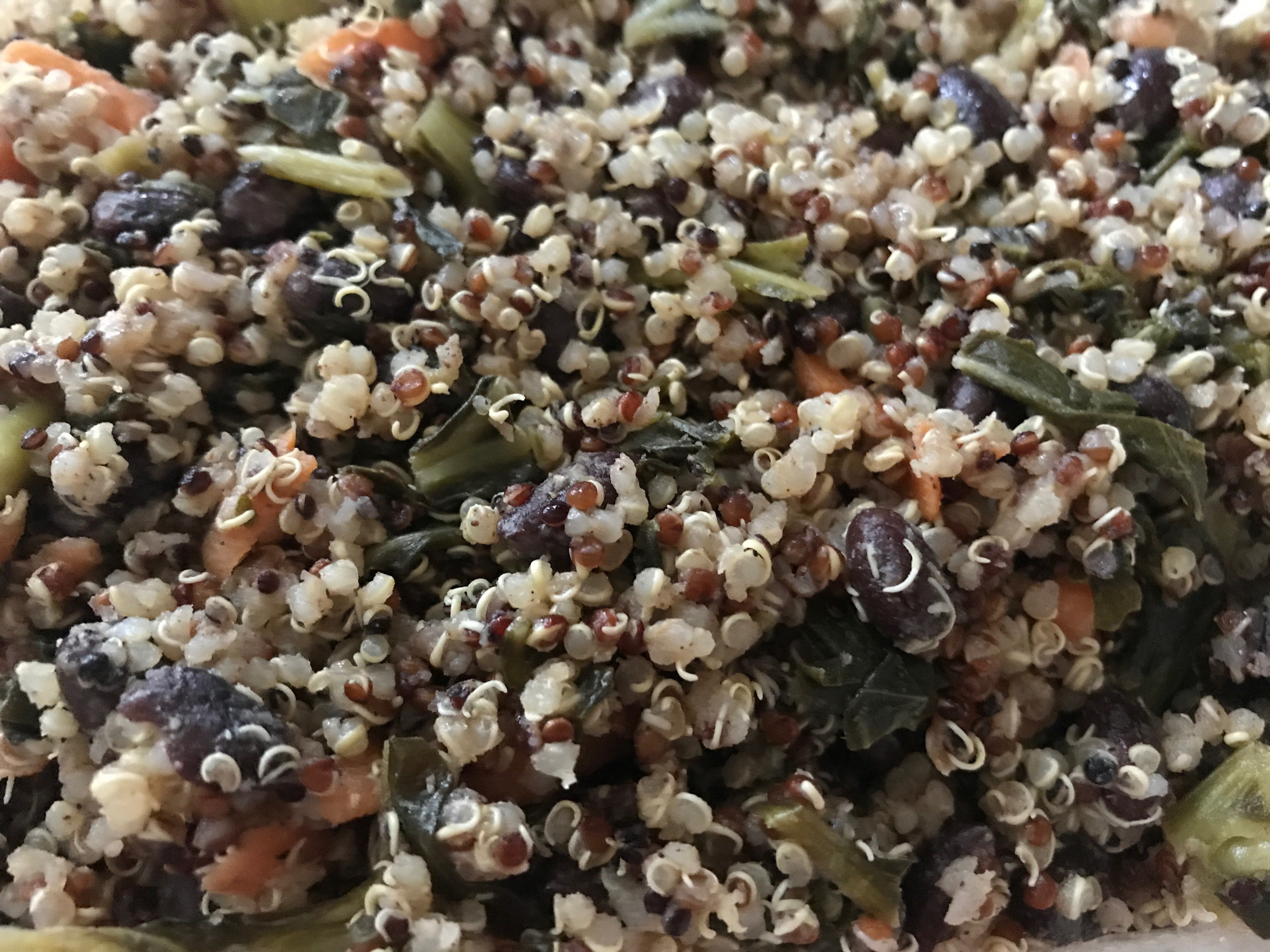
I make a quinoa salad which I and my family really likes which uses multi-colored quinoa, black beans, kale and carrots. The quinoa and black beans provide the carbs which are filling but also fiber and protein. The kale and carrots provide nutrients gained from vegetables and cuts the amount of quinoa (and hence the carbs) in a cup serving.

Quinoa Black Bean Salad

Ingredients:

2 cups water

1 cup multi-colored quinoa

2 cups frozen, chopped kale

1 cup thinly sliced baby carrots

16 oz can of no salt, no sugar added black beans, rinsed well and drained completely of all water

3 tbsp olive oil

1 tbsp apple cider vinegar

1/4 tsp salt

1/4 tsp black pepper

3/4 tsp ground cinnamon

3/4 tsp ground cardamom

1-3 tsp honey (optional; use desired amount of sweetness if using; if making for just the family, I omit; if making for company, I use 2 tsp)

Cooking Instructions:

  1. In a medium saucepan, pour the water and add the quinoa. Bring the water to a boil, then lower the heat and simmer until the quinoa has plumped, is showing white rings, and has absorbed all the water. This will take anywhere from five to 15 minutes, depending on how vigorously you are simmering the water. I find that it’s helpful to stir the quinoa every so often.
  2. Once the water is absorbed, remove the pan from the heat, cover the quinoa and let it sit. You want the quinoa to be completely dry before you mix it with other ingredients. This can take anywhere from 10 to 30 minutes, depending on how much of the water was actually absorbed into the quinoa before you removed it from the heat.  When it’s completely dry, you will be able to fluff the quinoa with a fork. If the quinoa clumps together when you try to stir it, then it’s still a bit damp.
  3. While the quinoa is drying, thinly slice baby carrots to make a cup. You can use regular sized peeled carrots but then you’ll want to cut the thin slices in half because you are only cooking the carrots a short amount of time in the microwave with the kale, and you don’t want the carrots to be hard. Once you have a cup’s worth chopped, put it aside for the moment.
  4. Put 2 cups of frozen, chopped kale into a microwave safe bowl.  Follow the instructions for cooking, only halfway during the cooking time, remove the bowl, stir the kale and add the cup of chopped carrots. Finish cooking the kale in the microwave.
  5. Add the kale, carrots and black beans to the quinoa and mix well.
  6. In a measuring cup, whisk together the olive oil, apple cider vinegar, salt, pepper, cinnamon and cumin and honey, if using.
  7. Drizzle the dressing onto the quinoa salad and use a spoon to incorporate the dressing into the quinoa salad.
  8. Salad can be served warm or cold. Can store in the fridge for a long time.

Changing Tradition: Dairy Free Pumpkin Cheesecake

“What exactly is traditional?”

This year, for the first time in eight years, I did not coordinate the parades and barbecue for the high school band which signifies the end of a “tradition” for our family. Every Memorial Day for these past few years, we’ve woken up early as a family and headed to the high school to drop off a high school child and to receive all the food parents were donating to the barbecue. Then, my remaining children, husband and I would head over to the local camp to set up for the barbecue. After cooking and serving hamburgers, hot dogs and veggie burgers to 70 people, we’d clean everything up, unload at home, and head back to the high school to pick up our child from the second of the two parades marched in on Memorial Day.

What’s varied over the years is the number of my children who helped at the barbecue. First there were two while my eldest marched with the high school band; then there was one as my middle child marched. What didn’t change was the fun we had serving as a family, and the expectations of my youngest who from his youngest years loved going to the camp on Memorial Day. Last year, however, I resigned from 15 years of school volunteer work to focus more on other opportunities.

For my youngest, who is on the autism spectrum, he was torn between wanting to support his mother and what he saw as a loss from participating in our “traditions” for Memorial Day. As it is, this year would have marked a change whether I had continued or not because my husband’s father passed away a couple of weeks ago, and though we spent a week with my mother-in-law for the funeral, my husband and youngest went back this weekend to help her sort through my father-in-law’s office materials.

Before my father-in-law passed away, though, I reminded my son that traditions are what we make, not what make us and that this could be a year to do something slightly different. For some of us, our foods are very traditional… foods we’ve always had and therefore must continue to have. This can make it difficult if we’re trying to eat healthier or suddenly have food allergies altering our food needs.

This week I received an email from someone who has always loved pumpkin cheesecake. It’s apparently been a “tradition” to make it for Memorial Day, a tradition that dates back to his childhood when he wanted pumpkin pie for Memorial Day and his mom wanted to make a cheesecake, and they compromised. This year, however, his mother can no longer eat dairy and has to be careful of her total carb intake due to diabetes, and he feared their tradition would have to end. Instead, he learned that the tradition simply need to be modified.

I used tofu versions of the dairy for the cheesecake, reduced the “sugars” by using a smaller amount of agave instead of a larger amount of sugar, and reduced overall carbs by opting to not have a crust for the cheesecake. The gentleman said his mother enjoyed the cheesecake immensely, so for those of us wondering if change can be good, this cheesecake says, “Yes.”

Pumpkin Cheesecake

Ingredients:

3 (8-ounce) packages tofu cream cheese, at room temperature
¾ cup Agave (If you like your cheesecake sweet, you may want to increase this to one cup)
1 (15-ounce) can pureed pumpkin or two cups cooked, pureed pumpkin
1/4 cup tofu sour cream, at room temperature
2 teaspoons ground cinnamon
1 teaspoon fresh ground ginger
¼ teaspoon ground cloves
4 eggs, at room temperature

Topping: 12 ounce tofu sour cream, 2 tsp agave, 1 tsp vanilla

Cinnamon

Cooking Instructions:
Preheat oven to 350 degrees F. and wrap a 10 inch springform pan with aluminum foil around the bottom. Line the bottom of the pan with parchment paper.

In a mixer, beat tofu cream cheese until smooth. Slowly add the agave with the mixer on low, scraping down the sides as needed. Add the pumpkin puree, sour cream, and the spices. Beat together until well combined. Add the eggs, one at a time, mixing well in between each addition.

Pour into the prepared pan. Spread out evenly and place in a large pan that will hold the springform pan and water. Pour boiling water into the larger pan until it’s about halfway up the springform pan. Bake the cheesecake in the oven for about an 1 hour or so. The cheesecake will be slightly jiggly in the center but a knife inserted near the edge should come out mostly clean.  Mine took an hour and ten minutes. This made a creamy, less dense cheesecake. If you like your cheesecake to be more solid, bake longer until the center is more firm.

Mix the sour cream with the agave and vanilla and spread over the top of the cheesecake. Bake for about another ten minutes. You just want the topping to solidify a bit.

Remove from the oven and let sit for 15 to 30 minutes. Cover with plastic wrap and refrigerate for at least 4 hours until the cheesecake is set. Remove from the springform pan and sprinkle with cinnamon on top before serving.