Recipe Revamping: Lemon Poppy Seed Cake

“What image represents me?”

If you have not had the experience yet of the college application process for a child in today’s world, you are bound to be surprised when you do. Unlike the applications of my day, students now are asked questions which, to me, seem a bit odd.

“What your favorite website is.” Presumably, colleges believe this is a window into a part of the students’ lives, an indication of what they enjoy, an inkling of where their time is spent…. Maybe?

“How did you spend your summer?” Another question probably designed to give insight but reminds me of those first week of school essays assigned in elementary school.

But my favorite: “If you had to pick an image that best represents who you are, what would it be?” As you can imagine, my daughter came downstairs from her room for that one.

“Mom, what image represents me?”

My wise, motherly response? “Huh?”

After she explained why she was asking and read the question in it’s entirety, my equally insightful, wonderful answer?  “Um. I’m not really sure, honey. Dance shoes since you’re a dancer? Books because you’re so studious? People since you are always serving others? That’s a tough question. Why don’t you go ask your father?”

At that moment, our son walked into the kitchen, so our daughter asked him, and his response? “I don’t know for you, but mama would be a ‘to-do’ list.”

Out of the mouth of babes, as they say….

I am famous for my to-do lists. Every project I work on, every task for the organizations I chair, every time we travel, every coordination email I send, every event I cater, every birthday party planned… literally everything I do is organized by a to-do list.

Part of it is my personality. I like structure and being organized. Some of it is the satisfaction of crossing off an item from the list and seeing your progress as the list gets smaller. Most of the reason, though, is that simply that I’m visual and if it’s not in writing, it doesn’t exist as far as my brain is concerned, and I won’t remember to do it. (As you can imagine, this has become more of an issue the older I become!)

This week on my to-do list was to bake a poppy seed layer cake for a luncheon my husband and I had been invited to attend. As I rummaged through cook books and googled online recipes, I noticed that while a myriad of recipes existed, they all seemed to use a lot of butter, shortening, eggs, and/or cream cheese or sour cream, all of which are high in saturated fats and cholesterol which I wanted to avoid in addition to, of course, making the cake gluten, dairy, and nut free, so I, too, could enjoy it.

This meant rethinking a few things. So, the first thing I did was opt to make a lemon poppy seed cake, because the lemon would flavor everything and reduce the need for flavor from butter or cream cheese or sour cream. The second thing I did was choose to use egg whites instead of whole eggs. The third decision was to make a “buttermilk” out of soy milk and lemon juice to replace sour cream or cream cheese in the recipe and to cut the amount to 1/2 cup. The fourth change was to use olive oil in the cake with its good fats and a vegan olive oil butter for the frosting which had a little saturated fat but much less than butter and far more good fats. And as always, I did what I could to cut the use of sugar, confining it to just the frosting. The result was a delightfully light tasting cake which all enjoyed.

Frosted Lemon Poppy Seed Layer Cake

Ingredients:

2 ½ cups your favorite Gluten Free Flour blend (I used King Arthur’s whole grain blend)

2 tsp gluten free baking powder

1/2 tsp baking soda

1/2 tsp salt

½ cup Truvia

1/2 cup poppy seeds

2/3 cup extra light olive oil

2/3 cup Agave

½ cup “buttermilk” (I used soy milk mixed with 1/2 tbsp lemon juice)

1/2 cup freshly squeezed lemon juice (depending on size of lemons, you will need anywhere from 3 to 6 lemons; you really do want to use fresh lemons if at all possible for the best taste)

1/2 cup water

6 egg whites, at room temperature

1/2 tsp cream of tartar

Baking Instructions:

1. Preheat oven to 350 degrees. Prepare three 9 inch round cake pans for use. (I just line the pans with parchment paper.)

2. Mix the flour with baking powder, baking soda, and salt. Add the truvia and poppy seeds. Set aside.

3. Mix oil, Agave, buttermilk, lemon juice and water. Set aside.

4. In a large mixer, beat the egg whites with the cream of tartar with the whisk attachment until thick, white peaks form when you lift the whisk.

5. Mix the dry ingredients into the wet ingredients. Combine well until the dry ingredients are completely moistened.  Batter will be thick.

6. Gently fold the beaten egg whites into the batter, a little at at time, until all the egg whites are fully incorporated into the batter.

7. Evenly and equally spread batter into each of the three cake pans and bake for about 15 minutes until the cake layers are puffed, golden, and a toothpick inserted into the cake comes out clean. (Mine took 17 minutes.)

8. Cool on the cake layers in their pans until completely cool.

9. Frost the layers with the lemon frosting below, and store in the refrigerator until close to serving time. Let the cake come to room temperature before serving. Enjoy!

Lemon Frosting

Ingredients:

1 cup sugar

8 tsp gluten free flour (I opted to use rice flour so the color would be white)

2 tbsp cornstarch

1/4 tsp salt

1/3 cup lemon juice (use fresh lemons if you can; depending on the size of the lemons you will need about 2 to 4 lemons)

2/3 cup milk

1 cup vegan olive oil butter (I used the Earth Balance version)

1 tsp vanilla

Cooking Instructions:

  1. Whisk together the sugar, flour, cornstarch and salt in a pan. Whisk in the “milk” until smooth.
  2. Over low heat, stir constantly until the mixture begins to boil and thicken. Depending on how shallow your pan is, this will probably take about 4 to 8 minutes.
  3. Once the mixture is thick, pour the mixture into a shallow glass container to cool. I find that a glass pie pan works very well. It usually takes an hour or more to fully cool.
  4. Once the mixture is cool, in a mixer, beat the vegan butter until light and fluffy, and then scrape down the sides of the butter.
  5. Add the cooled mixture with the vanilla and beat the frosting on a low speed to incorporate the mixture into the butter. It will look a bit curdled. Scrape down the sides.
  6. Increase the speed and beat until the mixture looks like a light and fluffy frosting. Its texture and taste will be similar to a whipped cream frosting.
  7. Use the frosting to frost between the cake layers and the outside and top of the cake. (This made enough frosting to generously frost a three layer cake.)


Breakfast Buffet: Spinach Strata

It’s already out of print….”

Last Saturday the writing collaborative I helped to found brought in an illustrator who gave me a wonderful book she had illustrated for an author who wrote about a girl who was gluten-sensitive, celebrating her birthday. The illustrator knew I did workshops for allergy-friendly baking and thought I’d enjoy the book. When I mentioned that it would be nice to purchase a few, she told me that the book had already gone out of print. (It was published in 2013.)

I was bummed. Not only because I wouldn’t be able to purchase more copies of the book but because there had been such a lack of interest in such a great book.

I should not have been surprised, though. My own experience has taught me that unless it affects folks personally, the impetus to consider other people’s plight and show consideration seems to be non-existent at times, and such a book would not need to be purchased by those of us who already know but by those who need to learn.

That does not mean that we stop trying to teach, though. Recently I met with the principal of our high school about a staff appreciation luncheon, and he, too, surprised me.  He asked me if I was considering staff with food allergies in my planning. Since this was the same principal who had held a breakfast for the senior students without any food that students with food allergies could eat, my astonishment must have shown on my face. He was quick to explain that he’d “learned his lesson” about food allergies, which I took to mean that a whole lot of parents must have called him about that breakfast!

Only when we continue to share will people start to come around. I have spoken so many times to the local PTO and my church that, though it has taken several years (years!), people finally have started to make changes. Not at every event, which they still need to consider, but at least at events where they know for sure that people with food allergies will attend.

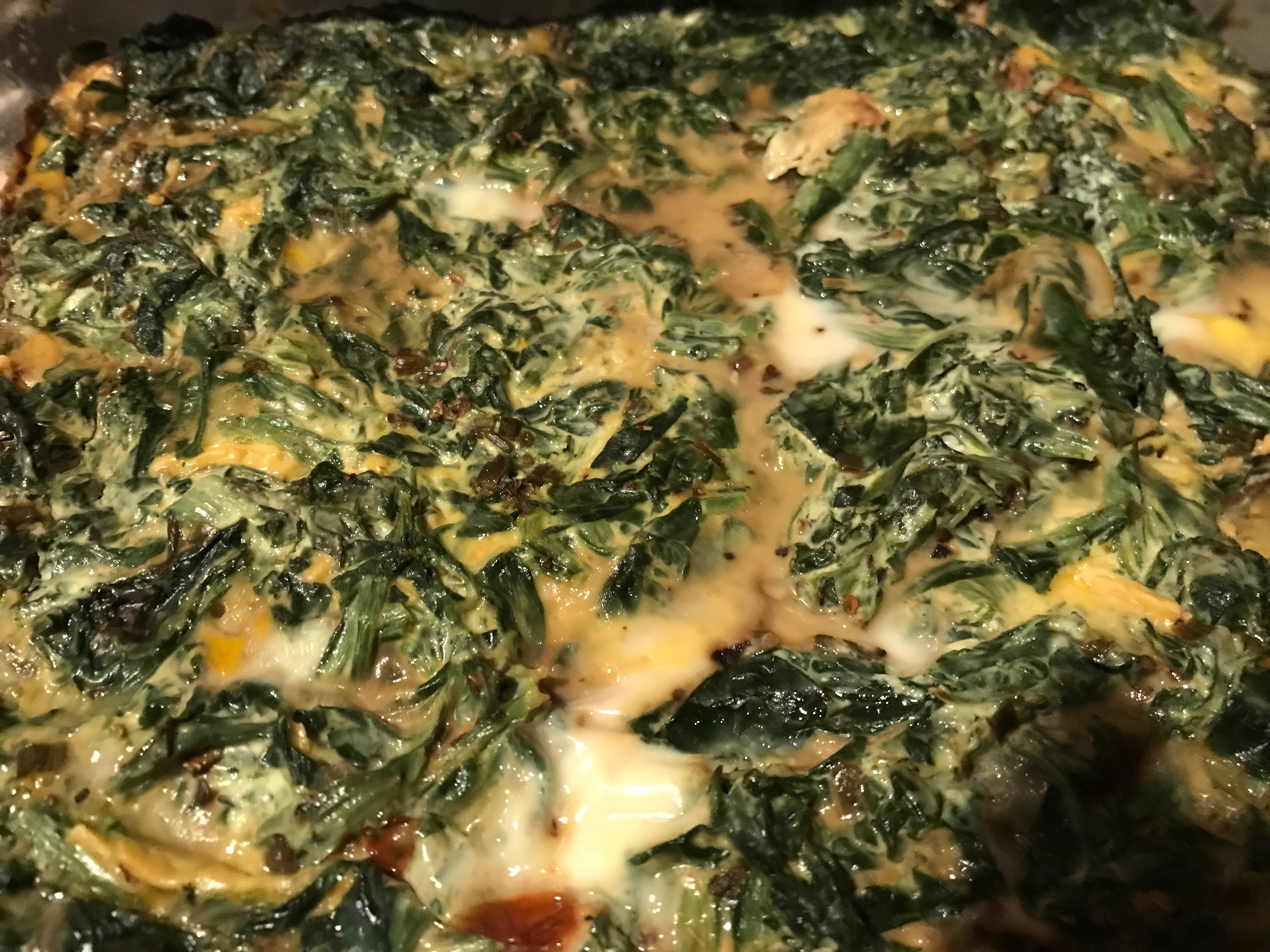
Recently a local group called me to ask if I could make a breakfast dish for some folks with dairy and gluten allergies. I had the perfect hot dish which I had made over Christmas, a Spinach Strata. Made with gluten free bread, eggs, soy milk, and spinach sautéed with tofu cream cheese, it is cheesy and gooey and yummy. We had enjoyed it at Christmas, and the folks at the breakfast buffet the other day apparently enjoyed it as well.

The recipe is below so you can, too!

Spinach Strata

Best if prepared the night before and cooked in the morning.

Ingredients:

six slices favorite gluten free bread (I used Ancient Grains whole grain millet-chai bread; I used an 8 x 11 pan; if you use a larger pan or smaller pan, you may need to adjust the slices of bread you need to cover the bottom of the pan)

dairy free mozzarella (I used about a cup of the Daiya brand but how much will depend on what size strata you may be making; you want to cover the top of the bread cubes)

fresh spinach (I used a 16 oz package of washed baby spinach; a smaller strata may need a less; a larger strata may need more, depending on how much spinach you like)

one container tofu cream cheese (I used an 8 oz container of Tofutti brand cream cheese; unless you aer halving the recipe, slight decreases or increases in spinach does not warrant changing the amount of cream cheese used)

eggs (I was making the dish in an 8 x 11 pan and ended up using six whole eggs, but the amount will vary depending on the size pan you use; you want the egg/milk mixture to cover come to the top of the spinach mixture)

“milk” (I used soy milk but you can use whatever you like; I also used a cup and a half for the six eggs because I was making the dish in an 8 x 11 pan, but the amount will vary depending on the size pan you use and how many eggs; you want the egg/milk mixture to cover come to the top of the spinach mixture; ratio is usually about 1/2 cup of milk per egg)

herbs and spices (I used black pepper, a little bit of red pepper flakes, onion powder, oregano and thyme, but you can use what suits your tastes)

Cooking Instructions:

  1. Grease a pan of your choosing.
  2. Cut the slices of bread into small cubes and spread the bread over the bottom of your pan.
  3. Sprinkle the bread cubes with the dairy free mozarella.
  4. In a pan saute the spinach with a little bit of water just until the spinach begins to wilt. Add the tofu cream cheese and stir well until the cheese has melted into the spinach.
  5. Carefully dollop the spinach mixture over the top of the bread and mozzarella cheese.
  6. Whisk together the eggs, dairy free milk, and herbs until well blended.
  7. Carefully pour the egg mixture over the bread and spinach. You want the egg mixture to reach the top of the spinach. If you need a little bit more, simply whisk up an additional egg or two and add it to the pan.
  8. Wrap the dish well in plastic wrap or foil and let it sit overnight in the fridge. If making the same day, let it sit at least an hour in the fridge so the bread can soak up the egg mixture.
  9. Bake in a preheated 350 degree oven until the strata is puffed and golden. Time will depend on the size and shallowness of your pan. My 8 x 11 pan took about 45 minutes.
  10. Leftover strata stores well in the fridge and tastes just as good when microwaved the next day.


New Year Visions: Vegan Spanakopita

Happy New Year!

A friend of mine wrote in on December 31, 2017, that this was a day where all the adults living (as in over 18) were born in the 20th century (1900s) and all the minors (under 18) were born in the 21st century (2000s). It made me think about the changes I’ve seen in life from the 1970’s until now and also consider what I’d like to see going forward into 2018. The result was an ABC’s of wishes I wrote. If folks are interested in reading it, feel free to click here: Wishes

In addition, I thought about all the ways food has changed from the 70’s until now.  Cheese Whiz to organic, artisan cheeses… Chef Boyardee ravioli to whole wheat, butternut squash, kale ravioli…white flour noodles to gluten free quinoa pasta… Nestle Tollhouse chocolate chip cookies to Enjoy Life cookies free of 12 major food allergens. The list goes on, and the point is the same: what we consider to be “normal” eating conventions is different going into 2018.

This was evident in our home as we were deciding what to make for a New Year’s dinner we were hosting with some friends. Between food allergies and vegan children, coming up with a satisfying entree wasn’t easy. In the end we opted to make a vegan spanakopita which would have protein, fit dietary needs, and be a satisfying holiday-ish entree for the folks who neither have food allergies or are vegan. To make the dish, though, required work, specifically how best to alter a “normal” spanakopita recipe.

For folks not as familiar with spanakopita, it is a traditionally Greek dish which mixes spinach and feta cheese as a filling to go between layers of phyllo or filo dough which are thin sheets of a low-fat flour dough. Folks with gluten or wheat issues cannot use the filo dough found in stores, and folks with dairy issues cannot eat the cheese, so in the past, these folks could not have spanakopita, but those days are now gone.

How to make spanakopita:

  1. The filo dough: Folks with no wheat or gluten issues can purchase filo dough at the store. A variety of companies sell them in sheets of 20 which is what you usually need (10 sheets for the bottom and 10 sheets for the top). If people want to make their own, The Spruce has a good recipe: Filo Dough Recipe.  If folks have allergies, though, the only option currently is to make your own gluten free filo sheets.  Gluten Free on a Shoestring has the best recipe that I have tried: Gluten Free Filo Dough Recipe . It is not really all that hard, and it is worth the work.
  2. The cheese: Traditionally, spanakopita uses feta cheese. Some folks combine feta and ricotta. Others combine feta and cottage cheese, but feta is always a key ingredient. If there are no food restrictions, there are plenty of recipes online using feta which one can follow. If dairy is an issue or one is vegan, there are basically two options for replacing the cheese: nut or tofu, both of which require making your own “cheese”. For folks who might be allergic to both nuts and tofu, I have not tried any of the cheese, but One Green Planet has “cheese” recipes made from other food like zucchini and hemp and paprika which might be worth trying: Nut and Dairy Free Cheese Recipes
    1. Nut “feta”: Folks who do not have nut allergies can consider making “feta cheese” out of cashews. You simply soak cashews overnight, drain them, and crumble in a food processor with lemon juice, salt and nutritional yeast to your taste and liking and to a feta consistency.
    2. Tofu “feta”: Folks with nut allergies can crumble firm tofu into a bowl to resemble feta chunks, and mix with lemon juice, nutritional yeast, white miso and/or apple cider vinegar, and salt to your taste and liking. I have found that to get the most “feta-like” texture, that it also helps to add a little bit of “milk”. (I usually use soy milk.)
    3. “Ricotta”: If you want to have the texture of “feta” with the texture of “ricotta” in your spanakopita, you can make your own ricotta, too. For tofu ricotta, puree tofu with lemon juice and nutritional yeast to taste and until smooth. For cashew ricotta, soak cashews overnight and then puree with lemon juice, water or “milk”, and nutritional yeast to taste and liking.
  3. The filling:  Usually spanakopita is a mixture of the cheese with cooked spinach which you combine with just enough beaten eggs to hold it together. You can saute fresh spinach. You can use thawed frozen spinach. Your choice. If using frozen spinach, it is best to squeeze out as much of the excess liquid as possible.  When I made our spanakopita, however, I wasn’t going to be using eggs because I needed it to be vegan, so I used a combination of thawed frozen spinach and kale and didn’t squeeze out the liquid. Instead, I added extra nutritional yeast as well as ground flaxseed to absorb the liquid and help bind the “cheese” and veggies which worked incredibly well.
  4. The seasonings: Spanakopita traditionally uses garlic and onions to season the dish. Recipes will vary as to what else is added. Oregano and basil and black pepper are common but it really depends on your tastes and liking. You can experiment and see what you prefer.
  5. Assembling the dish: To make spanakopita, you layer the filo sheets on the bottom of your dish (at least a 9 x 13; I use an 11 x 15 pan) by brushing the dish with olive oil or melted butter, layering on a sheet, brushing the sheet with olive oil or melted butter, and repeating until the top of the last sheet has been brushed with oil or butter. (Olive oil is a healthier fat and you can brush a thinner layer of it than butter so you end up using much less than you would of the butter.) Then you spread the spinach-cheese mixture onto the filo layers and begin the process of layering filo dough on top of the spinach mixture. If your filo dough is larger than your pan, simply tuck the excess into the sides. It is important to be sure to brush the top and final sheet of filo dough with oil or butter.
  6. Baking the dish: Because the filo dough crisps and fluffs up, it can be difficult to cut after it is cooked, so it’s best to cut through the top layers before you put the spanakopita into the oven. Don’t cut through to the bottom, though. Just the top. Then when it cooks, it puffs up around your cuts and makes it easy for you to cut the final slices after it is done. You can bake the spanakopita at any temperature between 325 degrees and 375 degrees. Depending on the temperature you choose, it will take between a half an hour and a hour usually to brown and crisp.

Paula’s Vegan Spanakopita Recipe:

Ingredients:

Tofu Ricotta: 14 oz firm tofu, 1 tsp lemon juice, 1/4 cup nutritional yeast

Tofu Feta: 14 oz firm tofu, 2 tbsp nutritional yeast, 2 tsp lemon juice, 2 tsp apple cider vinegar, 1/4 cup soy milk, 1/4 tsp salt

Seasonings: 1 tbsp minced garlic, 1/2 cup chopped onions, 1 tsp oregano, 1 tsp basil, 1/2 tsp black pepper

Veggies: 10 oz thawed frozen chopped kale, 32 oz thawed frozen chopped spinach

Filling Binders: 1/4 cup nutritional yeast, 1/4 cup ground flax seed, 8 oz Daiya mozzarella

Olive oil

20 sheets preferred type of filo dough

Cooking Instructions:

  1. Make the tofu ricotta by pureeing all the ingredients together in a food processor. Set aside.
  2. Make the tofu feta by crumbling the tofu into feta size chunks and mixing it with the rest of the ingredients in a bowl. Set aside.
  3. In a small pan, saute the seasonings with a small amount of olive oil just until fragrant. Set aside to cool.
  4. In a small bowl, mix the filling binders together and set aside.
  5. In a large bowl, combine the thawed kale and spinach with the ricotta and feta and seasonings. Add the filling binder.
  6. Preheat the oven to 350 degrees.
  7. Brush an 11 by 15 pan with olive oil. Just enough to very lightly coat it.
  8. Layer a filo sheet and lightly brush the layer with olive oil. Repeat until ten sheets have been done.
  9. Spread the spinach mixture atop the filo layers.
  10. Layer a filo sheet and lightly brush the layer with olive oil. Repeat until ten sheets have been done. Be sure to brush the top layer.
  11. Cut the spanakopita into slices, slicing only through the top layers of filo dough and not the bottom.
  12. Bake in the preheated oven 30 minutes, then turn the spanakopita around and bake for another 15 to 30 minutes, until the top has browned and crisped and the filling is hot.