Birthdays and Food: When you have allergies

OLYMPUS DIGITAL CAMERA

“I’m sorry, but I can’t come.”

The general consensus is that December 25th is  the worst date for a child to have as his or her birthday.  I disagree.

Adults have sympathy for children who have to share their limelight with Jesus. While it’s true that the child’s birthday and Christmas present will most likely be rolled into one, the adults in his or her life usually try in some way to make the birthday special to compensate for having to share their special day.  And because the birthday is a traditionally celebrated family holiday, the child is usually surrounded by relatives, wishing him or her a “Happy Birthday!” in addition to “Merry Christmas!”

The worst dates to have as a birthday are January 1st and around Memorial Day weekend.  No one is available at either of these times to celebrate a child’s birthday.  After the craziness of the holidays, most folks are looking for a quiet respite on January 1st, and Memorial Day weekend is traditionally the start of summer and when folks are opening up summer places or having family gatherings.

I know because my brother and I have those birthdays, and time after time our birthday parties were cancelled because the responses were “So sorry, but we have . . . already scheduled for that day.”

My parents were great about compensating, though, and we had the family tradition of going to a movie (which was a treat for us) and having pizza and ice cream cake (also a treat) on our birthdays instead.

As a child, though, whenever I was at someone else’s birthday party, I felt a little left out, because I was like that bridesmaid adage – always celebrating another child’s birthday, but never knowing the thrill of having my own birthday party celebration.

When you’re a child with food allergies, you can feel the same way.  It’s awkward to be the person who can’t eat the birthday cake and ice cream with everyone else.

So what can parents do to help their children?

1.  Take initiative on your child’s behalf:  If the party is hosted by a relative, ask them if they’d like your help with the birthday cake.  My relatives are always willing to let me bake an allergy friendly cake, because it’s one less thing for them to do for the party!  If the party is given by a friend, ask if they’d mind if you baked some cupcakes to add to the cake choice.  I’ve never had a friend say, “No.”  And if the party is being hosted by someone you really don’t know, simply explain to them that your child has severe allergies and ask if they’re fine with you contributing some allergy friendly “ice cream” to the celebration.  Once again, I have never had anyone refuse my request or not understand.

2.  Educate people:  I realized early on that most people simply are not aware of the types of food allergies children can have, and once they know, they are quite happy to do what they can to help a child feel included.  Early on, as we were invited to other people’s homes, I would talk with them about my children’s food allergies and how difficult it can be at parties, and it wasn’t long before the invitations began to change.  Included on them most often now is a little question about whether anyone has any food allergies that the host should be aware of, and when my children arrive at these parties, the host has made sure to provide food for all the food restricted children.

3.  Start a new trend:  The highlight of birthday parties always seems to be the cake, but it doesn’t have to be.  Because of my own history, I’ve always tried to make my children’s birthday parties memorable, but we’ve always hosted parties where the children are busy creating their own pizzas (allergy friendly, of course!) or making crafts or doing a science experiment or playing creative games.  And what I’ve found is that the children don’t really have an interest in the cake and ice cream part anymore.  And what’s happened is that some of my friends have begun to do the same thing.  So now, more often than not, even though cake and ice cream are served, once the “Happy Birthday!” has been sung, the children haven’t even stuck around to eat the cake but have gone back to the fun!

4.  Be prepared:  Sometimes “it’s just what it is”, and your child needs to be prepared for that reality.  If it seems like he or she will be the odd man out, unable to partake of the food at the festivities.  In that case, I simply make a special cupcake that I send with my child in a container, so he or she can enjoy eating with the rest of the children.  Have your child help you make and decorate the “special” cupcake, and he or she will most likely be even more thrilled with his or her cupcake than what is being served — or at least my children were always boasting about the cupcakes they got to make themselves!

5.  Talk with your child positively:  It’s easy to feel upset ourselves that our children are being “left out”, so we need to remember to share with our children all of the reasons to be happy about attending another child’s party.  Good feelings are contagious, and they’ll pick up on our positive attitude.

6.  Educate your child:  Children are bright.  They understand a lot at even a young age.  Make sure your children understands why they can’t eat foods at parties, and help them to think about their food allergies as just another part of what makes them the special people that they are.  My children don’t see their food allergies as handicaps.  They actually view it as an opportunity for mommy to continue to work on revamping even more recipes for them to taste test!

As I’ve become an adult, I’ve begun my own tradition of throwing myself a birthday brunch the week before Memorial Day weekend.  I invite local friends and give myself the gift of some time off from the hectic busyness of life with three children. To make my cakes special, I use the following frosting which is enough to frost a three layer cake.  It’s very tasty and not extremely sweet which is the way I like it.  It’s a slightly revamped version of a couple of frosting recipes you can find at http://www.elanaspantry.com

Chocolate Frosting

Ingredients:

2 cups Enjoy Life allergen free mini chocolate chips

2/3 cup safflower oil

2 tablespoons Agave

1 tablespoon gluten free vanilla

Cooking Instructions:

1. Put all ingredients into a microwave safe measuring cup and stir.

2.  Microwave for one minute, and quickly and vigorously stir until the chocolate chips are completely melted and the mixture is starting to be a little thick.

3.  Scrape the chocolate mixture into your mixing bowl (a metal bowl is best), and put into the freezer for about 15 minutes.  (You want the mixture to be hardening almost the whole way through with only the middle being slightly runny still.)

4.  Take out the mixing bowl and with a mixer, mix the frosting on a medium to high speed, occasionally scraping down the sides of the bowl, until the frosting is completely whipped and creamy.  (The mixture taken from the freezer will be a dark brown with a glossy texture.  When it’s been whipped, it’ll be a lighter brown and a thicker, creamier, frosting-like texture.)

5.  Use the frosting to frost cooled cake layers.  Unused frosting will keep in the fridge.
Eating Out: Can We Do It?

website lasagne

Where’s the shark? I want to see it!”

For several years gracious and generous friends of ours have allowed us to vacation as a family at their home on Cape Cod.   We have come to relish our times there, swimming at the both the ocean and bay beaches in Eastham, watching movies at the old-fashioned drive-in theater in Wellfleet, biking the Cape Cod rail to trail paths, and walking along the shops in Provincetown. This past week, however, we had our first experience with a great white shark, which fortunately to my mind but to the children’s dismay, we did not see up close.  The shark effectively put an end to our day at the beach as life guards blew their whistles and ran up the red warning flag, waving us all back onto the beach and out of harm’s way.

While we had remained safe from the shark that particular day, I unfortunately found myself in harm’s way later in the week due to my food allergies.  Despite my vigilance about what I eat and where I eat, I had an anaphylactic reaction one evening, presumably to some sort of cross-contamination of food from the restaurant we had eaten our dinner at.  I had ordered a dish which did not contain anything I was allergic to as its ingredients, and I had informed the server of my allergies and need for prevention of cross contamination.  Despite being proactive, however, I still found myself at the mercy of my allergies once again.

Unfortunately for those of us with food allergies, it’s all too common that we have to refrain from enjoying some of the pleasures of life, like eating out at a restaurant, because doing so can put our lives at risk. For many, this can be frustrating.  Who wants to have to cook all the time?  Whom of us wouldn’t enjoy a night out with friends?  And sometimes you just want a dish you would never make yourself.  The reasons for wanting to eat out are endless, and to be restricted by food allergies can be downright depressing at times.

So what can we do?

1.  Don’t lose hope:  The times are “a’changing” as they say.  More and more restaurants are getting on board with the program.  Even this week at the Cape we discovered an ice cream shop (the Ice Cream Cafe in Orleans) which is now serving gluten, dairy, and nut free frozen dessert options.  Granted, I only had three flavor choices as opposed to fifty ice cream flavors, but I had a choice. Yay!  The number of restaurants that cater to allergies has grown just in the past five years alone.  So as more folks begin to understand the need, our options will continue to increase.

2.  Cultivate relationships:  If you have a restaurant that you really like which you know you’ll frequent a few times a year, take the time to introduce yourself to the management and waiters when you arrive.  Explain that you have food allergies but you really want to be able to eat at their restaurant because you enjoy their food.  I have four places near my home where I know I can safely eat because they’ve gotten to know me and know that I will eat there as long as they accommodate my allergies.

3.  Create your own recipes:  Sometimes it’s not about going out but being able to eat a particular dish you really like.  Nowadays you can find the recipe for most restaurant dishes online.  Simply type in the restaurant name and add “recipes”, and you’ll find what you want.  Then you can adapt the recipe to fit your dietary needs and enjoy the dish in your own home without the worries of cross contamination.

4.  Practice being proactive:  Research restaurants before you go.  With online resources you can view their menus and ingredients without even leaving your home.  For example, I know that as someone with a dairy allergy, I cannot go to Olive Garden.  Every single dish except two (a garden salad and their meat spaghetti sauce) is made with some sort of dairy.

If you haven’t researched a restaurant ahead of time, ask your waiter if they have a sheet which tells you what ingredients are in their foods.  Many restaurants nowadays have forms which highlight dishes which are gluten, dairy, egg, soy or nut free.  If they don’t, ask the waiter to ask whether a particular dish has whatever you’re allergic to.  Most waiters are more than happy to oblige.

5.  Be prepared:  Sometimes, despite all the above, things go awry when you’re eating out, so make sure you have your epi-pen or benadryl with you at all times. Though, you never want to have to use them while enjoying a meal out, it’s always best to have them if you do need to use them.

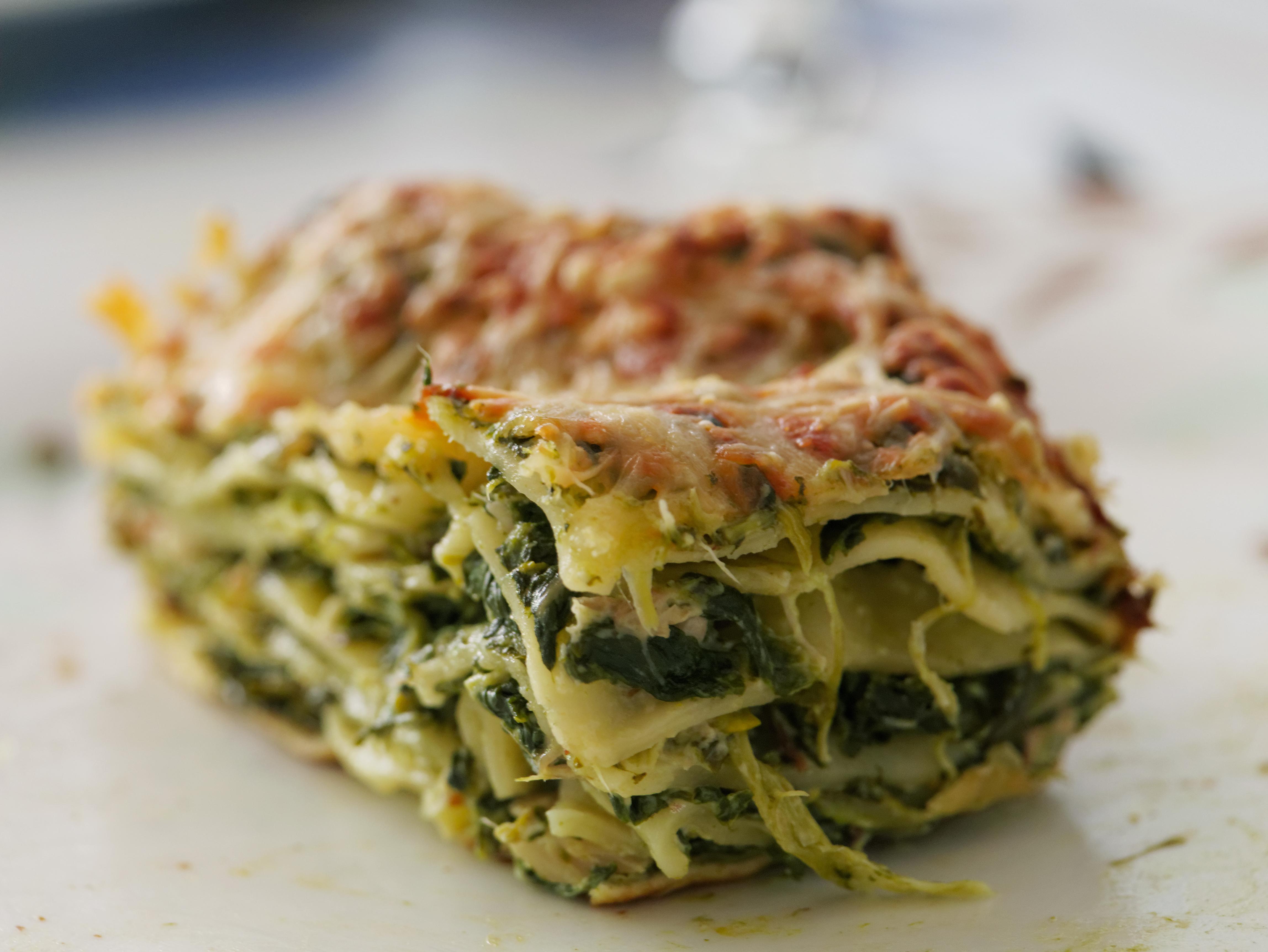
One of my favorite restaurants is Not Your Average Joe’s.  They are always willing to work with my allergy restrictions, but some dishes I just have to make for myself at home.  Their lasagna is one.  Below is their recipe and my recipe, adapted for my particular allergies.

Their Ingredients:                              
Lasagna Sheet 1 each
Basil Pesto 2 tbsp
Ricotta Cheese 3 oz
Crumbled Goat Cheese 1 oz
Sautéed Spinach 3 oz
Grilled Summer Squash 3 slices
Grilled Zucchini 3 slices
Cooked Asparagus 2 slices

Shredded Mozzarella ¼ cup

Grate Romano cheese 3 tbsp

Marina Sauce 2 fl oz

My Ingredients:
One sheet gluten free noodle
4 tbsp chopped fresh basil
2 tsp minced garlic
4 oz silken tofu
Sautéed Spinach 3 oz
Grilled Summer Squash 3 slices
Grilled Zucchini 3 slices
Cooked Asparagus 2 slices

1/4 cup vegan mozzarella

1/4 cup vegan parmesan

Marina Sauce 2 fl oz

Cooking Instructions:
1.  Spread pre-cooked pasta sheet the long way in front of you out on table.

2.  Spread pesto on bottom 3rd of sheet and pipe ricotta and goat cheese over pesto. (I mix the basil and garlic with the tofu and spread half of that instead — you’ll use the second half when you “repeat the process below.)

3.  Top with 1 1/2 each of squash and zucchini, 1 each asparagus and 1 1/2 oz of spinach. Fold over lasagna sheet and repeat process.

4.  Place lasagna on a plate and top with mozzarella and romano cheeses. (I use the vegan versions.) Place in microwave for 40 seconds.

5.  Place in an ovenproof dish and bake at 375 degrees for 6 minutes until heated through and golden brown. Remove from oven and drizzle with sauce around lasagna.

Practice Makes Perfect: The Muffin Strategy

website muffins

“Finally!  I’m a girl!”

High school drama clubs are known for their shortage of boys, and as such, time after time I was cast in male roles for the plays I auditioned for at my high school.

For the most part, I actually enjoyed the roles I played.  Not every high school girl gets a chance to be a maniacal Captain of Inquisition (Man of LaMancha) or a foul-mouthed military pilot (South Pacific).  (My father wasn’t too thrilled by this latter role!)

What was difficult about those roles, though, was that it didn’t come naturally to me to be a boy.  While others simply had to become their characters, I had to take on a persona AND remember to walk, talk, and gesture like a boy, too.  I’d be saying a line, and the director would yell, “Stop walking like a girl!”

“But I am a girl!” I’d wail, and he’d reply, “No, you’re a crazy inquisitor!  Now walk like one.”

And in time, I did.

With time and practice and a lot of thought, I learned how to become the male characters and eventually any character I needed to be — so much so that a couple of years ago I was showing several children how I wanted them to act in a scene I was directing, and one of my assistants said, “You know, you could do this as a one-woman show!  You’re switching roles without even thinking!”

Becoming any character, whether it was male or female, had become second nature to me.  That didn’t mean I wasn’t thrilled when I was finally given a female role as Bess, the wife of Scrooge’s nephew, in A Christmas Carol, but it does mean that something I initially thought too difficult to ever do actually wasn’t.

Cooking with Non-Traditional Ingredients

In the same way, it can seem awkward and uncomfortable when people suddenly have to cook or bake in non-traditional ways.  It can seem “unnatural” to cook without wheat, dairy, sugar, or eggs.  Figuring out how to adjust dry and wet ingredients for a “substitute” ingredient can be frustrating.  You’re being told to stop cooking the only way you’ve known how to in favor of a method you’ve never tried before.

As with my acting, practice is important for learning how to cook with non-traditional ingredients, but it can be a pain to practice. Practice takes time, money and energy, and you may invest all three and have a disaster which is completely inedible and a waste.  It’s helpful that these days you can find many cookbooks and online sites with recipes and tips from people, but sometimes, you try a recipe, and it doesn’t work for you or it’s not to your liking.

I remember when I first learned I had a dairy allergy.  I went to a bunch of vegan sites to get recipes, and I was disappointed by the taste of the food.  I asked a vegan friend whether being vegan meant having no taste buds, which obviously could have been very offensive to her, but knowing me, she simply laughed and told me that it wasn’t them but that I was a food snob, which in many ways I am. She did follow up her comment, though, with some advice.   “Learn what you can about vegan cooking, but create your own recipes using the tips you learn.”

Muffins for Practice

It was great advice, but you still have the problem of needing to practice in order to create those recipes. And here’s my tip for you:  Start with something like muffins and work your way to other foods.  Muffins are great for practice, because they don’t require a lot of ingredients that you wouldn’t already be using or have in your house, which saves on money. They’re quick to make up, which saves you time; and you don’t have to make a large batch of them, so they’re not wasted if they don’t come out the best. In addition, who doesn’t like a good muffin?  Even if you have to practice almost daily for a week, your children will still be willing to eat them again and again.

Years ago I found a basic muffin recipe in a cookbook which I have simply modified over time as the number of foods I’m allergic to has increased. The recipe is:  2 cups flour, 1 tsp salt, 2 tsp baking powder, 1 beaten egg, 4 tbsp sugar, 1 cup milk, and 1 tbsp melted butter.  The original recipe explained that you could add 1/4 to 1/2 cup of any chopped or mashed fruit, nuts, chocolate chips, etc… to the batter. Then you bake them for 20-25 minutes in a 400 degree oven.

You can use that recipe or another recipe that you find in a favorite cookbook to practice for whichever ingredients you need to substitute, and you can go the earlier posts on this site about substituting for dairy, eggs, sugar, wheat or nuts to help you.

Meanwhile, a favorite recipe of my children’s is posted below.

Blueberry Banana Chip Muffins

Ingredients:

2 1/2 cups 100% whole wheat flour or 2 cups Authentic Food Gluten Free Flour Blend

2 tsp baking powder

1 tsp cinnamon

1/2 tsp nutmeg

1/2 tsp ginger

1/2 tsp salt

1 cup Enjoy Life Allergen Free mini chocolate chips

1 cup mashed ripe bananas

1/2 cup egg whites

2 tbsp Agave

1 tbsp safflower oil

3/4 cup soy milk

1 cup frozen wild blueberries

Baking Instructions:

1.  Preheat the oven to 400 degrees.  Line 18 muffin cups with liners.  (I use “If You Care” ones.)

2.  Combine the flour, powder, cinnamon, nutmeg, ginger, and salt.  Stir in the chocolate chips.

3.  Mix the bananas, egg whites, Agave, oil, and milk.  Add the blueberries.

4.  Quickly stir the dry ingredients into the wet, mixing only until the dry ingredients are moistened.

5.  Evenly divide the batter among the muffin cups.

6.  Bake for abut 20 minutes until a toothpick inserted into the center comes out clean.

Cross Contamination: Preventing It

website contamination

“Don’t kiss a boy with your mouth open.  Boys have germs.”

It was the summer before I was slated to begin my first year at college when my mother decided to have “the talk” with me.   What I was expecting, I really don’t know, but the statements above were not it.

I wisely refrained from telling my mother that I had already violated her late-coming mandate, and only later, with my friends, did I laugh about the “cooties” theory of relationships.  I knew my mother meant well, and having been raised in an entirely different time and culture, she had no way of knowing that my modern American teenage life was unlike her Korean childhood.

Contamination concerns

I realized, as well, that my mother simply wanted to protect me as I left home to begin my “independent” life.  She cared, and I was glad she did.

In the same way, people tend to care about and be protective of family members who have food allergies.  They worry about possible cross-contamination, and since cross-contamination can be a matter of life or death for some folks, it’s definitely worthy of thought and concern. The two concerns most people have are that they might accidentally contaminate food being served or that they think it’s difficult to prevent such a thing from occurring.

Some Tips

My personal tips, though, are:

1.  Don’t stress! Avoiding cross contamination is not difficult.  You just need to be pro-active.

2.  If the allergies in the family are severe, keeping two separate sets of cooking utensils and pots or pans is one way method to use.  Have different styles and colors of each so you can easily identify which ones you use for regular cooking and which ones you use for the allergy cooking.   So, for example when I make eggs for the rest of the family using a little bit of butter (which they prefer), I have a larger egg pan which I use to make their eggs.  On the burner next to theirs I use a smaller pan to make my egg which I usually cook with olive oil.

3.  Another thing you can do either in conjunction with or instead of having two separate utensils and pans for everything is simply to wash things in hot water and soap in between the uses. Whenever I’m cooking for someone with a peanut allergy which happens to be one of the few food allergies no one in our family currently has, I first wash everything I’m going to use for baking or cooking in hot, soapy water and dry them with a clean fresh towel even before I begin cooking. Numerous studies have shown that any contaminating residue from what you’ve cooked before is definitely washed away with a good scrubbing in hot, soapy water.

4. A third method you can utilize is to invest in parchment paper which I use all the time. It’s great because you can line your cookie sheet or insert it in your tube pan or put it on your casserole dish for any cooking or baking and then simply remove it, which keeps the food from contaminating your pans.  During the holidays when I have to bake all sorts of different items — gluten free, egg free, sugar free, nut free, etc… — along with traditional baked goods, the parchment paper comes in very handy as I simply remove and reline with each different goodie I’m baking.

Chocolate Chip Bars

Ingredients:

2 1/4 cup whole wheat flour or 2 cups Authentic Foods gluten free blend

1 teaspoon baking soda

1 tsp cinnamon

1/2 tsp salt

1/2 cup soy free Earth Balance “butter”

3/4 cup Agave

2 eggs, at room temperature

1 teaspoon vanilla

3 cups Enjoy Life allergen free mini chocolate chips

Baking Instructions:

1.  Preheat the oven to 350 degrees.

2. Line a 11 x 17 x 1 inch cookie sheet with parchment paper slightly larger than the pan, so the ends hang off.

3.  Mix the flour, baking soda, cinnamon and salt together.  Set aside.

4.  In a mixer, cream the butter until smooth.

5.  Slowly pour the Agave into the butter with the mixer mixing on low speed until the Agave is completely incorporated into the butter.

6.  Add the eggs, one at a time, mixing well in between each addition.

7.  Add the vanilla.

8.  Slowly add the flour mixture, about 1/2 cup at a time, mixing on low until all the flour is incorporated.

9.  Add the chocolate chips.

10.  Carefully spread the batter into the pan, using a rubber spatula to make sure the batter is evenly spread throughout the entire pan.

11.  Bake for about 20 minutes until the batter is golden and puffed.

12.  Cool in the pan on a wire rack.  (This stores well by simply covering it tightly with plastic wrap or foil.)

Making the Changes

OLYMPUS DIGITAL CAMERA

Look how far I’ve come with my split, Mommy!”

My middle daughter is a dancer. Not only does she look exactly like a dancer with her natural rail thin length and long, muscular legs and arms, she walks and moves with the grace of a dancer, too. In addition, she acts like a dancer, always thinking in terms of music and dance moves. Since she also likes children as well, it’s no wonder that she wants to be a dance teacher when she grows up.

As such, at almost 13, she’s already begun taking the steps she deems necessary to accomplishing her career goal. She’s taking a variety of dance classes so she can be accomplished in different types of dance. She’s working on her splits and stretches so she can be as flexible as she needs to be to dance, and she’s making plans to be a student aide in the preschool dance classes when she begins her first year of high school.

Step by step, little by little, with achievable goals, my daughter is doing what she needs to follow the course she’s set out for herself.

Adapting to Dietary Changes

Learning how to cook, bake and eat healthier and/or within the confines of dietary restrictions or allergies is just as achievable in the same way through many little changes in habit along the way which lead ultimately to a different eating and cooking lifestyle.

Sometimes a health issue leads to a radical change in diet – a heart attack, a diagnosis of diabetes, a severe allergic reaction to a type of food – which can be a source of frustration, especially if you’ve been eating a certain way for a large part of your life. The instinct is to simply change everything all at once, which can just set you up for disaster.

What’s key to remember is that changing your eating and cooking habits should be viewed as another lesson you’re learning in life. Being able to balance and ride your first bicycle as a child didn’t happen overnight. Neither did you jump into a lake and swim its length your first time out. So, if you’re learning to eat gluten free or with less meat and fat in your diet or without sugar and you’re finding yourself struggling with the recipes, the tips, and desire, cut yourself some slack.

Tips for Changing Your Diet

Some tips to help you on your journey:

1. Make one change at a time. Maybe it’s swapping out olive oil for butter this week and waiting until next week to make a turkey burger instead of hamburger with the goal that by the end of the month you’ll try a salmon burger. Or maybe you’ll try one new gluten free recipe every week or two, learning this week how to make pancakes you can actually eat but waiting until you’ve made those successfully a couple of times before you try to revamp your favorite birthday cake recipe.

2. Seek help. There are so many online blogs and websites, paper cookbooks, and cooking shows these days to turn to for aid for just about every type of cooking that exists. Use them to learn tips and to find tested recipes. Ask a friend who’s a few steps ahead of you what he or she has gleaned from his or her culinary experience. There’s nothing that says you need to go the road alone. Maybe you’ll even find a friend or family member who wants to practice revamping recipes with you or is willing to be your guinea pig for taste testing.

3. If you don’t like it, don’t eat it. Unfortunately, there’s a myth out there that you need to just deal sometimes when it comes to eating food that is healthier for you or which fits into your allergy or dietary restrictions. It’s simply not true. If the texture or taste of the first gluten free brownies you try to make doesn’t appeal to you, don’t settle. Find another recipe to try. If you don’t really like the taste of olive oil in a recipe that calls for butter, try another healthy oil. If really and truly hate ground turkey, don’t use it. If you don’t like the foods you’re eating, you’ll never stick to eating healthier or within your dietary restrictions. Or you’ll force yourself to bear it, but you’ll be sad, craving the foods you’re really rather be eating. Neither is best, so make sure you actually like what you eat.

4. Practice, practice, practice. We all have those memories of failing at something and being riled when someone told us, “If you don’t succeed at first, try, try again,” but honestly, everything in life takes practices. Not just school lessons, sports and musical instruments, but relationships, exercise and cooking, as well. When my son was first diagnosed with an egg allergy, it took months for me to perfect a chocolate cake that the entire family liked. The practice batches weren’t bad. They just weren’t to the standard we wanted in terms of texture and taste. Now, though, I have a recipe that I go back to time and time again and which we all enjoy.

5. Start slowly. Unless you have a food allergy, you can begin a healthy diet by halves and work your way up, so to speak. If your goal is to eat 100% whole grains instead of white flour, but you’re unsure of the taste and texture appeal, try swamping out just half of the white flour in a recipe. If you aren’t quite ready to completely get rid of butter, don’t. Just limit yourself to a certain amount a week on something where the taste really matters to you while you swap it out in everything else. If you don’t think you can go from whole milk to skim, drink 2% for a few weeks, before drinking 1% for another few weeks until you’re drinking the skim and wondering why you were ever concerned in the first place about making the switch.

And if you do have a food allergy, you can still start slowly.  If you’re suddenly allergic to milk, just try one type of a different “milk” this week and wait to try vegan cheeses.  Though we often want to find substitutes for all our usual eating patterns, there’s no need to “fill” every niche of your diet in a short span of time.   It may take months for you to discover which substitute products for milk or wheat or egg or whatever that you like the best.

6. Be willing to experiment. If you come across a recipe or an idea that you think sounds interesting, but you’re unsure, just go for it. What’s the worst that can happen? You don’t really like what you tried or made? Big deal. Now you know that there’s something you won’t do again. That’s a good learned lesson. More likely, you’ll discover something that you really do like and want to try to make or eat again. Or you may be inspired to figure out how to make the recipe better or to try the item again, just made by another company.

Fruit Smoothie

Ingredients:

1 cup frozen strawberries (or peaches or blueberries or mixed berries or mangos or bananas, whatever you like)

4 ounce silken tofu (this is 1/2 cup)

1/2 to 1 cup soy milk, depending on how thick you like your smoothie (you can also use another type of “milk” you’d prefer or a 100% juice of your choice)

2 tablespoons Agave

Preparation Instructions:

1. Blend all ingredients using whatever method you prefer or have:  blender, hand blender, food processor, etc….

2.  Scoop into individual cups and enjoy!

NOTE:  You can also add yogurt to this if you’d like, 4 0unces of a dairy or nondairy type.

Comfort Foods: Revamping Them

website mac and cheese

“We need a depression session.”

As high school students, my three best girl friends and I knew exactly how to handle any teenage angst that came our way.  A break-up, issues with our parents, school problems — all could be handled with a carton of ice cream and a package of cookies.  Armed with both, we’d meet up at one of our houses and just dig in — the cookies were sturdy enough to scoop the ice cream so no utensils would be required!

There was something about creamy vanilla ice cream topping a crisp chocolate chip cookie that was satisfying not just to the taste but to the soul as we talked, cried, and laughed our way to the end of both the carton and the package.

Comfort Eating

We don’t have to look far these days to know that “comfort-eating” has been tagged as a no-no.  It’s been linked to obesity.  It encourages consumption of “unhealthy” foods over “healthy”.  And psychologists say it prevents us from tackling what the real issues in our lives are.

Knowing all this, though, we have to admit that most of us do it.  For some, certain foods bring back the comforting memories of a better time.  For others, a little sugar rush helps get through the bump in the day.  For many, the fact that certain foods encourages the release of serotonin is exactly what we need to turn a bad mood into a happy one.

What can we do

While I’ve learned over the years to curtail eating just for comfort, there are still those times when I yearn for one of those traditional comfort meals — just because.  And when I have those moments, I want to be able to eat them without feeling guilty.

So, over the years, I’ve revamped many a recipe so my family and I can enjoy those occasional bouts of comfort eating.  Below is an Emeril recipe for mac and cheese that was just too much of everything which I revamped because my children loved it so much.  I’m including it here so you can see how easy it is to alter a favorite recipe without sacrificing taste and “comfort”.

Macaroni and Cheese

Emeril’s Recipe:

one pound of elbow macaroni

6 slices of bacon

1 tbsp minced garlic

6 large eggs

2 cans evaporated milk

1/2 tsp cayenne pepper

1/4 tsp ground nutmeg

3 cups grated sharp Cheddar cheese

1 cup grated Monterey Jack cheese

1 cup grated Parmesan cheese

Paula’s Revamped Version:

one pound 100% whole wheat pasta (can also use gluten free pasta)

2 links chicken Italian sausages (fully cooked type)

one 16 oz thawed frozen broccoli florets

2 tsp minced garlic

1/4 cup chopped frozen onions (can use fresh, too)

1 tsp ground black pepper

1/2 tsp ground nutmeg

3 cups Cabot 50% reduced fat cheddar cheese (shredded)

2 12 oz cans fat free evaporated milk

4 eggs plus 1/2 cup liquid egg whites

1/2 cup Cabot 50% reduced fat cheddar cheese (shredded)

Cooking Instructions:

1. Preheat oven to 475 degrees and very lightly grease a 9 x 13 pan. (I normally use a little bit of olive or grapeseed oil.)

2. Prepare the whole wheat or gluten free noodles as directed on the package, but cook it one minute less than indicated.  Drained the noodles and put them into a large bowl.

3. In a food processor, chop up the two sausage links into fine pieces and add to the noodles.

4. In a food processor, chop up the thawed broccoli florets into fine pieces and add to the noodles.

5. Add the garlic, onions, black pepper and nutmeg, and 3 cups of the cheese, mixing well with the noodles.

6. Whisk well together the cans of evaporated milk with the eggs and egg whites.  Pour into the noodle bowl and combine.

7.  Using a ladle, scoop out the mac and cheese into the 9 x 13 pan.  When you reach the end of the noodles, pour any leftover milk/egg mixture from the bottom of the bowl onto the noodles in the pan.  Gently tap the noodles to make them even in the pan.

8. Sprinkle the remaining 1/2 cup shredded cheese over the top of the noodles.  (You can increase this to 1 cup if your family really likes a more gooey mac and cheese.)

9. Bake in the preheated oven for 15 minutes or until the sauce is bubbling at the edge and no longer liquidy in the center.  Let the mac and cheese sit for 10 minutes before serving.

Food “Processing”: A Look at Cooking Tools

website processor

We have too much stuff!”

During the first ten years of married life, we moved four times, which helped to keep our material possessions to a minimum.  For the past second ten years, however, we’ve lived in the same house and increased our family to five in number. At the same time, both sets of parents have “de-cluttered” their houses as they’ve moved into smaller places, which has resulted in our home becoming substantially more full.

As a result I’ve become a bit of a manic freak about getting rid of stuff.  Every six months the children and I go through their books and their toys to donate to organizations which help needy children.  Every summer for the past few years, I’ve gone through the continually growing pile of “stuff” in the basement to donate to organizations like the Epilepsy foundation who so wonderfully come to your house and pick up anything and everything you’re willing to donate for them to sell at discount prices.

Even as I write, my youngest is delightfully planning the yard/garage sale I told him we’re going to try to do this summer to rid ourselves of even more “stuff”, all of which are great and wonderful items to have but which we ourselves no longer need.

Useful kitchen equipment

In the heat of the “purger”, however, there are a handful of items which I will never, ever part with or give away.  Those are my few cooking extravagances which I use almost every day.  My slow cookers I’ve already written about, but just as a reminder:  Crockpots are a godsend for getting dinner on the table when life is crazy.

The second item is my Kitchen Aid which I’m still grateful to my in-laws for purchasing as a Christmas present the first year I was married after I mixed up several dozen batches of cookie dough by hand and couldn’t use my right arm for a week after!

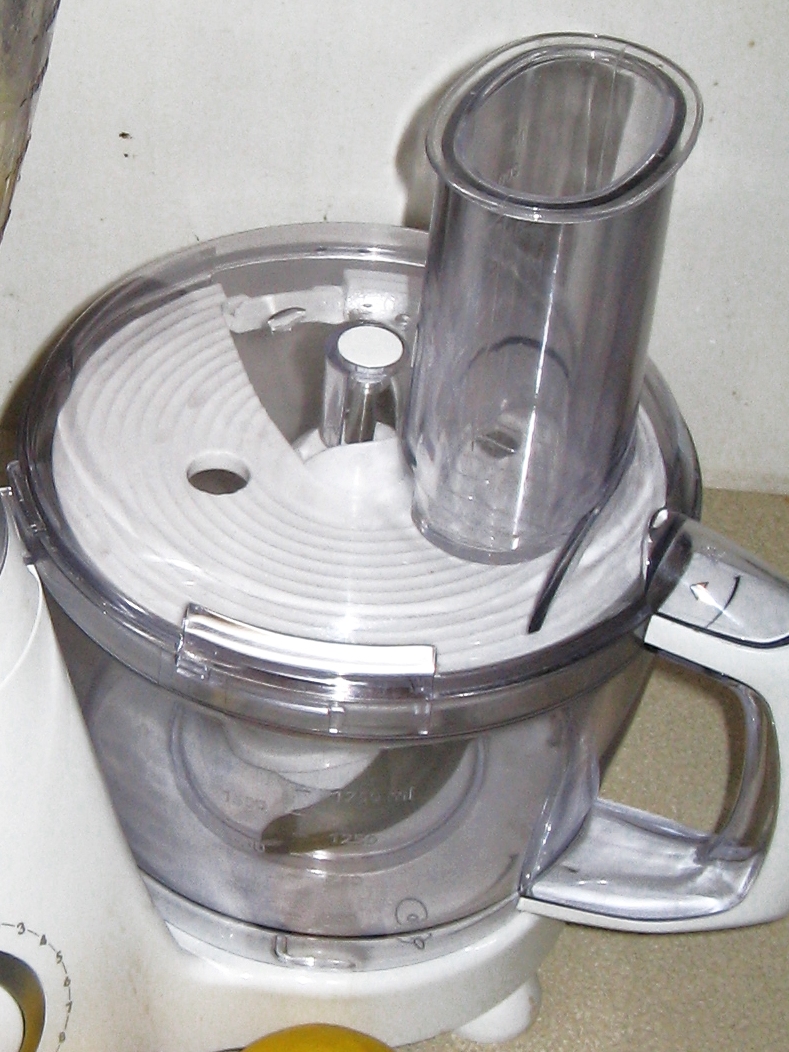
The final item which I use all the time and which I would highly recommend to anyone and everyone who wants to cook at all is my food processor.  I’m not talking about one of those large ones which department store wedding registries try to sell you and which seem to have a bad rap for being big, bulky, and hard to clean.  I’m referring to a simple small four cup food processor which you can find at a second hand store for a few bucks and which is more than adequate for any family use.

Benefits of a food processor

If you do any cooking at all, you’ll know that so much of the time consumption is the chopping and preparation.  The beauty of the food processor is that it does all your chopping, shredding, and more while you’re working on something else.  It also chops and cuts and shreds more uniformly than you’ll ever be able to do, which helps for even cooking.  Finally, it can perform tasks such as grinding nuts and whole oats into flour which is truly wonderful if you’re always having to substitute different foods into your cooking and baking due to food allergies or dietary restrictions.

I use my food processor several times a week for almost all my cooking but there are specific recipes for which I’m really grateful to have such a tool on hand. Below are two such recipes.

Company Salmon with Peach Salsa

Ingredients:

16 oz thawed frozen peaches* (you can certainly use fresh)

one 14.5 oz no salt added fire roasted diced tomatoes

1/2 cup frozen chopped onions (you can use fresh if desired)

1 tsp minced garlic

1 tbsp Key West lime juice (can use regular lime juice, too)

1/4 cup fresh cilantro (can use a couple of tsp of dried, too)

1 tsp ground black pepper

1/2 to 1 tsp coarse sea salt (can omit)

10-12 4 oz frozen salmon fillets with no skin** (you can certainly use fresh)

1 tbsp olive oil

1 tbsp vegan butter (or whatever type you need or prefer)

Cooking Instructions:

1. In the food processor chop the peaches to the size and consistency you like for your salsa.  (Some folks prefer their salsa chunky while others like it pureed.  I tend to make mine somewhere in the middle.)  Pour into a bowl.

2. In the food processor chop the diced tomatoes with the onions, garlic, lime juice, and cilantro.  Add to the peaches in the bowl and stir well.  Set aside or put into the fridge so the flavors can meld.

3.  Season with the black pepper and salt, if using.

4. Over medium heat, melt the butter with the olive oil in a pan that will fit your salmon fillets.

5. Carefully place the fillets into the hot pan, and cook for five minutes.  It’s best that you just leave the salmons alone to form a nice browned crust.

6.  Flip the salmon over and cook for two minutes to finish.

7.  Place the salmon on plates with the crust side up and spoon peach salsa over the top.

* If you’re using the frozen peaches, you can simply pull them from the freezer, dump them into a microwave safe bowl and defrost for one to two minutes, just until they’re not frozen solid.  If you’re thinking ahead of time, you can pull them out a few hours before and defrost them in the fridge.  If you’re using fresh, you need to slice the peaches off the core.

** I like to buy wild caught frozen salmon because it’s cheaper, and then it’s ready whenever I need it.  If you’re thinking ahead, you can put the salmon into the fridge the night before to defrost.  If you’re like me and only thinking of dinner at the last minute, simply the salmon in their packages into a bowl of cold water for twenty minutes, turning them halfway through the time.  Then remove them from their packaging, rinse, and pat dry.

Gazpacho

Ingredients:

1/4 cup fresh basil

6-8 green onions

2 cloves garlic or 2 tsp minced garlic

one yellow pepper, cut into large pieces

46 oz 100% tomato juice*

2 cans 14.5 oz no salt added petite diced tomatoes**

1 tsp ground black pepper

4 tbsp balsamic vinegar

2 tbsp extra virgin olive oil

8 baby cucumbers, washed and cut into large pieces***

1/2 tsp fresh ginger****

2 cups to 4 cups reduced sodium fat free broth of choice (beef, chicken or vegetable)

Cooking Instructions:

1. In a food processor puree the basil, green onions, garlic, and yellow pepper.

2.  In a large bowl, add the puree to the tomato juice and blend well.

3.  Add the two cans of petite diced tomatoes, the black pepper, the balsamic vinegar and the olive oil, and mix well.

4.  In the food processor finely chop the cucumbers.  Add to the tomato juice mixture with the ginger.

5.  Add the broth one cup at a time until the gazpacho is at the consistency you like.  We like a thicker soup and only use 2 cups, but I have friends who like it to be of thinner consistency and I have added up to four.

6.  It’s best if you chill the soup for a couple of hours to allow the flavors to meld.

* Make sure you do buy just 100% tomato juice which will just be tomatoes and water.  A lot of the “juices” out there have so much other added “stuff”.

**If you don’t want to use canned tomatoes, you can certainly peel, seed, and dice 4 cups of fresh tomatoes.  You can also use regular diced canned tomatoes, but the chunks will be larger.

*** I like the baby cucumbers because I use them as is, skins and all.  If you use regular cucumbers, you’ll need to peel and seed them.

**** I keep fresh ginger paste/puree in the fridge which is always at the ready for me to use, but you can certainly peel and put in a small sliver of fresh ginger root.

“Herb”ivore: Using Herbs for Flavor

website herbs

“You can’t kill this.  It’s a succulent.”

True Confessions:  I am a plant killer.  Since I have no malicious intent and do not deliberately intend to kill my plants, I am, however, only guilty of involuntary plant-slaughter at most and not actual murder or even voluntary plant-slaughter.

And since I know this about myself, I don’t ever buy plants to have in my house; and friends and family who know me well don’t buy plants for me as gifts.  One day, however, a friend arrived for brunch with a plant in hand called a succulent.  (If you’re not familiar with a succulent, as I was not, it’s what a cactus is, though there are other varieties of succulents which are not cacti.)

My friend, who is absolutely marvelous with plants, assured me that she had brought me a plant that even I could not kill.  As you can imagine, with my track record, I was skeptical.  But my friend was right.  It’s a year and a half later, and the little succulent is still going strong.

It’s probably because you can basically ignore it, and it will still thrive on its own. As long as I remember to water it at least once a month, it’s good to go. Essentially it’s my type of plant, and if my friend had not given me the succulent I would never had learned that I could be free of my identity as a plant killer.

Why use herbs

For some people, they feel similarly about herbs and spices.  They don’t know exactly what to do with them and haven’t used them a lot, so they don’t.  They stick with salt and pepper and bottles of Mrs. Dash which just combine many herbs and spices together for use with anything.

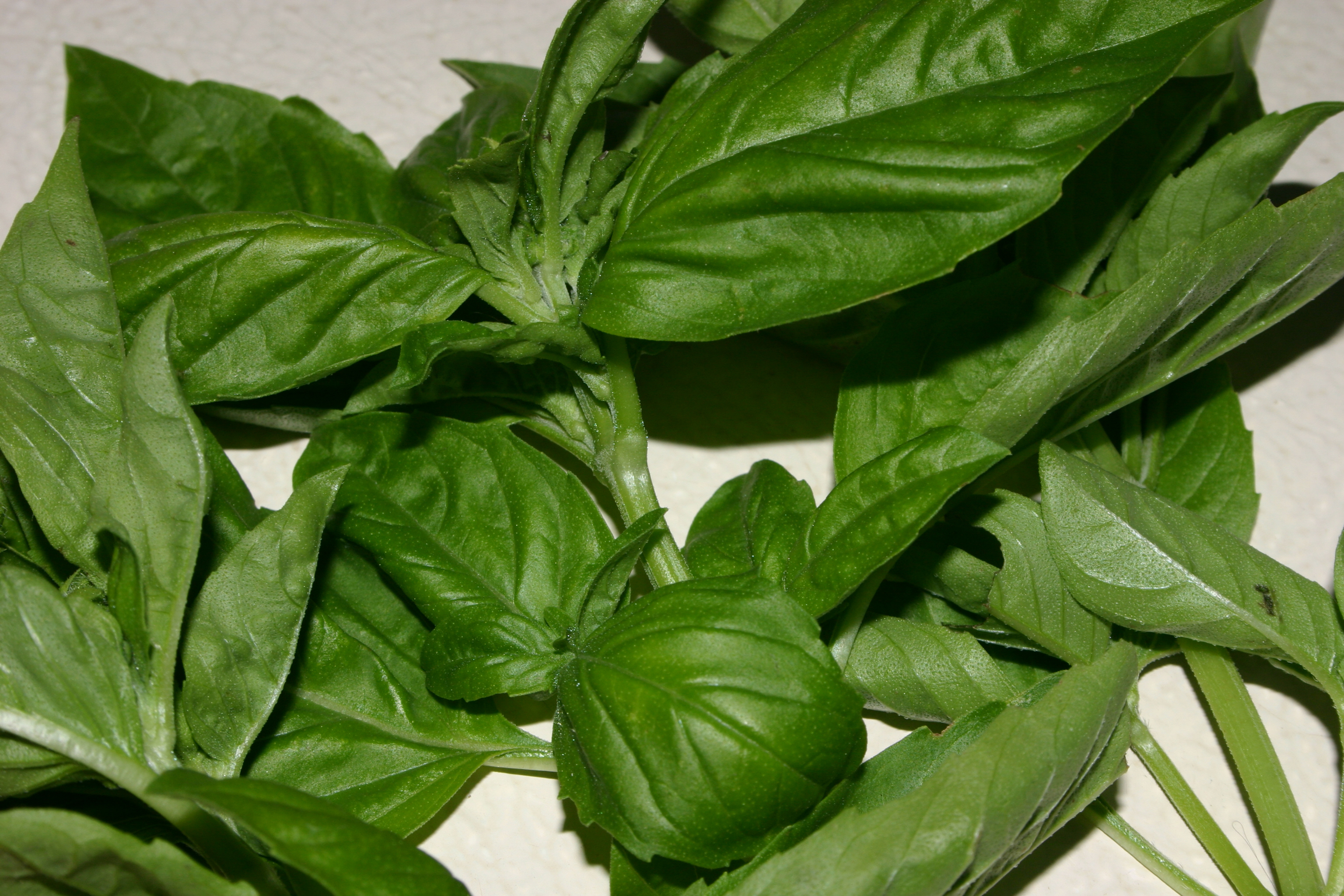
Herbs and spices, however, are wonderful to use in cooking, because they can bring nuanced flavors to your food and allow you to cut back on your sodium use. Today, the variety you can find at the grocery store is remarkable.  You can buy it dried, freeze-dried, frozen, packaged in refrigerator tubes, ground, pureed, as leaves, and of course, fresh.

Fortunately for me, my husband has a green thumb, and he grows wonderful herbs for me in small planters we keep on the back porch which I can just snip as I want. When I don’t have fresh herbs available, though, I freely use the dried, freeze-dried, and refrigerator tube versions as well.  And I always have a variety of ground spices in my pantry for my use.

Tips for using herbs and spices

There are a few things to always keep in mind when using herbs and spices.

1.  Fresh herbs are usually added near the end of your cooking time, because they lose their flavor if cooked for too long, while dried herbs and spices are added at the beginning because they need the heat to bring out their flavor.

2.  Dried herbs have a more concentrated flavor so you use less than you would  of fresh herbs.  1/2 to 1 tsp of a dried herb is usually equal to a tablespoon or two of a fresh herb.

3.  Since the oils in a dried herbs are essentially “trapped” inside, before you add dried herbs to your dish, you should “crush” them a bit between your fingers to release their flavor.

4. Spices such as cloves, cinnamon, nutmeg and ginger are usually associated with baking and fruit dishes, but they add wonderful flavor to meat and seafood dishes and even to soups, beans, and macaroni and cheese.

5. Most herbs go well with just about anything from meat to vegetables to even fruit.  Experiment to see what flavors you like with what.

6. When you really want to bring out the flavors in a recipe, creating a base aromatic is the best way to go.  Simply put a little bit of oil in your pot and add dried herbs or spices, along with chopped onions or peppers or garlic, and slowly cook them over low heat for a little while before adding your meat or vegetables or fish or soup or whatever.

7. If you’re making something like a soup or stew or roast which needs a long time to cook, dried herbs are really better to use than fresh.  If you want to use fresh herbs, you can add those at the end as a garnish.

8. If you buy fresh herbs in a package from the store and don’t use it all up immediately, wrap the leftover herbs in a slightly damp towel and put it in sandwich baggie to keep it fresh a little longer in the fridge.

9. If you buy dried herbs and spices, they will lose their potency after a while, but the length of time varies.  Essentially, the rule of thumb is that if you can’t smell anything when you gently rub the spice or herb and/or they’ve completely lost all their color, most likely they should be tossed.

10. When using dried herbs, you should shake the herbs into your hands and then add them carefully to your dish.  If you shake the container over the dish itself, the steam from the cooking gets into your container and can spoil your dried herbs more quickly.

11. Dried herbs should be kept in a dark, dry, cool place.  Those little spice racks we buy are actually not very good for storing the herbs and spices, because usually those are put on the wall, near the stove where the light, heat and moisture all work together to spoil the herbs and spices.

12. If you want to buy dried spices or herbs but get that “fresh” flavor, buy whole dried spices which you can grind in a spice grinder just before using.

Herbed Shrimp and Vegetables

Ingredients:

1 – 2 tbsp olive oil (depends on how much you prefer to use)

1 cup frozen chopped onions (can use fresh if you have)

1-2 tsp dried herbs of your choosing (depends on how you prefer to use)

1-2 tsp minced garlic (jarred, tube, freeze-dried, fresh, whatever in the amount you prefer)

4-6 zucchini, 5-6 inches long, cut into 1/2 inch half moons*

2 yellow peppers, diced into 1/2 inch squares

1 14.5 oz can no salt added petite diced tomatoes, drained

1 lb thawed frozen deveined cooked shrimp**

4 cups fresh herbs of your choosing, chopped (will reduce to about 2 cups when diced)***

1/2 tsp coarse sea salt (you can add more or just omit altogether)

1/2 tsp black pepper

Cooking Instructions:

1. In a large stovetop skillet combine the olive oil with the onions.  Saute over low heat, stirring occasionally, for ten to 15 minutes until the onions are caramelized, which essentially means they’ve turned darker in color and become a bit thicker in texture.

2.  Add the dried herbs and garlic and saute for another five minutes over low-medium heat, being careful to stir so the garlic doesn’t burn.

3. Add the zucchini and peppers and saute over medium heat for about 3-4 minutes until the colors become a bit darker and more vibrant.

4.  Add the tomatoes and saute another 3-4 minutes.

5. Add the cooked shrimp with the herbs, salt and pepper, and stir until well coated and shrimp becomes slightly warm, about 1-2 minutes.

6. Serve by itself or over pasta or rice or couscous or quinoa or whatever.

* I prefer to buy or grow and use smaller zucchini because the flavor is better and it’s not as seedy.  If you purchase a larger store zucchini, then you should adjust your amount accordingly and scrape out the seeds from the zucchini before slicing.

** I love frozen deveined cooked shrimp because it’s cheaper and always ready when I want to use it.  You can use fresh shrimp but you then need to add it after the vegetables with the tomatoes so they can cook during that 3-4 minutes.  If yo use the frozen shrimp and forget to take it out ahead of time like I always do, you can just put the shrimp in a bowl of cold water to defrost them.

*** I use a lot of herbs for this recipe because my family likes it that way, but you can use reduce the amount by half.  As for the types of herbs we use, we like to vary it every time, but we usually use some combination of oregano, basil, mint, ginger mint, cilantro, rosemary, thyme, dill, chives, and/or parsley.

Easy Does It: Cooking with a Crockpot

website crockpot

“What’s for dinner?”

The yellow school bus had pulled up less than a minute ago, and my youngest had bounded into the car, dumped his backpack onto the car floor, and buckled his seat belt before asking the question he asked every weekday at the same time.

Before I could answer, he cast a hopeful look at me and threw out another one word question, “Pizza?”  Then, he giggled, because he was already anticipating the answer which I gave most every day to this ritualistic exchange.

“Noooo, no pizza today, little pizza monster.”

If my son had his way, we’d have pizza every single night for dinner.  And in some ways, it would make my life simpler if we did just eat the same meal every day.

“What’s for dinner?” is arguably one of the most frequently asked questions of a mom.  And for many moms at the witching hour, it’s one that can cause considerable stress.  Families today are pulled in so many directions, and getting supper onto the table for a family meal can be a daunting prospect, let alone trying to make it a healthy meal that also takes into account every person’s food allergies.

Crockpots or slow-cookers

If you’re like me, though, you do want to make family dinners a priority, and if you do, I’d like to encourage you to think about using a crockpot.

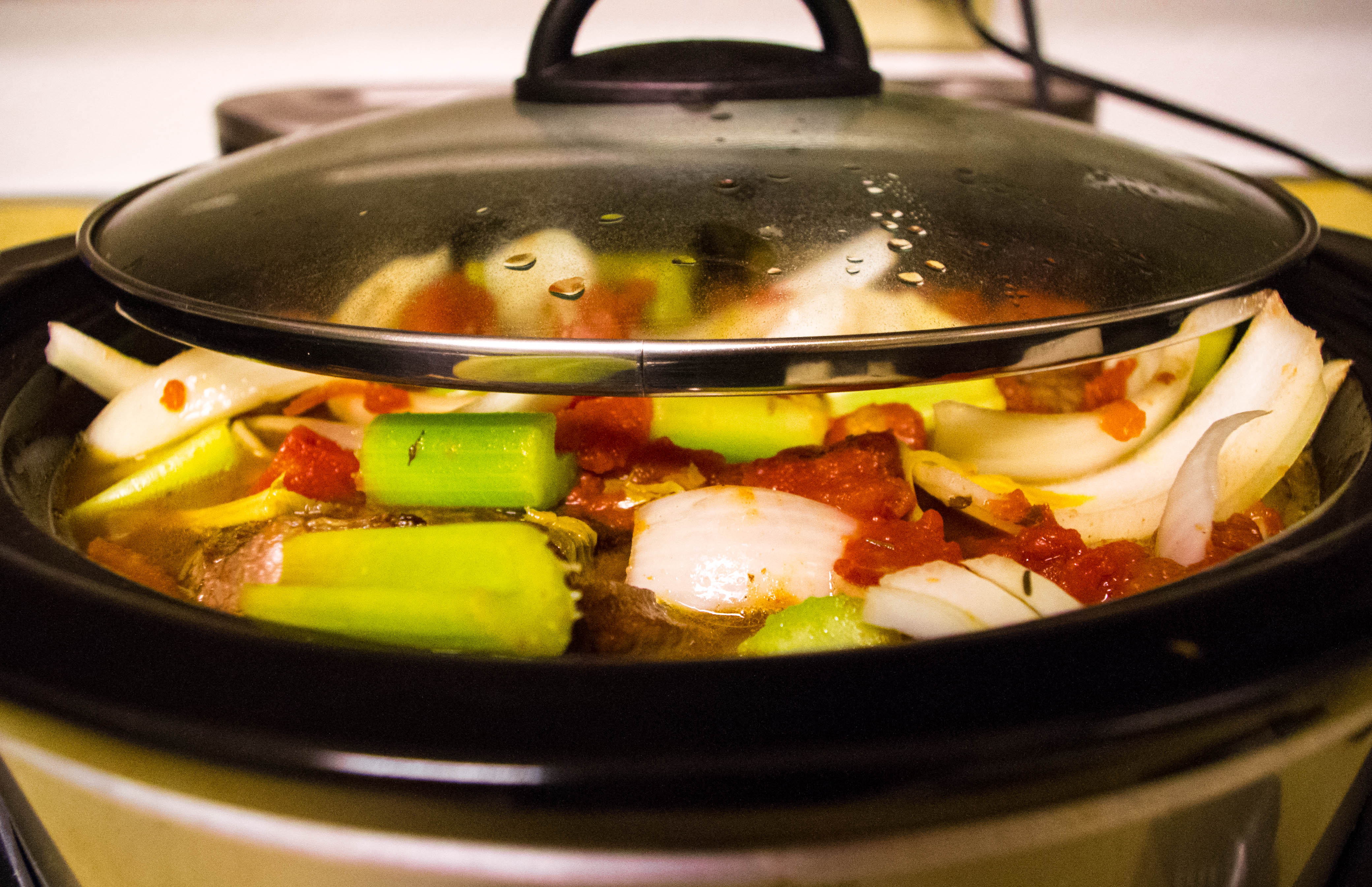
If you don’t know what a crockpot or slow-cooker is, it’s simply a pot in a warming element that cooks your food slowly over time.  Today, there are many varieties, but the most used are the 4 quart and 6 quart sizes.  They usually have a knob which you can turn to a low, high or keep warm setting.  Some are programmable, though, and others have the settings by hours, usually 4, 6,or 8 which are the most used times on a crockpot.

You can purchase them for reasonable prices these days at any store, but you can also acquire them for very little money at second-hand stores like Savers or the Salvation Army or online at sites like Craig’s list .  Whatever you spend, it will be one of the best investments you’ve ever made.

Advantages of a crockpot

I actually own four in different sizes, because you can cook just about anything in a crockpot – meats, stews, soups, vegetables, beans, cakes, puddings, fruits, quiches, etc….

The advantage of doing so is that you won’t be cooking during the most difficult time of your day.  You simply put everything into your crockpot first thing in the morning, and the food is ready when you and your family are ready to eat at the end of the day.  Also, because the crockpot can keep things warm, for those days when you simply can’t eat as a family, the food can stay warm in the crockpot for as long as you need so each person can eat when it suits their schedule.  (I actually have a meal in one of my slow-cookers right now as I write:  Thin and Trim chicken sausage mixed with zucchini, eggplant, summer squash, peppers, carrots, tomatoes, onions, and herbs.  Doesn’t that sound delicious?  And this evening when we’re rushing in from all the children’s after school activities, it’ll be ready for us to eat!) 

In addition, crockpots are wonderful for those summer months when you want something warm but don’t want to make the house warm by using the oven.  As well, for those times when you need to cook a lot (think Thanksgiving!) and your oven is full, you can use crockpots to cook your side dishes at the same time as whatever is in your oven.

Slow-cooking tips

Some tips for you to know when cooking with a slow-cooker:

1) Don’t stress about it!  You can put together just about anything, and it will come out fine.

2) Whatever you need to cook the longest should be on the bottom.  So foods like potatoes and carrots and other root vegetables which can take longer should be at the bottom if you were to make a meal like pot roast and vegetables.

3) If you like your meat to still moo when it’s done, you don’t want to cook it in a slow-cooker.  Slow-cookers are for when you like your meat to be tender and falling apart when you put your fork to it.

4) Your crockpot should always be at least half full to 3/4 full for it to cook properly.

5) Foods cooked on the low heat setting normally take between 7-9 hours.  If you use the high heat setting, the food usually cooks in half the time as the low heat setting.

6) If you make a single food like meatloaf or a whole chicken, you want to add some liquid like beef or chicken broth to the pot, or these items will be a bit dry.

7) If you’re cooking other foods like a stew or roast and vegetables, you want to limit the amount of liquid you add, because the process of slow-cooking will add liquid to the foods naturally.

8) Never put frozen meat into the crockpot.  They will not cook well.

9) You can, however, put little frozen fruit or veggies into the crockpot like peas or blueberries if you’re making a mixed vegetable or fruit dish.

10) You should always cut off any extra fat from any meat before putting it into the slow-cooker because the fat will just drain into your food.

11) If you want to enhance the flavor of  food you’re cooking, you can brown the meats or sauted your aromatics (garlic, onions, et…) before adding them to your slow-cooker.

12) Boneless chicken breasts only take a few hours, about three to four hours in a crockpot on low, but cuts of meat like  a roast take longer, 8 to 10 hours on low.

13) If you want vegetables to be only lightly cooked, you should check them after two hours.  Most vegetables only dishes will be done in three to four hours.

14) Crockpots are great for beans, because you don’t have to presoak them.  Just wash them and put them into the crockpot with your seasonings, and after 6 to 8 hours, they’ll be done and ready to eat.

15) Don’t be afraid to experiment!  There are so many online blogs and recipe sites, as well as crockpot cookbooks, that you could probably make a different crockpot meal every day of the year and not exhaust the recipes.

Crockpot Enchilada Casserole

Ingredients:

1 to 3 tsp chili powder (depends on how hot you like things)
1 cup low salt, fat free chicken broth
6 oz can of tomato paste
1 tsp dried oregano
1 tbsp ground cumin
One 8 oz can no added salt tomato sauce
2 tsp minced garlic
½ tsp black pepper
1 cup salsa

One 15 oz can of no added salt beans (ranchero, kidney, northern beans, black – whatever you like best or have on hand)
2 cups thawed frozen corn
1/2 cup diced red, yellow or green peppers
1/2 cup finely diced zucchini
1/2 cup sliced broccoli

4 chicken breasts (sliced into thin slices or diced into small squares and sauteed just until no longer pink) 

10 corn tortillas
8 oz shredded reduced fat, low sodium cheddar cheese (can be omitted)

Cooking Instructions:

1.  Mix the chili powder, chicken broth, tomato paste, oregano, cumin, tomato sauce, garlic, pepper and salsa together.  Set aside.

2.  Combine the beans, corn, peppers, zucchini, and broccoli.  Set aside.

3. Layer two tortillas on the bottom of the crockpot.*

4.  Follow with ¼ of the chicken slices.

5.  Top with ¼ of the sauce mixture.

6.  Add ¼ of the bean mixture.

7.  Top with 1/5 of the cheese.

8.  Repeat the layering three more times.

9.  Top with the last two tortillas and remaining cheese.

10. Cover the slow-cooker and cook on low for 6 to 8 hours or on high for 3 to 4 hours.

*NOTE: The two tortillas don’t completely fill the crockpot, so we layer the tortillas perpendicular to the layer beneath (i.e. making a cross shape with every two layers).

To Grease or Not to Grease: Thinking about the Question

website grease

The forest floor was a mess!

Broken branches littered the ground.  Sapling undergrowth surrounded mossy stumps.  Trees leaned against one another, their branches fighting for the sun’s rays.  Vines encircled tree trunks and ran away onto the ground below.  Tiny wildflowers grew in, under, and around whatever it could, and years of layered dead leaves blanketed everything.

Being a city gal, when my husband told me were going to visit the family forest, I pictured straight trees standing tall in neat rows with large spaces of manicured grass in between.  Imagine my surprise to discover, instead, nature’s version of an unkempt house.

Current Thinking about Trees

Few folks these days think much about forestry.  If we think about trees, we think about wasting trees by using too much paper.  Air dryers in the bathrooms proclaim that we’re protecting trees if we use them.  Schools and businesses send everything electronically so we can save trees.  Children are taught to recycle paper to prevent the killing of trees.

Misperceptions about Using Trees

Protecting trees is a good thing.  Misunderstanding what actually helps trees, though, can pose a problem.  There’s an island in the middle of a lake in a state where the trees are “protected” by a law stating no trees can ever be cut.  As such, it’s so overgrown that all the animals for whom that island used to be a natural habitat have left because there is no longer room for them to live.  In what way does this make sense?  Nature itself knows the dangers of overcrowding.   Natural fires are forests way of clearing themselves of standing dead trees.

In similar thinking, we’re told that using paper products when we cook and bake is bad because it hurts the environment, but we freely and willing use propellant sprays which contain nitrous oxide, an ozone depleting gas, and whose containers add substantially to the problems we have with overflowing landfills.  Again, where is the sense in that?

Advantages of If You Care Products

Personally, I’ve chosen to use many of the If You Care products for my cooking and baking.  I like that the company is committed to creating environmentally friendly products and to using trees, which are both sustainable and renewable, as opposed to fossil fuels which currently are not sustainable and are definitely not quickly renewable.

As well, if you have food allergies as I do, using products like parchment paper and baking cups helps prevent contamination when you are using a cookie pan or muffin tin, because your food doesn’t touch the baking implement.  Additionally, if you are trying to eat healthier and don’t want to grease with butter or oil, parchment paper provides a fat-free alternative which isn’t Pam spray.

Disclaimer

Now, about this point, some folks are wondering what sort of kick-back I’m getting, whether it’s from the forestry industry or the If You Care company.  I can tell you that small family-owned forestry companies rarely make a profit.  The owners are foresters usually because they love trees, and they care about the land.  As for the If You Care company, they have no idea that I use their products or that I recommend their products, but if anyone happens to knows the owners and want to let them know that I’m a big advocate, I’d be quite happy to entertain any thoughts of a kick-back!  (We have 12 straight years of college tuition stretching before us!  We can use all the monetary help we can get!)

Upside Down Pumpkin Pear Cake

Ingredients:

2 tbsp vegan butter, melted (or whatever type you prefer)

1 tbsp Agave

1/2 tsp cinnamon

Two 15 oz cans of pears, drained (best to get the ones in 100% juice, not syrup)*

2 1/2 cups 100% whole wheat flour or 2 cups Authentic Foods Multi-Blend Gluten free flour

2 tsp gluten free baking powder

1 tsp baking soda

1/2 tsp salt

2 tsp cinnamon

1/2 tsp nutmeg

1/2 tsp ground ginger

1/4 tsp cloves

2 cups cooked pureed pumpkin (can use one 15/16 oz can)

1/2 cup grapeseed oil (or another type you prefer)

1/2 cup unsweetened applesauce (you can use another 1/2 cup of oil if you prefer)

1 cup Agave

1 cup liquid egg whites or 4 tbsp ground flaxseed mixed with 12 tbsp water (can use 4 whole eggs if you want)

Baking Instructions:

1.  Preheat oven to 350 degrees.  Prepare a 9 x 13 pan.  (I would use “If You Care” parchment paper, but you can use Pam spray or oil or butter.)

2.  Mix the melted butter with the Agave and cinnamon and spread over the bottom of the cake pan.

3.  Cut the pears into fans and arrange over the bottom of the cake pan.  (To make fans, simply put three to four cuts into the pear which only go about 2/3 down the pear.  Hold the uncut portion and “fan” the cut pieces away from one another.)

4.  Mix the flour, baking powder, baking soda, salt, cinnamon, nutmeg, ginger, and cloves.  Set aside.

5.  Blend the pumpkin, oil, Agave, and eggs.

6.  Quickly mix the dry ingredients into the wet and mix just until the dry ingredients are moistened.  Spread the batter carefully over the pears.

7.  Bake for 30 minutes until a toothpick inserted in the center comes out clean.

8.  Cool the cake in the pan on a wire cooling rack.  Carefully flip the cake over onto a platter and remove the parchment paper.  (You can also simply serve the cake from the pan and invert the slices onto a plate with your spatula.)

*  If you do not want to use canned pears, you can use two ripe fresh pears.  Wash and slice the pears into eight long slices.  Coat a pan with 2 tsp grapeseed (or another type) oil.  Mix 1 tbsp water with 1 tsp Agave or Truvia.  Saute the pears in the Agave mixture until they’re softened.   Arrange the pears on the bottom of the cake pan and proceed as instructed.

“Dairy”licious: Substituting Dairy Products

website dairy

“It’s chocolate.  How bad can it be?”

My oldest had been diagnosed as lactose intolerant, and I had purchased a soy yogurt for her to try.  It looked and smelled like chocolate pudding, but apparently it did not taste like chocolate pudding!

Feeling a bit frustrated by the vehemence of her refusal to eat another bite, I grabbed the spoon, dipped it, and stuck some yogurt into my mouth.  Let’s just say that my oldest is turning 17, and she still laughs today about the face that I made at the taste of that chocolate soy yogurt.   To say it was unpleasant is a definite understatement.

For many of us who have grown up with the tastes and textures of dairy products, it can be an adjustment to have to switch from milk to almond, rice, soy, flax, or coconut milk or from milk yogurts to soy or coconut yogurts or from regular cheese to soy cheese.  I myself have simply given up on cheese.  After trying too many types to name, I’ve admitted that I will never like the taste of a non-dairy cheese.

Substituting for Dairy

I have, however, found yogurts, milk, and ice creams which I like, and I’m grateful that I have.  I’m even more thankful that I can still cook and bake all the foods I love even without dairy.  I simply make a one to one switch for all products such as milk, yogurt, cream cheese, or sour cream in any given recipe.

If you’re substituting with a soy product for dairy, you won’t often find much of a difference in your desserts or cooking.  If you use a rice product, you will find that you may have to increase your dry ingredients by a tablespoon or two because rice produces a thinner, runnier milk, and you’ll need to increase your fats by a tablespoon or two because rice milk has no fat in it, unlike the milk you’ll be replacing.  If you’re using an almond or coconut milk or yogurt, make sure you like the taste of either, because the subtle taste will underlie whatever you’re baking or cooking.

Substituting for Heavy Cream

The most difficult recipes to substitute for are if you want to make something which requires heavy cream.   For soups and anything else you would normally thicken with cream, pureed cooked veggies work really well as a substitute.  For cakes, whipped cream, mousses, and other such goodies canned coconut milk does the trick, providing you have no allergies to coconut and also like the taste of coconut.  I know some folks who say that pureeing raw cashews with water is also a good substitute, but I haven’t tried that myself since I’m allergic to tree nuts. Another option is to use aquafaba which is the liquid formed from cooking chickpeas. You can purchase no salt, no sugar added canned chickpeas and use the liquid as you would heavy cream by putting it into your mixer and whipping it.

Replacing Liquid Dairy

If you simply want to replace the dairy produce altogether, though, you can also substitute with other types of liquids and foods.  For baked goods calling for milk, substituting water or 100% fruit juice works excellently.  Simply decrease the amount by 1/4 since milk tends to be a thicker liquid.  As with rice milk, though, you sometimes need to add a tablespoon or two to your fat amount to compensate for the fat that would be in the milk.

Replacing Solid Dairy

If you want to substitute the dairy in something like a pumpkin pie or cheesecake, silken tofu works well.  For pies, you’d replace the 14 oz can of evaporate milk with one package of silken tofu.  For a cheesecake, if a recipe called for four packages of cream cheese and I didn’t want to substitute all four packages with soy cream cheese, I would substitute with two packages of the soy cream cheese and two packages of silken tofu.

Replacing Cheese

And if you really do need to use a vegan cheese, which I do in a lasagna, for pizza, and in a macaroni and cheese dish, there are the Daiya and Chaou brands.  Their cheeses do tend to melt similarly to real cheese, and if you flavor them with your herbs, garlic and onions, the taste is similar to real cheese. My tip for you, though:  After you bake your dish, broil the top for a couple of minutes to fully melt the cheese into that gooey-ness you like from a real cheese. Another tip, if you mix just a tiny amount of olive oil in with the cheese, when you bake it, it will become more crusty like mozzarella.

Dairy Free Dark Chocolate Snack Cake

Ingredients: 

3 1/2 cups 100% whole wheat flour or 3 cups favorite gluten free flour blend

2 tsp baking soda

1 tsp salt

1/2 cup Hershey Special Dark unsweetened cocoa (or regular unsweetened cocoa if you prefer)

10 oz package Enjoy Life mini chocolate chips

1 cup chopped dried cranberries (or another dried fruit like cherries or raspberries or blueberries — if you have a food processor, chop the dried fruit into even smaller pieces to more evenly distribute the flavor through the cake)

1 cup Agave or honey

3/4 cup your favorite plant based oil (I like avocado oil with anything chocolate)

2 tsp vanilla extract

2 cups water (or fruit juice if you’d prefer)

2 tbsp apple cider vinegar (or another type you prefer like white or raspberry)

Baking Instructions:

1.  Preheat the oven to 350 degrees. Prepare a 11 x 15 pan.  (I would use “If You Care” parchment paper, but you can Pam spray it or coat it with oil or butter and flour.)

2.  Mix together the flour, salt, baking soda, and cocoa powder.  Stir in the mini chips and chopped dried fruit.  Set aside.

3.  Blend together the Agave, oil, vanilla, and water.

4.  Add the dry ingredients to the wet with the vinegar, and mix quickly just until the dry ingredients are moistened.

5.  Pour into the prepared pan, and bake for 25 minutes until a toothpick inserted in the center comes out clean.

6.  Cool in the pan on a wire rack, or if you’re like my children, dig into it while it’s still warm!

“Whole” hearted: Substituting for White Flour

website whole hearted

No one volunteers to have a chest x-ray, an EKG, a stress test AND an echocardiogram, all at the same time!

I certainly hadn’t.  As a young woman in her thirties (at the time), chest pains were the last thing I expected to be experiencing.  Yet, I was – intermittent pain over a period of a few months.  They weren’t regular or consistent enough for me to give much heed to them at first.  After a while, however, I realized that, though they were few and far between, the pains occurred whenever I became stressed or angry.  Still, however, I rationalized the pains away.

Then came that fateful day when I became angry during a spat with my oldest teen-aged daughter.  (Can anyone relate?)  Not only was my blood boiling figuratively, but it was literally wildly pumping through my veins and into my heart chamber, so much so that the pains in my chest became unbearable, and hence the x-ray, EKG, stress test, and echocardiogram.

I’m happy to report that, no, I didn’t have a heart attack, but I did learn that I have a minor congenital heart defect which over time can cause some issues.  The prognosis was that I would be fine, but the advice I was given was to slow down, stress less, and think more about my heart.

So, I did what I usually do in these situations:  First I prayed.  Then I read.  As I read, I learned that I was already doing what I needed in the way of food – mostly eating whole grains, fruits, vegetables, beans and fish with everything else in moderation.   What I was surprised to discover was all the new research about gluten and the many people who have issues with wheat and other such products.

What flour and gluten does

Folks don’t normally give flour and gluten much thought, but in reality flour and gluten are an important, dynamic part of our baking and cooking.  In baked goods, flour – and essentially the gluten in flour – is what actually provides the “framework” for the cake, cookie, or bread.  It absorbs the moisture and provides the protein strands necessary to give our baked goods a proper structure and a proper consistency.  So, when you replace gluten flours with gluten free ones, your baked good loses its ability to properly regulate its moisture content and its rising capacity, which is why many gluten free breads are denser and heavier than wheat breads.

You can substitute whole grains for white

For most people, flour and gluten is not actually an issue.  What is at stake is eating the right type of flour, which essentially means ditching the white, all-purpose flour and switching to a100% whole grain flour which has the fiber, protein, vitamins and minerals lacking in its white, all purpose counterpart.  Many people are hesitant to make the switch, though, because they think their food won’t taste as good.

The trick to remember is this:  For baked goods, always lightly spoon your flour into your dry measuring cup and level it off without packing the flour down.  If you do this, you can substitute your whole grain flour in a one to one ratio without fearing for the density of your favorite dessert.  For your cooking, simply use less of the whole grain flour for that roux you’re making or those potato pancakes you’re forming.  A rule of thumb is to measure out one cup of whole wheat flour and then take out one tablespoon. This will be closer to what you’d use with white flour. Because the whole grain flour is slightly denser, you can use less to get the same consistency.  And for those of you who still are reluctant to attempt a change, you can compromise with the white whole wheat flours which have begun to flood the market.  It’s a white wheat instead of the red wheat and is closer in consistency to the white , all purpose flour, while still retaining many of the same benefits of the red, hard wheat.

If you need to omit gluten altogether

For folks who do need to refrain from eating gluten, though, you can still have your just desserts, as well.  It used to be that you needed to buy an umpteen number of different flours and starches, as well as xanthan gum, to make up your own flour mix in a specific ratio.  Today, however, we are blessed with an abundance of companies just dying to take our money in exchange for saving us time and reducing our stress.  You can get some of these gluten free flour blends at the grocery store… Hannafords, Shaws, Market Basket, Stop and Shop, Price Chopper, Wegmans…. At the grocery stores, Bob’s Red Mill, King Arthur, and Pillsbury blends are the ones you’re more likely to find. You can also go online. Some brands you’ll find online are Authentic Foods, Cup4Cup, Better Batter, Jules, Namastes…. For folks looking for a one to one substitute, there aren’t too many options when it comes to baking. For other types of cooking, you can substitute any high protein/high fiber flour because the flour is usually just for coating or thickening. For baking, sorghum flour can be used in a one to one ration in some baked goods but sorghum flour absorbs more liquid so be sure to increase your liquids by 1/4 cup or so. Some folks like to use spelt flour, but spelt is only a substitute for folks who can’t eat wheat. For folks who have gluten issues, spelt has gluten. If you do use spelt, it tends to usually need just a bit less liquid than regular wheat.

How to use the gluten free mixes

The benefits of the flour blends are that everything is mixed in the proper ratio for you already, and you can easily substitute them into your favorite recipes.  Read the information on the packaging carefully because some are one to one replacements and others are not. Always remember to whisk the flour in a bowl after measuring, though, before you add the other ingredients.  This helps to lessen the density of the flour by breaking it up and incorporating some air into the flour.

If you want to make your own gluten free mix

Every day, however, there are new flour mixes coming on the market, so folks should experiment and see what you prefer.  If you decide you do want to make your own mix, however, there are sites such as http://www.allergicliving.com/gfblend where you can find some great “recipes” for flour blends. As a general rule to make a gluten free flour blend requires mixing a couple of types of gluten free flours with a couple of types of starches to get the same consistency of wheat flours. Some combinations I make are below.

All Purpose Recipe (Makes 4 1/2 cups):

1 1/4 cup brown rice flour or sorghum flour

1 1/4 cup millet flour or gluten free oat flour

1 cup sweet rice flour or potato flour

1 cup tapioca starch or potato starch

2 tsp xanthan gum

Pie Crust Recipe (Makes 3 cups):

1 cup brown rice flour or sorghum flour

3/4 cup garbanzo bean or fava bean or chickpea flour

3/4 cup potato starch or cornstarch or arrowroot starch

1/2 cup 1/2 cup tapioca starch

High Fiber and Protein Recipe (Makes 3 cups):

1 cup brown rice or sorghum flour

1/2 cup gluten free oat flour

1/2 cup millet flour

2/3 cup tapioca or arrowroot starch

1/3 cup potato starch or cornstarch


Paula’s Gluten Free Pumpkin Pancakes

Ingredients:

2 cups “milk” (use what you prefer; I like to use flax milk or oat or soy milk)

2 tbsp lemon juice

3 tbsp melted Earth Balance “butter” (or whatever type you prefer)

2 tsp oil (use a plant-based oil you prefer; I like safflower or avocado oil)

2 cups your favorite whole grain Gluten Free Flour Blend*

1 cup ground flaxseed

2 tsp gluten free baking powder

1 tsp baking soda

1 1/2 tsp cinnamon

1/2 tsp nutmeg

1/2 tsp cardamom

1/2 tsp ginger

1/4 tsp allspice

1/4 tsp cloves

1/2 tsp salt

1 cup pureed cooked pumpkin

2 tbsp Agave

1 egg or 1/4 cup egg whites or 1 tbsp ground flaxseed mixed with 3 tbsp water

Cooking Instructions:

1.  Preheat your griddle or pancake pan on the stove,  preparing either as necessary.

2.  Mix the lemon juice into the soy milk and let it sit for at least five minutes.

3.  Mix the melted “butter” with the oil, and set aside.

4. Combine the flour, baking powder, baking soda, cinnamon, nutmeg, cardamom, ginger, allspice, cloves, and salt.  Set aside.

5.  Mix the pumpkin with the Agave and egg or egg whites or flaxseed mixture.  Add the milk and lemon mixture, along with the cooled “butter” mixture.

6.  Quickly mix the dry ingredients into the wet, blending just until the dry ingredients are moist.  Let the batter sit for a few minutes.  (I like a thick batter for pancakes, but if it is too thick for you, add some more milk, one tbsp at a time until it’s the consistency you’d rather it was.)

7.  When your griddle or pan is ready, drop 1/4 cup-fulls of batter onto the griddle and cook until the edges are getting a bit dry and little bubbles pop in the center of the pancake batter.  Flip and let the pancakes finish cooking for a minute or two on the second side.

* If you don’t need to be gluten free, you can always make these with 100% whole wheat flour instead.  They’re good either way!  If you use whole wheat flour, though, omit the flaxseed unless you like really, really thick pancakes.