Recipe Revamping: Saltine Brickle

“Please, can you help me?”

I receive emails from various types of people. Folks who have toddlers with food allergies. Mature adults whose doctors have put them on restricted diets. People who have suddenly developed food allergies after years of eating anything they wanted. Diet conscious folks who want to eat healthier. What all these folks have in common, though, is that they’ve always been adults.

This week I received an email for the first time from a child who had stumbled upon my site. She is ten and apparently really likes saltine brickle, which she had tried at a friend’s house. Her mother, however, had told her it had too much fat and sugar and wasn’t good for her. Like many folks of her generation, she went online to see if there was a solution to her problem.

In her email to me, she wanted to know if I could “fix” the recipe so it wouldn’t have as much fat and sugar but still taste good.

I confess, I found her and her email just too cute! Of course, I had to do what I could to help her out. It turned out that she has both a nut and dairy allergy, so I needed to accommodate those in the revamping of the recipe.

When you google saltine brickle recipes, you’ll find that the recipes call for anywhere from 1 to 2 cups of butter, usually about 1 cup of sugar, and anywhere from 1 1/2 to 3 cups of semi-sweet chocolate chips. The first order of business became all that butter. I opted to cut the amount down to 1/2 cup, and for the dairy allergy I used vegan soy free butter. The second item to tackle was the sugar. I could have simply cut the amount, but since I don’t like to use sugar as a general rule, I chose to use agave and cut the amount down to only 1/4 cup of it. For the chocolate, I swapped dairy and nut free dark chocolate mini chips for the regular sized semi-sweet chocolate chips, and I reduced the amount to 1 cup. To make the dessert slightly “better” I used a whole grain cracker instead of the white flour saltines. I tried Market Basket whole grain saltines, Manischewitz whole grain matzo, and Van’s whole grain gluten free crackers. For the final change, I decided to add some protein to the dessert and sprinkled pumpkin seeds on top.

The final creations were all tasty and worth the effort, and the young girl wrote to tell me that her mom let her make my version because she, one, thought it was great that her daughter showed initiative, and two, because she agreed that the reduction in sugar and butter and the addition of whole grains and protein made them “better” for eating.

Saltine Brickle

Ingredients:

40 whole grain saltine sized crackers, your choice of wheat or gluten free (you want to make a 16 inch x 10 inch rectangle; if using the matzo crackers, you’ll obviously use less because they are larger crackers) 

1/2 cup vegan soy free butter

1/4 cup agave

1 cup allergy friendly dark chocolate mini chips

1/2 to 1 cup pumpkin seeds (I used the no salt added version but I tried both roasted and raw and liked both; if you have no allergies to nuts or peanuts, try using those if you don’t like pumpkin seeds; the amount to use depends on whether you just want a few seeds on each cracker or want the crackers to be covered with them.)

Baking Instructions:

  1. Preheat the oven to 425 degrees.  Line a rectangle 17 x 11 inch pan with aluminum foil. Generously grease the foil with your favorite method.
  2. Place the crackers on the foil lined pan to make a 16 x 10 inch rectangle.
  3. Melt the vegan butter in a small saucepan over low heat, stirring frequently (should take only about a minute). Add the agave.
  4. Carefully pour the butter mixture over the crackers so each cracker is covered.
  5. Bake the crackers in the oven for  4 minutes. Remove the pan and turn off the oven.
  6. Sprinkle the mini chocolate chips over the crackers and put the pan back in the turned off oven for 1 minute.
  7. Using a spatula, carefully spread the melted chocolate so all the crackers are covered.
  8. Sprinkle the pumpkin seeds over the top of the chocolate.
  9. Put the pan into the freezer for about 10 minutes until the chocolate has solidified.
  10. Break apart the brickle and enjoy!

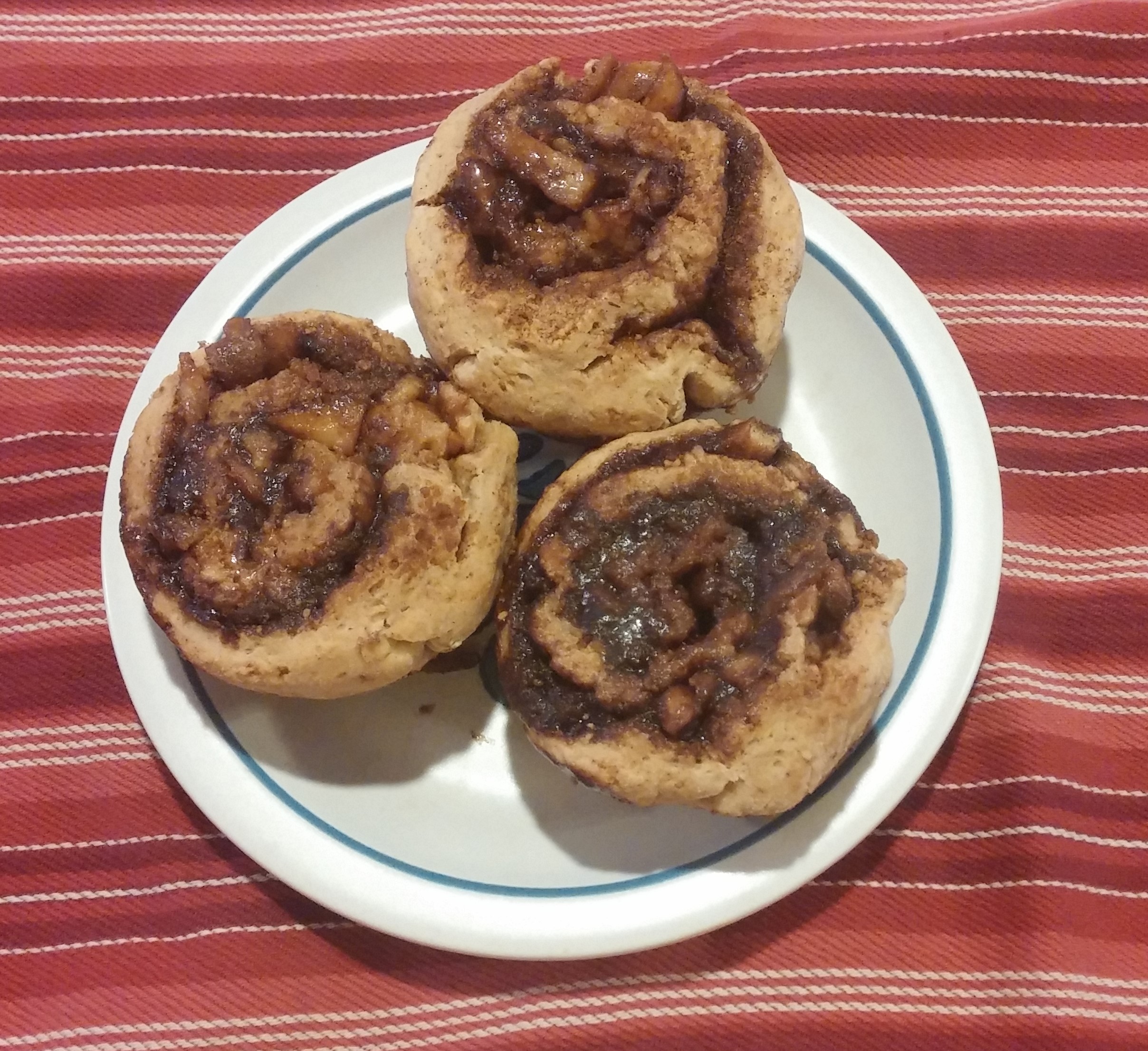
Autumn Appetites: Cinnamon Apple Strudel Muffins

apple-cinnamon-muffins

“Will you teach me to cook?”

A couple of months ago my son asked if I’d give him weekly cooking lessons because as he explained, “When I grow up I need to know how to make the two most important meals of the day:  breakfast and dessert!”

So, over the past several weeks he’s learned how to make pancakes, waffles, French toast, marble cake, brownies, and oatmeal crumb cake. This morning, since Autumn has officially begun, and my favorite apples, Honey Crisp, are finally in season, I thought I’d teach him how to make my version of an apple strudel.

Strudels are lovely recipes where dough is filled with yummy fruit, rolled and cooked. I have found them to be rather messy, though, and not easy to eat without a fork and knife. I do, however, love to make use of Honey Crisp apples during the Fall months because they are naturally sweet which means I don’t need to add any additional sweetener to them.

The recipe that follows is sort of a combination between an apple strudel and a cinnamon roll which is cooked in the shape of a muffin using muffin tins. I got the idea from a recipe by Nicole Hunn of Gluten Free on a Shoestring (http://glutenfreeonashoestring.com/). If your only issue is gluten, she is a good source to refer to for recipes. Since I, however, have multiple allergies, I’m always having to adjust her recipes to fit my particular needs. In this case, though, her idea of making cinnamon buns in a muffin tin appealed to me, and I adapted that method for my recipe, which it turns out even my eleven year old can easily make.

Making this recipe for a Saturday morning is lovely because while the forming of the muffin takes about 20 minutes, the last half of the time is them baking in the oven while you make something else to go with them, which in our case this morning was turkey breakfast sausage.

For the recipe, I created my own flour blend because I wanted the “breakfast” muffins to be fiber full and have some protein. I found over time that a combination of sorghum, millet, oat, brown rice and tapioca flour gives us the best taste and texture. I also opted to use coconut sugar because I stay away from refined white sugar. Folks who have coconut allergies, though, should go ahead and use sugar or some other sugar substitute. In addition, I chose flax milk for my liquid because I figure it doesn’t hurt to add more omega 3’s to our diet, but again, if folks are allergic or prefer some other milk, go for it.

Cinnamon Apple Strudel Muffins

Ingredients:

Filling:

Apple:

2 Honey Crisp apples

1/4 cup water

1/2 tsp cinnamon

Cinnamon:

1 cup coconut sugar

2 tablespoons cinnamon

1/4 cup vegan soy free butter (or regular if you’re not allergic and prefer)

Batter:

1 cup sorghum flour

1 cup millet flour

1 cup tapioca flour

3/4 cup brown rice flour

1/4 cup oat flour

2 tsp xanthan gum

2 1/2 teaspoon baking powder

1 1/2 tsp cinnamon

1/2 tsp nutmeg

1/4 tsp salt

1/2 cup coconut sugar (or sugar, if you’d prefer or are allergic)

1/4 cup plus 2 tablespoons of vegan soy free butter (or regular if you’re not allergic and prefer)

2 eggs

1 cup flax milk (or other type if you prefer or are allergic; I would’t recommend rice milk, though, because it’s too thin)

Topping:

1 tbsp vegan soy free butter

1 tbsp coconut sugar

1/2 tsp cinnamon

Baking Instructions:

  1. Preheat the oven to 350 degrees and grease a 12 muffin tin with your preferred method.
  2. Peel, core and chop the apples by cutting them into quarters, then slicing each quarter thinly into five or six slices, turning the slices on their sides and cutting them on the short ends into small strips. You’ll have a couple cups worth of matchstick width pieces of apples.
  3. Put the apple pieces into a shallow pan which allows the pieces to be one layer. Pour the water over the apples and sprinkle the cinnamon on top. Stir the apples to coat them well with the cinnamon and then saute the apples over medium-low heat. The water will come to a boil and then slowly dissipate. Stir occasionally until all the water is gone and the apples are soft. Usually this entire process only takes about five minutes. Turn the heat off and let the apples cool while you make the rest of the filling and the batter.
  4. Mix the coconut sugar with the cinnamon and set aside. Melt the vegan butter and set aside.
  5. Mix the sorghum, millet, tapioca, oat and brown rice flours with the xanthan gum, baking powder, cinnamon, nutmeg, salt and coconut sugar.
  6. For the next part, it works well if you have a mixer with a dough handle but if you don’t have a dough handle, you can mix the dough with spoon and then finish kneading everything in by hand: Add to the dry ingredients, the vegan butter, eggs and milk, incorporating them just until you have a ball of dough, if you’re using the mixer. If you’re doing it by hand, mix the ingredients into well incorporated and then knead on parchment paper sprinkled with flour until you have a soft, pliable ball of dough.
  7. Put the dough ball onto parchment paper sprinkled with flour (I use the brown rice flour but you can use any type you’d like). Lightly sprinkle the dough with flour and roll it into an 15 by 12 inch rectangle. I find it’s best to start in the center and slowly work your way outward in all four directions, occasionally shaping the dough with your hands into a rectangle shape. (This was the part my son found to be the most fun!)
  8.  Using a brush, brush the melted butter over the surface of the dough, leaving about a 1/4 inch on one of the short ends free of butter. It’ll seem like you have a lot of butter but be sure to use all of it on the top of the dough.
  9. Sprinkle the butter surface of the dough with the coconut sugar mixture, leaving that 1/4 inch on the short end free as before of anything.
  10. Carefully spread the apple slices evenly on top of the cinnamon covered dough so that they’re in an even single layer but mostly covering the surface with the exception of the 1/4 inch on the short end.
  11. Starting on the short end opposite the free 1/4 inch side, carefully tuck in the end and begin rolling the dough toward the uncovered end. You can use the parchment paper to help roll. With every roll of the dough, it helps to use your hands to tighten it along the entire edge before continuing with the rolling. If you are using the parchment paper and have sprinkled flour, the dough will easily roll off the paper. If you are finding that it does stick, use a spatula to gently unstick the dough from the paper before continuing with your rolling. (I have never had to do this, but just in case….)
  12. When you reach the end which is free of filling, gently seal the edge and use your hands to carefully shape the log so it’s evenly round along the entire log.
  13. Slice the log into 12 even pieces. I like to just lay a 12 inch ruler and mark off the 12 inches and then use a serrated knife to cut the pieces.
  14. Put the pieces into the greased muffin tins. You should find that they just fit into the tins. You may need to shape/squash them a bit on the sides to get them in if your dough is nice and puffy, but that’s okay.
  15. Bake in the preheated oven for 25 minutes. They’ll be puffed and golden brown. While the muffins are baking, mix the tablespoon of coconut sugar with the cinnamon. Set aside.
  16. Using a butter knive, gently go around the edges to release them from sticking. Let them cool about five minutes in the tins before removing them to a cooling rack. While they are cooling in the tins, divide the tablespoon of butter evenly on top of each of the 12 muffins and brush them until the butter is melted. Sprinkle the sugar/cinnamon mixture evenly on top of the muffins and let it melt into the butter.

Note: For the holidays, instead of using the cinnamon sugar on top, I make an icing to drizzle on top which is tofu cream cheese blended with agave and cinnamon. If you prefer to use sugar, you can mix powdered sugar with cinnamon and milk.


Creative Cooking: Zucchini Chocolate Chip Cake

“Anyone who wants them can take them!”

Every summer my husband’s family descends upon the Adirondacks to help with the family forest which has been in existence now for 60 years. When we are up there in the mountains, we have no television, can barely tune into a radio station, can only access email if we go into the town to little one room library, and still have a landline in the house because cell phone coverage is spotty at best. (This is why I’ve written no posts in the past few weeks!)

What we do have here, though, is a lot of farms with wonderful vegetables, and I love going weekly to the farmers’ markets they have every day of the week in a different town. After a while, however, I laugh because folks in the area begin to want to rid themselves of the abundance of vegetables they have, and people will show up at our place with huge bags of vegetables, and when you go to places like church, zucchini will be sitting on the table with a sign, “Please take!”

As such, I’m always looking for ways to use up vegetables like zucchini, and recently my son asked me if I could make a zucchini chocolate chip cake. I hadn’t made one in a long while so I needed to create a recipe. I was out of eggs so I used bananas instead, and because I never use white refined sugar, I chose to use coconut sugar.  In place of regular flour I used gluten free blends and single types, and for flavoring I simply used cinnamon and vanilla, which is all I had in the house. In place of milk I used soy milk but any type will work.

What follows is what we made, and we declared it a success since the entire cake was eaten within two meals!

Zucchini Chocolate Chip Cake

Ingredients:

2 cups gluten free flour blend (I used a brown rice flour blend)

1/2 cup gluten free oat flour

1/2 cup sorghum flour

1 cup coconut sugar

1 tsp salt

2 tsp baking soda

1 tsp baking powder

2 tsp cinnamon

2 to 3 ripe bananas (you’ll need one cup’s worth of pureed bananas)

1 tbsp gluten free vanilla

1/2 cup safflower oil

1/2 cup soy milk (can use any type, though)

3 cups finely shredded zucchini

1 cup Enjoy Life mini chocolate chips

2 tbsp apple cider vinegar

Baking Instructions:

  1.  Preheat oven to 350 degrees. Line a 9 x 13 pan with parchment paper (or grease as you prefer).
  2. Mix the GF flour blend with the the oat flour, sorghum flour, salt, baking soda, baking powder, and cinnamon. Set aside.
  3. Puree the bananas so you have a cup’s worth.  Add the vanilla, oil and milk and mix well.
  4. Stir in the zucchini and chocolate chips.
  5. In a large bowl mix the dry ingredients with the wet, adding the vinegar.
  6. Pour into the prepared pan and bake in the oven until the cake is puffed and golden and a toothpick inserted in the center comes out clean.  Will take between 20 to 30 minutes, depending on your oven.

Recipe Revamping: Pumpkin Tunnel Cake

“Calories: Tiny evil creatures which live in your closet and quietly sew your clothes tighter every night.”

The above was written on a pillow sitting in a store window, and my son pointed it out to me, thinking it would make me laugh. He was right! I’m convinced these creatures have been multiplying in my closet over the past few years. What else would account for my clothes beginning to become more snug as I age? *grin*

I thought about the pillow when I received an email asking if I could revamp a recipe not just for allergies but to reduce overall calories. The recipe in question was for a tunnel cake and called for a total of six eggs, a cup of butter, and 12 ounces of cream cheese, so it’s no wonder the request was being made!

If you’re not familiar with a tunnel cake, it’s simply a bundt cake with a filling inside. They’re fun cakes to make wonderful to serve to guests because they look pretty and taste lovely. This particular cake was a pumpkin ginger cream cheese cake. The original recipe called for the filling: 12 oz cream cheese, 1/2 cup sour cream, 1/2 cup sugar, 1/2 tsp ginger, 1/4 tsp salt, 2 large eggs, 1/2 tsp vanilla, and 1/2 cup crystallized ginger; and for the cake: 2 1/4 cup flour, 2 tsp salt, 2 tsp baking powder, 1 tsp baking soda, 1 tbsp ground ginger, 2 tsp cinnamon, 1/2 tsp nutmeg, 1/4 tsp cloves, 1 15 oz can pumpkin, 2 cups sugar, 1 cup butter, 4 large eggs, and 1 tsp vanilla.

To revamp the cake:

The Filling: To tackle the calories and the allergies to dairy, I opted to use tofu cream cheese and tofu sour cream in place of the regular cream cheese and sour cream, and I decreased the amounts by half. Even with half of the filling, there was plenty to fill the “tunnel” and to give the cake it’s pretty look and it’s surprise taste. I opted to keep one whole egg in the filling because it would help with the texture of the filling, figuring I could do something about the amount of eggs in the cake itself. To further reduce calories (and because I never use white refined sugar), I used Truvia in place of the sugar, which meant I could use half the amount needed.

The Cake: Because the person emailing couldn’t eat gluten, I swapped a gluten free blend for the white flour, but I didn’t want to use a rice flour blend for the entire cake, so I only used 1 1/2 cups of a GF blend and used sorghum and gluten free oat flour for the rest of the amount to add protein and fiber to the cake as well as to give the texture of the cake some density. I also chose to use 3/4 c of Agave instead of the 2 cups of sugar which further reduced calories as well as getting rid of the refined white sugar. To tackle the bad fat in the butter, I opted for safflower oil instead and reduced the amount to 3/4 cup. For the eggs, I decided to use 2 eggs and use 1/2 cup of egg whites for the rest.

The cake came out quite lovely. I served it to guests who asked for the recipe because they liked it so much! Below is the recipe as I made it. Enjoy!

Pumpkin Ginger Tunnel Cake

Ingredients:

Ginger Filling:

6 oz Tofutti cream cheese, room temp (3/4 cup)

1/4 cup Tofutti sour cream, room temp

1 1/2 tbsp Truvia

1/2 tsp ground ginger

1/8 tsp salt

1 egg

1/4 tsp gluten free vanilla

1/4 cup finely chopped crystallized ginger (I chop it in my food processor into tiny pieces)

The Pumpkin Cake:

1 1/2 cup Gluten Free rice flour blend

1/4 cup sorghum flour

1/2 cup oat flour

1 tsp salt

2 tsp baking powder

1 tsp baking soda

1 tbsp ground ginger

2 tsp cinnamon

1/2 tsp nutmeg

1/4 tsp cloves

2 cups pumpkin, cooked and pureed or canned

3/4 cup Agave

3/4 cup safflower oil

2 eggs

1/2 cup liquid egg whites

1 tsp gluten free vanilla

1 tbsp apple cider vinegar or white vinegar

Baking Instructions:

  1. Preheat the oven to 350 degrees and grease and flour a Bundt pan with your preferred method. Just make sure that you’ve covered every crevice well so that your cake will easily come out when you invert it. Nothing is worse than the top of your bundt cake sticking to the pan!
  2. Using a mixer, blend the cream cheese until smooth and creamy. Add the sour cream, truvia, ginger, and salt. Add the eggs, one at a time, beating just until incorporated. Mix in the vanilla and crystallized ginger. Set aside.
  3. Whisk together the gluten free flour blend, sorghum flour, oat flour, salt, baking powder, baking soda, ginger, cinnamon, nutmeg, and cloves. Set aside.
  4. Mix together the pumpkin, agave, oil, egg, egg whites, and vanilla.
  5. Add the dry ingredients to the wet with the vinegar and mix well until the dry ingredients are completely moistened.
  6. Fill the prepared bundt pan half full and make a little tunnel in the batter for the filling.
  7. Give the filling a good stir because the ginger pieces would have have fallen to the bottom. Carefully spoon the filling into the tunnel. It will probably spill out a bit. Don’t worry, it’ll be fine.
  8. Carefully add the rest of the cake batter to cover the filling.
  9. Bake for about 40 minutes until the cake has risen, is golden and a toothpick inserted comes out clean.
  10. Cool on a wire rack for at least 15 minutes, better to do 25 to 30. Carefully invert and remove the cake from the pan. Cool completely.


Creative Cooking: Dairy Free Dark Chocolate Mousse

“But I want it quick and easy!”

I’ve already confessed to being a lazy cook, someone who likes to make a good meal with the least amount of effort. Now, I confess that I’m also a very impatient cook. If I want to make something, I rarely like to wait the time it takes for something to get cold or to reach room temperature, and I never have patience if I try someone else’s recipe and it fails, making it a waste of my time.

Recently one of my daughter’s really wanted a chocolate mousse, but with my dairy allergy we couldn’t make it with heavy cream. Many online recipes call for using coconut milk which I have done in the past for making a whipped cream. The problem is that it doesn’t always work. Sometimes you purchase a can of coconut milk, put it the fridge, and it doesn’t solidify properly. Other times, the coconut milk tastes a little off, making your mousse not as palatable. And in both scenarios, you’ve had to wait for the coconut milk to chill, only to be disappointed.

So, we then looked at recipes which used tofu, but we found many of those recipes to be too sweet because people wanted to cover the tofu taste and did so with sugar. We also discovered that many of the tofu recipes either still called for the use of heavy cream or used almond milk, both of which I can’t have. In addition, a bunch of the recipes required a wait time for the tofu to get to room temperature or required a complicated process of straining the tofu mousse after making it.

Undaunted, though, I decided I’d make a mousse to my liking in taste, texture, and time spent. So I pulled out two cold 16 ounce containers of silken tofu and went to work. Since the process of straining the mousse seemed to be because people wanted a creamy texture which would be marred by chunks of tofu, I decided that I’d simply puree the tofu completely smooth first with my hand blender. This would eliminate any additional work needed later. And it worked really well.

Next, after looking at the too sweet recipes, many of which called for two cups of chocolate chips for one package of tofu plus additional sugar, I figured that for the two tofu packages, one 10 ounce package of Enjoy Life allergy friendly mini chocolate chips (about one and a half cups)  with no addition of any other sugar products would suffice. I microwaved the chips in a large four cup measuring bowl for one minute, stirred, and then microwaved them for another 20 seconds so that when I stirred the chips, they were melted and smooth.

Because I knew that adding the warm, melted chips to the cold tofu would result in the chocolate becoming solid again, I decided that I’d adopt the tempering process one uses with eggs to the chocolate. I added a couple of spoonfuls of the cold tofu to the warm chocolate and blended it well with the hand blender. I repeated the process three times, and then added the entire chocolate mixture into the rest of the smooth tofu, using my hand blender to completely blend the chocolate and tofu together.

When we tasted the mousse, we realized that while cutting the amount of chips made for a less sweet mousse, it also made for less of a chocolate taste, too, so I added two tablespoons of Hershey’s Special Dark unsweetened cocoa powder with 1/2 tsp of gluten free vanilla and blended one more time with the hand blender until everything was smooth and creamy. We divided the mousse among eight dishes and sprinkled chopped dairy free chocolate pieces on top as a garnish.

The entire process from start to finish was less than ten minutes, and by the time we were done eating dinner, the mousse had cooled enough in the fridge to make for a delicious impromptu dessert!

Dairy Free Dark Chocolate Mousse

Ingredients:

Two 16 oz containers of silken tofu

10 oz package Enjoy Life mini chocolate chips

2 tablespoons Hershey’s Special Dark unsweetened cocoa powder

1/2 tsp gluten free vanilla

Cooking Instructions:

  1.  Puree the tofu completely smooth first with a hand blender. If you don’t have a hand blender, use a food processor or blender. The key is to make it completely smooth and creamy.
  2. Microwave the chips in a large four cup measuring bowl for one minute, stir, and then microwave them for another 20 seconds so that when you stir the chips, they are melted and smooth.
  3. Add a couple of spoonfuls of the cold tofu to the warm chocolate and blended it well with the hand blender. Repeat the process three times, and then add the entire chocolate mixture into the rest of the smooth tofu, using the hand blender to completely blend the chocolate and tofu together.
  4. Add the Hershey’s Special Dark unsweetened cocoa powder with the vanilla and blend one more time with the hand blender until everything is smooth and creamy.
  5. Divide the mousse evenly among eight dishes and sprinkled chopped dairy free chocolate pieces on top as a garnish.


Cooking Techniques: Stir Fry

“It was magnificent!”

Our family had a recent opportunity to attend a concert my oldest was performing in which was her women’s Glee club singing with Cornell’s men’s Glee club. Over 120 voices combined in four part harmony to create a most wonderful listening experience. What was amazing was listening to the individual voices even as their voices melded to become one united sound.

I thought about this when I received an email asking about how to make a good stir fry. Stir fry is food’s equivalent to a choir. Separate types of food becoming one dish where the tastes of the individual food remains even as their flavors meld to create a delicious stir fry.

Too often, though, people think of stir fry as something difficult. “Well, I don’t have a wok,” some say. “It’s too much chopping,” others say. I’ve also heard, “I never have the proper ingredients.” The fact, though, is that stir fry can be easy, quick, and done without a wok. It’s a great way to use up leftovers or to make when you only have a little bit of a variety of food items available. It’s also versatile and can be made any number of one thousand and one ways, not to mention stir fry is very accommodating for people with food allergies.

The Pan: The reason people like woks is that their curved shape allows you to cook at different temperatures at the same time. The bottom, which is closest to the heat is hotter and the temperature gets increasing cooler as you get to the top. This means you can move cooked foods toward the top and add newer food to the bottom to begin cooking on the hottest part, and then you simply mix everything together in the end. The shape of a wok also allows you to cook in different ways. The food that hits the hot bottom sears which traps flavor into the veggies or protein. When the sauce is added, though, moisture rises in the concave center of the convex wok, allowing the foods near the middle to top of the pan to be braised, which softens the food without making it mushy. If you don’t have a wok, though, you can still make a good stir fry. The key is simply to use a skillet which is just slightly larger than your burner and which has at least 2 in sides, which most of the larger skillets have these days. The center closer to the burner will get hotter than the edges of the skillet which allows you to move food to cooler sections of the pan, and the higher sides will allow you to braise. If you don’t have a large skillet with 2 in sides, you can also simply cook in smaller batches, cooking the veggies and protein separately, then mixing the two, and thickening the sauce separately and adding it to the mixed vegetables and protein. Doing everything separately doesn’t add time, it only adds another dish, and if you use the dish you’ll ultimately be serving the food in, then it won’t even do that!

The Veggies: All good stir fry dishes have an assortment of vegetables. Varying what goes into the dish can make for a colorful presentation as well as provide a variety of nutrients, textures, and flavors. People tend to get hung up on what they see as a “traditional” stir fry with bamboo shoots and baby corn and water chestnuts, but virtually any vegetable can go into a stir fry, so whatever you may have on hand works: broccoli, green beans, carrots, peppers, cauliflower, cabbage, kale, spinach, sweet potato, zucchini, squash, bean sprouts,leeks, asparagus, beets, radishes, mushrooms, onions, eggplant, and of course, baby corn, water chestnuts and bamboos as well. What’s key is cooking your vegetables uniformly. This means chopping vegetables of similar texture into the same size. It may also mean that you start vegetables which may take longer to soften like carrots and sweet potato first and adding greens like spinach or kale at the end. What’s nice about stir fry is that your goal isn’t to cook the vegetables for a long time; it’s to cook them just long enough for their colors to become bright and deep. You want the veggies to be still have some of their crunch and crispy-ness, not for them to be mush. For folks who don’t want to do any chopping or prep at all, nowadays you can buy your vegetables pre-chopped in the vegetable section. You can also used frozen chopped veggies, which is what I tend to do because then I always have veggies on hand.

The Protein: A stir fry doesn’t need to have protein but if you’d like to add protein, just about any type can go into a stir fry. Beef, pork, chicken, shrimp, scallops, tofu, beans. As with the vegetables you want the protein to be able to cook quickly and uniformly, so make sure all pieces are similar size. Cutting the protein into smaller pieces allows you to use less, increases it’s ability to blend in with the vegetables, and spreads its flavor. Most recipes will tell you to sear the meats like beef, chicken and pork first and then to move them to the cooler section of the wok or skillet while you cook the vegetables and then to mix the two together, adding the sauce. This allows the meats to begin cooking their cooking process with the searing but then finishes the cooking with the braising which keeps the meat from becoming tough and dry. When using protein like tofu or softened beans or seafood, though, it’s often better to cook those at the last minute, just before you add the sauce because they usually only need a couple of minutes to cook, and overcooking them will make them tough or fall apart. For folks worried about the prep and chopping for these, you can find pre-sliced tofu and meats at the grocery store. For seafood such as scallops, I use the frozen variety; I simply thaw them in cold water for about 15 minutes and throw them in. You can also simply used leftovers from previous meals which you throw in at the last minute just to rewarm.

The Sauce: A good stir fry will have some flavor added more than just your veggies and protein. What you do can vary, though. If you don’t want a sauce, you can simply use herbs and spices. Stores carry premixed blends for specifically adding to stir fry. You can also experiment with herbs and spices to see what you like. For me fresh ginger, garlic, and green onions are my preferred flavors. If using dried herbs and spices, you’ll want to add them to the veggies and to the protein as you begin cooking them so the flavor have time to meld. If using fresh, add them at the end. If you opt to make a sauce, the key thing to know is that you need a thickener for your sauce. For stir fry usually cornstarch is the thickener of choice but you can also use tapioca starch or arrowroot or any type of flour. You want to whisk the thickener in with your liquid before adding the sauce to the pan to thicken. A good rule of thumb is that one tablespoon of cornstarch, tapioca starch, arrowroot, or flour is needed for every cup of liquid. When cooking the sauce, you’ll want to continually stir the sauce whether you’re cooking the sauce separately or whether you’ve added it to the pan with the vegetables and protein. If you add it the pan with food in the pan, simply move the veggies and protein to the edges of the skillet or up the sides of the wok, so you can thicken the sauce in the middle of the pan. Once thickened, combine the sauce with the veggies and protein. As for ingredients in a stir fry sauce, that all depends on your tastes. For the liquid part you can use soy sauce, hoisin sauce, oyster sauce, broth such as chicken, beef, or vegetable, red or white wine, sherry, etc…, whatever your tastes prefer. To add another dimension of flavor to whatever liquid you choose, you can add different flavored vinegars like apple cider, rice, or red wine, juices like lemon or lime or pineapple, oils like sesame or peanut, etc…. You can also add herbs and spices like garlic, scallions, ginger, shallots, lemongrass, etc…. To make the sauce, simply mix all your chosen ingredients in the ratio that tastes the best to you and which makes one cup’s worth, add your thickener, mix well, and cook over heat, stirring constantly until the sauce thickens to a consistency where it will cling to the veggies and protein in your stir fry. If you find that for some reason you need more thickener, simply mix more of your thickener with the equivalent amount of water and add it to the sauce (so, one teaspoon of cornstarch with one teaspoon of water).

The Sides: Stir fry can be eaten alone or atop something else. Good options if you want to eat them with something else are rice (brown, white, wild, jasmine, etc…), quinoa, barley, noodles such as udon, soba, lo mein or rice noodles, strips of spaghetti squash or zucchini ribbons or chopped cabbage, fresh greens like spinach, kale, arugula or swiss chard, etc…. Use your imagination and be creative.


Creative Cooking: Crumb Cake

“Your EKG is abnormal.”

A couple of weeks ago I was asked to make an allergy friendly version of a crumb cake recipe for an office party.  I was told, though, “Please don’t change anything other than to make it gluten and dairy free for my co-workers.  It’s a delicious recipe, and I don’t want to lose the taste.”

I did as instructed, but it killed me emotionally. Simply reading the ingredients was enough to give anyone a heart attack. Between the cake batter and the crumb topping the recipe called for two cups of full fat sour cream, four cups of sugar, four cups of butter, four whole eggs, and of course, white flour.

I’m sure the gentleman was correct in saying that the crumb cake was delicious. All that butter and sugar, how could it not be. My question, though, was whether it couldn’t be just as delicious as a healthier version of itself. I thought about that question again this week as I laid in a hospital bed after a severe stomach flu rendered me completely dehydrated which in turn caused an abnormal EKG.

I was sent home yesterday and spent this morning being checked out by a cardiologist. Fortunately, because I do lead a healthy lifestyle of exercise and good eating choices, the abnormal EKG did appear to be caused by low potassium levels and not anything being wrong with my heart itself. I thought, though, about how differently the results could have been if I did eat crumb cake the way a lot of people do.

Food is to be enjoyed, and I want to eat delicious crumb cake just like other people. I think, though, that what one eats should be the best it can be for my body’s health. So, I confess, that after I made the crumb cake as I was asked, that I went to work creating a healthier version which I shared with my writing group, a friend, and my family, all of whom declared it to be delicious. It took a little though, but I was able to make a few simple changes which made all the difference.  Let me share….

The Sugar: Four cups of sugar is crazy. Really. As I’ve mentioned in the past, sugar is a poison to our body, and we’re better off avoiding it if we can. As I’ve also mentioned, sugar replacements aren’t the end all as well. They still have calories and still can cause some fluctuations in one’s glycemic index, but that you can lose so much less in a recipe and are not as refined has pluses which sugar does not. So, I opted to use a cup of Agave for the cake batter and 1/2 cup of coconut sugar in the crumb topping which reduced the sweetener from 4 cups to 1 1/2 cups. Everyone agreed the cake was plenty sweet enough.

The Butter: Four cups of butter is A LOT. I agreed, though, that for a good crumb topping you did need a substantial amount of butter to get the right consistency and taste. So the question was how to create a balance between quantity and quality. In the end, I swapped grapeseed oil for the butter in the cake batter. As a plant based oil it has health benefits which butter does not, and as a liquid fat, I only needed to use 1/2 cup versus the two cups of butter in the original recipe. For the crumb topping, I decided I could halve the amount and use one cup of a vegan soy free butter which still reflected the taste and consistency of a good crumb topping. So, I was able to decrease the fat from 4 cups to 1 1/2 cups.

The Eggs: Eggs are not bad in general. In fact, they’re quite good for you. But as with all things, moderation is the key, and four whole eggs carry a lot of cholesterol in those egg yolks, which is not always good for people with certain health risks. This was an easy enough fix, though. I simply opted to use 3/4 cups of liquid egg whites which eliminated yolks altogether but kept the liquid ratio needed for the cake batter.

The Sour Cream: I admit, I love sour cream. Even the tofu version I have to eat because of my dairy allergy. It’s creamy texture and tangy taste definitely make for a delicious crumb cake. The problem is that even the vegan version isn’t really that great for you. Being made from tofu only adds a small margin of protein, nothing concrete enough to counter the fat and other additives. So, I thought about for something different to give the cake it’s moisture and flavor. In the end I decided to use pureed pumpkin because it would lend a pretty orange color to the cake as well as all those good minerals and vitamins which our bodies need. Two cups of pumpkin instead of sour cream eliminated a lot of extra fat and calories from the cake.

The Crumb Topping: This was key to do correctly, because crumb cake is, after all, about the crumb topping. If it didn’t meet expectations, all would be lost. As I previously mentioned, I had reduced the quantity of butter to one cup and swapped 1/2 cup of coconut sugar for the two cups of white sugar , but there was still the problem of how little nutritional value the white flour in the topping had, not to mention my allergies to wheat. I finally chose to use a combination of gluten free whole rolled oat and gluten free oat flour. With the addition of protein and fiber, I felt better about the topping being healthier than the original version. I also reduced the overall amount of “flour” and used 2 cups instead of the original three cups to reduce the extra calories.

The Flour: White flour is another food to be avoided if at all possible. There is no nutritional value to white flour, and if you’re like me and allergic to wheat, you can’t have it anyway. The problem, though, is that my usual switch, which is to use high fiber, high protein gluten free flours like bean flours and sorghum flours wouldn’t necessarily give me the texture I wanted for the crumb cake. Crumb cake batter is supposed to be a medium batter, not light and airy but not overly dense. Since I had altered the crumb topping, though, to have more fiber and protein, I decided I could be more lenient with the cake batter, and I opted to use a gluten free baking mix that was a mixture of brown rice flour and sweet white sorghum with potato and tapioca starches that worked well.

The Flavoring: Since I had omitted the sour cream which usually gives a good crumb cake its flavor, I needed to consider adding some spices to the pumpkin replacement. Cinnamon, nutmeg and cloves did the trick.

The Ratio: Because crumb cake is all about the crumb topping to cake ratio, and because I was reducing the amount of flour and butter, I opted to cook the cake in an 11 x 15 pan which meant I could distribute the crumb topping over a shallower depth of cake batter to ensure that there wouldn’t be more cake to crumb topping which might prevent enjoyment of the any piece given.

The Appearance: Crumb cake usually has a powdered sugar coating which makes for a beautiful presentation. I admit, I didn’t want to eliminate the aesthetics because for me presentation is important, too. I could, however, greatly reduce the amount used. The original recipe called for 1/2 cup of powdered sugar. I was able to use one tablespoon and create the same appearance without all the added sugar.

Crumb Cake

Ingredients:

Cake Batter:

2 1/2 cup gluten free flour blend (use a version with brown rice flour)

2 tsp ground cinnamon

1 tsp nutmeg

1/2 tsp cloves

1 1/2 tsp baking soda

1 1/2 tsp baking powder

3/4 cup liquid egg whites

2 cups cooked, pureed pumpkin

1/2 cup grapeseed oil

1 cup Agave

1 tbsp apple cider vinegar

Crumb Topping:

1 cup gluten free whole rolled oats

2 cups gluten free oat flour

1/2 cup coconut sugar

1 tsp ground cinnamon

1/2 tsp ground nutmeg

1 cup vegan soy free butter

1 tbsp powdered sugar

Baking Instructions:

  1. Preheat the oven to 350 degrees and line a 11 x 15 pan with parchment paper. Set aside.
  2. Mix together the gluten free flour blend, cinnamon, nutmeg, cloves, baking soda, and baking powder. Set aside.
  3. Blend together the liquid egg whites, pumpkin, grapeseed oil, and agave. Add to the dry ingredients with the apple cider vinegar, and blend until the dry ingredients are fully moistened.
  4. Pour cake batter into the prepared baking pan.
  5. Combine the whole rolled oats, oat flour, coconut sugar, cinnamon, and nutmeg. Using clean hands incorporate the vegan butter into the mixture until everything is completely mixed and you have no dry ingredients leftover. You’ll have a nice clump which you can then crumble for the crumb topping.
  6. Evenly distribute small chunks of the crumb topping over the cake batter.
  7. Bake the prepared cake in the preheated oven for 30 minutes or until a toothpick inserted in the center comes out clean and the cake is puffed and golden.
  8. Cool the baked cake on a wire cooling rack. Using a sifter, gently sprinkle the powdered sugar to completely cover the crumb topping.


Holiday Traditions: Allergy Friendly “Stollen”

Yay! It’s Advent….

My son has been counting down to Advent since mid-October. Because we have a tradition of taking time as a family every evening of Advent to read one of the many books we’ve collected over the years, sing a song, and pray, Advent is one of his most favorite times of the year. And with our oldest at college these past two Christmas seasons, it’s meant he gets more turns in the rotation to pick books and songs….

As with my son, the traditions people have are one of the many reasons they look forward to the holidays, and it can be disappointing if a tradition can no longer be held.

I received an email this week from someone whose family always makes stollen for Christmas. Stollen is a traditional German fruit bread. Original stollen is a dry, not sweet yeast bread. Versions one finds in the stores these days tend to be much sweeter, drenched in butter and sugar.

This particular woman has developed sensitivities to wheat and yeast and was wondering if there was a way to make something similar to the stollen of her family traditions. The challenge was to keep the dry texture without being a yeast bread and to make something with no sweetener other than the dried fruit. In the end I created something which had a similar texture to stollen though not the shape.

For the flours, I blended garbanzo bean, sorghum, coconut, and arrowroot. This created the drier, crumbly texture we wanted. For the dried fruit, I opted for dates and raisins because they are always easy to find in the stores. To keep the cake from becoming too dense because of the lack of sugar, I made a “buttermilk” using soy milk and lemon juice and used eggs. Then I added spices – cinnamon, ginger, nutmeg and cloves – for flavor. I decided not to top the cake with butter and powdered sugar in favor of making a healthier, no sugar topping, but others can feel free to shake powdered sugar on top instead.

When I served the new creation to tasters, the folks who have had traditional stollen declared it to be similar in taste and texture, so I’m going to call it a success.

For folks who may not eat stollen regularly, this is definitely a dry, not sweet cake. So, don’t make it if you want something dense, moist and sweet. It does go very well with coffee if you drink yours with cream and sugar. I like eating it just as it is.

“Stollen”

Ingredients:

8 oz pitted whole dates

1 cup raisins

1 teaspoon baking soda

1 cup boiling water

3 cups of the gluten free flour blend (see below)

1 tsp cinnamon

1/2 tsp ground ginger

1/2 tsp ground nutmeg

1/4 tsp ground cloves

1/2 tsp salt

1 tsp baking powder

1/2 cup  soy milk with 1/2 tbsp lemon juice (can substitute any type of “milk”)

2 eggs

3 tbsp safflower oil

1 tsp vanilla

1 cup soy milk

2 5-6 inch bananas

1/2 tsp cinnamon

2 tbsp garbanzo bean flour

2 tbsp coconut flour


Flour Blend:

1 1/2 cup garbanzo bean flour

1 1/2 cup sorghum flour

1 cup arrowroot starch

1/2 cup coconut flour


Baking Instructions:

  1. Preheat the oven to 350 degrees. Line two 9 inch round cake pans with parchment paper.
  2. Mix the dates and raisins with the baking soda. Chop them up in a food processor to make small pieces which will evenly disperse throughout the stollen.
  3. Pour the boiling water over the dried fruit, and set it aside.
  4. Mix the garbanzo bean flour, sorghum flour, arrowroot starch, coconut flour, cinnamon, ginger, nutmeg, cloves, salt, and baking powder.  Set aside.
  5. Blend the milk with lemon juice with the eggs, safflower oil, and vanilla.
  6. Combine the dried fruit, dry ingredients, and wet ingredients until everything is moistened and well blended together.
  7. Divide the batter evenly between the two cake pans, and bake for 25-30 minutes until the cakes are puffed, golden, pulling away from the sides of the pan, and a toothpick inserted in the center comes out clean. (Depending on your stove, you may want to set the timer for 20 minutes and keep checking.)
  8. When the cakes are done, cool for about five minutes in the pans, and then removed them to a wire cooling rack to cool completely.
  9. In a food processor or blender, puree the bananas with the milk. Stir in the cinnamon, garbanzo bean flour and coconut flour. (The 4 tbsp of flour makes for a thick, spreadable topping. If you want a thinner, runnier “sauce”, reduce each of the flours by half.)
  10. Over a double boiler (I use a make-shift one by fitting one pan into a second one) heat the milk mixture, stirring constantly, until it begins to thicken. Spread over the cakes and enjoy. (If you don’t want the topping, just shift powdered sugar over the tops of the cakes while they are still warm. This will make for sweet version of the stollen.)


With Gratitude: Savory Triple Squash Muffinsu

“Is your kitchen ready 4 the holidays?”

I was driving to meet some friends when I saw a sign outside a home design business asking, “Is your kitchen ready 4 the holidays?”

My immediate response was, “Of course not, but who cares?” Obviously, though, people must care, or the business would not be using the sign as part of its marketing strategy.

For me, the holidays are about the three “F’s” — faith, family, and food. I confess, though, that the priorities aren’t always in that order. If I’m hosting, I tend to focus a lot on the food because I care very much that everyone attending will be able to safely enjoy what they eat.

So, when I received an email this past week in response to the post about the pumpkin cranberry muffins, I understood the desire behind the question: “Do you have a savory muffin recipe for Thanksgiving? My grandmother doesn’t like her breads to be sweet.”

This particular person had found my recipe because she was looking for an allergy friendly muffin recipe for her grandmother whose diet was restricted, but as she mentioned, she wanted something savory instead. So, for folks who want a choice, I’m posting a savory triple squash muffin recipe which I made last week and had many, many folks taste test with good reviews. They also have the added benefit of being gluten, dairy, soy, nut, sugar, and egg free.

Triple Squash Muffins

Ingredients:
1 cup gluten free whole rolled oats
1 cup boiling water
2 tbsp golden ground flaxseed
6 tbsp water
1 cup gluten free oat flour
1 cup garbanzo bean flour
2/3 cup potato starch
1/3 cup arrowroot starch
2 tsp baking powder
1 tsp baking soda
1/2 tsp salt
1 tsp dried oregano
1/2 tsp dried thyme
1/2 cup safflower oil
1 cup cooked, pureed winter squash (butternut, acorn, pumpkin, etc… your choice)
1 cup shredded zucchini
1 cup shredded yellow summer squash
1/2 cup boiling water
2 tbsp vinegar (white or apple cider)
Baking Instructions:
1.  Preheat oven to 400 degrees and line muffin tins with liners.
2.  Pour 1 cup of boiling water over 1 cup of gluten free whole rolled oats and set aside.
3.  Mix 2 tbsp of ground golden flaxseed with 6 tbsp of water and set aside.
4.  Combine 1 cup gluten free oat flour, 1 cup garbanzo bean flour, 2/3 cup potato starch, 1/3 cup arrowroot starch, 2 tsp baking powder, 1 tsp baking soda, 1/2 tsp salt, 1 tsp oregano, and 1/2 tsp thyme.
5.  Blend the oats with the flaxseed mixture, 1/2 cup safflower oil, 1 cup winter squash (butternut, acorn, pumpkin, etc…), 1 cup shredded zucchini, and 1 cup shredded summer squash.
6.  Add the dry ingredients to the wet, along with 1/2 cup of boiling water and 2 tbsp of vinegar (white or apple cider).  Mix just until the dry ingredients are fully moistened.
7.  Divide the batter evenly among 24 muffin cups.
8.  Bake for about 20 minutes until the muffins are puffed, golden and a toothpick inserted into the center comes out clean. (You may want to check after 15 minutes.  It could take up to 25 minutes.  It all depends on how accurate and well your oven keeps its temperature.  In my oven, it’s about 20 minutes consistently.)

Autumn Fruits: Easy Marinara Sauce

website tomato sauce

“Are you going to do something with those tomatoes?”

A couple of weeks ago, my sister-in-law generously gave me several pounds of home grown tomatoes, the last picked of the season before the weather became cold. I was thrilled, but then my son became ill, and a week was lost at the hospital and helping him to recover at home.

Over the weekend, my husband looked at the tomatoes still taking up space on our counter, and asked, “Are you going to do something with those tomatoes or am I going to have to compost them?”

The idea of composting all those lovely tomatoes horrified me, so I quickly grabbed a cutting board and went to work….

Folks who have been reading the blog for a while know that I’m a big fan of the least amount of effort for great results. So, what’s something easy one can do when you have pounds of tomatoes and no idea what to do with them? Marinara sauce.

Marinara sauce is just a sauce made from tomatoes. If you make up a huge batch, though, you can freeze it and use it in a variety of ways: the base for a thicker spaghetti sauce, sauce for pizza, in Spanish rice, for ratattouille, the base for a cocktail sauce, for soups, to top enchiladas, in Sloppy Joe’s, the list is pretty never-ending. And what’s lovely is that unless you’re allergic to tomatoes, it’s allergy friendly, too – no nuts, dairy, egg, gluten, sugar, peanuts, etc….

Easy Marinara Sauce

  1. The Tomatoes: I simply cut the tomatoes into fourths and cook them as is, seeds, peels and all.
  2. The Flavoring: Whatever you’d like. I usually throw in about eight to 10 whole garlic cloves, two purple scallions quartered and a chili pepper.
  3. The Herbs: Whatever you’d like. I like basil, oregano, and thyme. Use dried herbs. If you want fresh herbs, those can be added when you actually use the marinara sauce for a recipe.
  4. The Pan: I have a lovely Circulon pan which is 12 inches in diameter and three inches deep which I use for making marinara sauce. I recommend a larger, shallower pan over a deeper but smaller pot, which is the use recommendations. The reason? Because the shallower pan allows all the tomatoes to cook down quickly without you needing to continually stir to get the top tomatoes down to the bottom where the heat source is.
  5. The Cooking: If you cook the tomatoes in the shallower pan, you only need to cook the tomatoes, with a lid on, for about 20 to 30 minutes.
  6. The Consistency: If you want a chunky marinara sauce, simply let the cooked tomatoes cool as is. If you like a smoother marinara, puree everything up in a blender or food processor. If you don’t like the seeds, strain them out after pureeing. If you want a thicker marinara sauce, add tomato paste or cooked, pureed vegetables like squash or carrots or pumpkin which also add another flavor dimension.
  7. The Storing: Marinara sauce will keep for weeks in the fridge and for years in the freezer. To store in the freezer, make sure the sauce is completely cooled and then put the sauce into freezer friendly containers or bags. I prefer to put two cups of sauce into freezer bags because that’s the amount I tend to use for most recipes and because the bags will then lie flat in the freezer, taking up less space.
  8. The Use: If you know ahead of time you want to use frozen marinara sauce, simply take the containers or bags out of the freezer the day before. If you decide at the last minute to use sauce, the sauce easily defrosts as it cooks in the microwave or in a pan.


Recipe Creations: Chocolate Chip Carrot Snack Cake

“Yeah, but I’d rather eat that than cardboard.”

A couple of weeks ago, my son and I enjoyed a visit to a science museum where I was surprised by a new exhibit. They had created a room filled with information about healthy eating with a couple of hands-on activities for the children looking at skeletal bones and experimenting with food.

As we left the exhibit, we found ourselves behind a group of teenagers and overheard their conversation. One of the girls commented about the display that talked about how bad sugar was for our bodies, and one of the boys responded with, “Yeah, but I’d rather eat that than cardboard.”

I understood what he meant. Too often the “healthy” desserts don’t match up with our expectations for taste, and unfortunately, once someone’s had a negative experience, it turns them off to trying again.

Recently, my high school daughter had a couple of friends over, and they wanted something “sweet”. Since I don’t like to serve “junk”, I thought about what I could make, and carrot cake came to mind. The problem is that carrot cake in its traditional form is so utterly bad for you, despite the carrots. The fat content is really high because of the butter in the cake, the traditional use of nuts, and the cream cheese frosting, and to keep carrot cakes moist and binding, you use a lot of eggs.

I didn’t want to give up on this dessert, though, so I decided to work on a snack cake version, something without frosting and which would be considerably lighter in texture, taste, and calories — and of course, I wanted to eat it, too, so I made it allergy friendly for my allergies to wheat, dairy and nuts, making sure to add some flours higher in protein and fiber and minimizing the use of white refined sugar.

The result? My daughter, who has never actually liked carrot cake, loved it, and one of my daughter’s friends said it was the best carrot cake she’d ever had in her life. While I take that as the hyperbole it was, it is a reminder to me that if we continue to serve good tasting food which also happens to be healthy, then maybe, just maybe, we’ll find a way to reverse the trend of obesity, diabetes, and heart attacks….

Chocolate Chip Carrot Snack Cake

Ingredients:

1 1/2 cup gluten free brown rice flour blend (I used Authentic Foods)

3/4 cup gluten free oat flour

1/4 cup sorghum flour

2 tsp baking powder

1 tsp baking soda

1 tsp ground ginger

1 tsp ground cinnamon

1/2 tsp ground cardamom

1/2 tsp ground nutmeg

1/4 tsp salt

1 cup Enjoy Life mini chocolate chips

20 oz container crushed pineapple in its juices only

3/4 cup agave

3/4 cup safflower oil

1 cup egg whites

2 cups loosely packed shredded carrots

1 tbsp apple cider vinegar

2 tbsp agave

1 tsp ground cinnamon

1 tsp ginger

Baking Instructions:

1. Preheat the oven to 350 degrees and line a 9 x 13 pan with parchment paper.

2. Mix together the brown rice flour blend, the oat flour and the sorghum flour with the baking powder, baking soda, ginger, cinnamon, cardamom, nutmeg and salt.  Add the chocolate chips. Mix well, and set aside.

3. Drain the crushed pineapple and remove 1/2 cup of the crushed pineapples. Reserve the remaining pineapple. Puree the 1/2 cup pineapple in a food processor until it’s smooth.

4. To the pureed pineapple add the agave, safflower oil, egg whites, and shredded carrots. Mix well.

5. Add the carrot mixture to the dry ingredients with the apple cider vinegar. Blend just until everything is incorporated together and the dry ingredients are moist.

6. Pour into the prepared pan and bake in the oven until the cake is golden and a toothpick inserted in the center comes out clean. It took about 25-30 minutes for me, so I suggest setting the timer at 25 min and then checking.

7. While the cake is cooking, take the remaining crushed pineapple and mix it with the agave, cinnamon and ginger. You can put it into the fridge if you want it cold.

8. When the cake is done, serve slices of the cake with dollops of the spiced crushed pineapple.


Happy Fourth: Berry Crisp

website berry crisp

“I want something easy….”

Happy Fourth of July! I received an email yesterday, asking for a dessert that could feed a large amount of people, would be allergy friendly, was Fourth of July-ish, and would be easy to make. Fortunately, I had just the suggestion.

Berry Crisp. It’s one of my children’s favorites, and my son always says that it reminds him of the Fourth of July because of the color of the berries. What I love is that if you keep frozen berries in your freezer, you can whip this up quickly and easily any time of the year.

Berry Crisp

Ingredients:

one 16 oz pkg frozen blackberries*

one 16 oz pkg frozen raspberries*

one 16 oz pkg frozen blueberries*

one 16 oz pkg frozen strawberries*

1/4 to 1/2 cup favorite GF flour (I use either garbanzo bean or sorghum or GF oat flour because they have more fiber and protein than others; use the smaller amount if you want a juicier crisp and the larger amount if you prefer a drier crisp)

1/2 cup Agave (if you like a sweeter crisp, increase this to 3/4 c)

1 tsp cinnamon

1/2 tsp nutmeg

1/4 tsp ginger

4 cups gluten free whole grain oats

1/2 cup GF flour (I use either garbanzo bean or sorghum or GF oat flour because they have more fiber and protein than others)

1 tsp cinnamon

1/2 tsp nutmeg

1/4 tsp ginger

1/2 cup melted vegan butter

1/4 cup Agave

Baking Instructions:

1. Preheat oven to 375 degrees. Lightly grease an 11 x 15 pan with your favorite method. (If you don’t have a large pan like this, you can use several smaller dishes like the three pictured above.)

2. Empty into and mix all the frozen berries in a large bowl with the flour until they’re coated.

3. Combine the agave with the cinnamon, nutmeg and ginger and coat the berries with the agave mixture.

4.  Cover the pan tightly with aluminum foil, and bake the berries in the preheated oven for about half an hour until the berries are warm and soft and starting to bubble a little.

5.  While the berries are cooking, mix the whole oats with the flour, cinnamon, nutmeg and ginger. Mix together the melted butter and agave, and mix the oats with the butter mixture. Set aside and let the oat mixture cool.

6.  After the berries have cooked for the half hour, remove the foil from the pan, and reduce the oven to 325 degrees.

7.  Give the oat mixture a good stir. (The oats should be cooled now and have formed little clumps.) Evenly spread the oat mixture over the berries.

8.  Bake the crisp in the lower heat oven for another 15 to 20 minutes, just until the oat mixture has begun to crisp up and brown just a little.  The berries will be bubbling. (Be sure to check after 15 minutes because the oats can become too toasty very quickly.)

9.  The crisp can be served while warm with vanilla “ice cream” or “whipped cream” or just plain. It can also be eaten room temperature or cold.

If you have leftovers, you can wrap it and leave it on the kitchen counter or you can put it into the fridge.  My son thinks it’s a great breakfast food!

* NOTE: Obviously, if the season is right or if you simply prefer and don’t mind paying more, you can use fresh berries instead of frozen. If you use fresh berries, then you don’t need to use very much flour at all, so reduce the flour coating to about 2 tbsp or leave it out altogether, depending on how juicy or dry a crisp you prefer.