Thanksgiving Thoughts: Easy Roasted Vegetable Medley

“Do you have a go-to recipe..?”

For the past couple of weeks I have been posting some thoughts for different dishes folks could consider making for Thanksgiving, and this week someone wrote in, asking whether there was anything “easy” I tended to always make.

The answer is, “Yes.” My go-to for any occasion, not just Thanksgiving, is a medley of roasted vegetables. It’s easy to do, looks pretty, and can be “jazzed” up. I use frozen, chopped vegetables, which cuts both the roasting and prep times, and once the vegetables are roasted, it takes just minutes to “adorn” them. Once that’s completed, the vegetables can sit in your fridge until about thirty minutes before you’re ready to eat them, at which point, you simply warm them at 300 degrees for about 20 to 25 minutes.

If I am making the medley for Thanksgiving, I try to make them a bit more “special” by caramelizing onions and adding it to the vegetables or roasting garlic and adding slivers with freshly chopped herbs. Sometimes I make a gluten free bread crumb topping and top the vegetables with it. Other times, I make it “au gratin” and add vegan parmesan. Any of these options makes for a delicious side dish.

For folks who are wondering about the turkey which may go with the roasted veggies, I did a post a couple of years ago which you can find at Turkey Talk and which provides some tips for tackling turkey.

Roasted Vegetable Medley

Ingredients:

olive oil

frozen vegetables of choice (baby carrots, butternut squash, baby brussel sprouts, cauliflower, etc…)

Cooking Instructions:

  1. Preheat the oven to 500 degrees.
  2. Arrange vegetables of the same size in an ovenproof pan and drizzled with a tiny bit of olive oil. Mix and roast in the oven for about 10 to 15 minutes, turning every four to five minutes, until the vegetables are to the desired tenderness.
  3. If you have vegetables of different sizes, you may need to do a couple of rounds of roasting, by size, until all your vegetables are done.
  4. Arrange all the vegetables in a pan that fits them well. Top with your desired method of flavoring: mixing with freshly chopped herbs and black pepper; caramelizing onions and mixing them in; roasting garlic and mixing in slivers; making a bread crumb topping and sprinkling it on top; shaking parmesan on top.
  5. If serving immediately, you’re good to go. If serving at a later time or day, simply allow the vegetables to cool, cover well, and then thirty minutes before meal time, heat the dish at 300 degrees for 20 to 25 minutes until warm.
Thanksgiving Thoughts: Vegan Pumpkin Pie, Two Ways

“But pie….”

After posting the black bean-kale soup recipe, I received a question about pies. More than any other holiday, Thanksgiving tends to be about the pies. Pumpkin, apple, cranberry-pear, and mince meat tend to be the more traditional pies associated with Thanksgiving, but I have seen people put out other types like lemon meringue and chocolate pies as well. For today’s post, I’ll focus on the question asked which was for a vegan pumpkin pie, but below are links to other pies I’ve posted about in the past.

Apple Pies

Struesel Cranberry Pear Pies

Peach Pies

Chocolate Pies

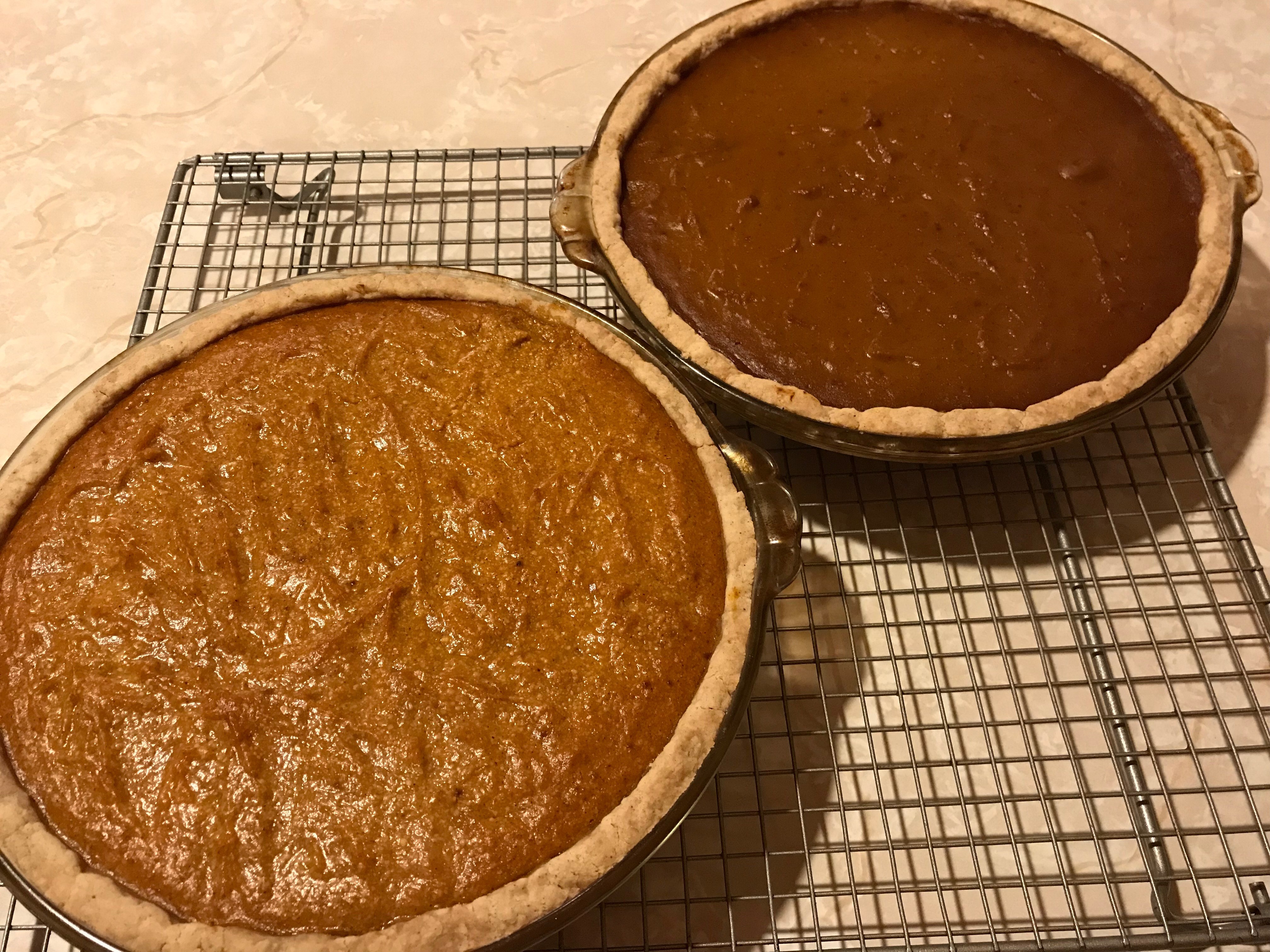
Making a pumpkin pie vegan is easy. For the crust, folks can simply substitute vegan butter, vegan shortening or coconut oil for the butter or shortening in any pie crust recipe without anything else needing to be done to the recipe.

For the pumpkin filling, the first ingredient which makes pumpkin pie non-vegan is the eggs, and in pumpkin pie, the eggs simply act as a binder, which is simple to replace. To make a pumpkin pie which is just like regular egg-filled pumpkin pie, the easiest substitute for the eggs is a flour or a starch. Most recipes you’ll find use cornstarch. Many folks, however, are allergic to corn, and I personally like to add protein and/or fiber if possible when I can, so I opt to use a gluten free flour like oat or millet or sorghum.

The other ingredient in pumpkin pie which is dairy is the milk, whether it’s evaporated milk or heavy cream which is used. To substitute for milk in a pumpkin pie, one can choose a plant based “milk” like almond or soy or hemp or flax or any other type on the market which you prefer.  Usually 1 1/2 cups of a “milk” is equivalent to a can of evaporated milk.

For folks who might want a slightly different pumpkin pie and who are not allergic to soy, I also make a pie using tofu which tends to be a heartier, more protein filled pie. Pureed tofu then acts as the binder which eliminates the need for flour, and the pie also does not require any “milk” at all.

For both types of pumpkin pie, I reduce the “sugar” amount substantially and use an alternative to refined white sugar – coconut sugar for the more traditional type of pumpkin pie and agave for the tofu pumpkin pie. Folks who have eaten my pies never say it’s not sweet enough and always comment on how the pumpkin flavor really shines.

Below are recipes for both versions.

Pumpkin Pie Recipes

Ingredients:

Pie crusts (click the link for tips on making Allergy Friendly Pie Crusts)

Version 1 Filling:

2 cups cooked, pureed pumpkin (canned works, too)

1/2 cup coconut sugar

2 tsp spices (I use a mixture of cinnamon, nutmeg, ginger, allspice, cloves and/or cardamom)

I 1/2 cup plant based “milk” (I prefer to use flax or soy milk)

1/4 to 1/2 cup gluten free flour (use the lower amount for a more silky pie; the higher amount for a sturdier pie; I like to use millet or sorghum or GF oat flour to add some protein and fiber)

Version 2 Filling:

2 cups cooked, pureed pumpkin (canned works too)

1/2 cup agave (I like to use the maple flavor agave for this pie; if you can’t find it, you can mix 2 tbsp of maple syrup with enough agave to make 1/2 cup – this gives you the flavor but substantially reduces the amount of calories you’d get from using 1/2 cup of maple syrup)

2 tsp spices (I use a mixture of cinnamon, nutmeg, ginger, allspice, cloves and/or cardamom)

16 oz silken tofu, pureed to be smooth and creamy

Baking Instructions:

  1. Preheat the oven to 350 degrees.
  2. Prepare the pie crust and put into a 9.5 inch glass pie pan. Set aside.
  3. Choose which pumpkin pie filling to make, and mix all the ingredients until well blended.
  4. Pour into the prepared pie crust.
  5. Cover the edges of the pie crust with aluminium foil, leaving the center of the pie uncovered.
  6. Bake for 60 to 65 minutes until the pie is set and the center only jiggles a bit.
  7. Put into the fridge to completely cool. Best to cool overnight but at the very least, several hours. Without the eggs, the cooling is what solidifies the pie.


Thanksgiving Thoughts: Vegan Black Bean Kale Soup

“It is wonderful that she can see other people eat like this….”

I had a workshop last weekend where a mother brought her entire family. She explained that she wanted her daughter to see that they were not the only family who had to eat the way they did – meaning allergy friendly. Over the course of the two hour workshop, I watched the daughter enjoy treat after treat, surprised that her mother had told her she could eat anything she wanted from the table.

Too often the holidays are difficult for folks with health and/or food allergies because we know that much of what is on the table we can’t eat. At Thanksgiving, this can be especially depressing since Thanksgiving is celebrated largely through food.

Over the past couple of weeks I have been trying to post Thanksgiving ideas which are not as traditional, just to give folks something new to consider. From the emails I’ve received, it seems folks liked the the notion of vegan, gluten free cornbread stuffing and vegan, gluten free butternut squash swirled cheesecake. Today I’m going to suggest a hearty soup for folks who like to serve a soup course for Thanksgiving.

For any traditionalists who may have people with food allergies or health needs coming to dinner, making a roasted vegetable soup is a good way to go. The Roasting Vegetables post shares how to roast vegetables in a quick and easy way. To make what you’ve roasted into a soup, simply add to the roasted vegetables your favorite no salt, no sugar added vegetable broth, herbs, garlic and onions and puree to the consistency of your choice. Then on Thanksgiving day, just put it into your crockpot and let it cook until your guests arrive. Serve with allergy friendly crushed croutons, “cheese”, “sour cream”, and/or sunflower or pumpkin seeds.

Anyone who may be looking for something a bit heartier and different, though, I offer a black bean, kale soup, just as easy to prepare as the roasted vegetable soup but which adds not just another flavor to the meal, but which can be a more “filling” soup for vegans who have come for dinner.

Black Bean-Kale Soup 

(serves 6 to 8, depending on size of bowls)

Ingredients:

14 oz can no salt, no sugar added lentils

one tsp olive oil

minced garlic to taste

chopped onions to taste

crushed thyme leaves to taste

ground cumin to taste

black pepper to taste

one to two cups frozen or fresh finely chopped kale

1/4 to 1/2 cup finely diced yellow pepper

14 oz can of black beans, drained and rinsed

2 tbsp to 1/4 cup finely diced vegan ham

32 oz no salt, no sugar added vegetable broth

salsa to taste

Cooking Instructions:

  1. In a food processor or blender, empty the contents of the can of lentils and puree/blend until smooth. Set aside.
  2. In a large-width pan shallower (not a narrow soup pot) which has at least 2 inch sides, add the olive oil, garlic, onions, thyme, cumin and black pepper. Saute over medium-low heat for a minute to release the flavors, stirring so nothing burns.
  3. Add the kale and yellow pepper and saute for another couple of minutes to release the water from the vegetables.
  4. Add the drained and rinsed black beans and vegan ham bits, and saute for a minute, mixing them well with the herbs and vegetables.
  5. Add the vegetable broth and salsa to taste, and simmer for 10 to 15 minutes over low heat until the soup has reduced a bit and is thicker.
  6. Serve with allergy friendly sour cream and “cheese”, if desired.