Cooking Techniques: Croquettes

“But you play that, not eat it!”

I confused my son last week because I made croquettes (kro-kets), and he thought I said, “Croquet (kro-kay).” He thought it was funny that we were going to eat the game! And of course, croquettes actually look like little balls, so throughout the entire meal, he kept pretending that he was hitting them through croquet hoops.

If you aren’t familiar with croquettes, the name comes from the French, but they’re simply chopped up meat or chicken or cheese or vegetables or fish or potato or rice or quinoa or beans or combinations of all these, rolled in breadcrumbs or seeds or nuts and then cooked. For me, croquettes are a lovely way to use up leftovers. They’re versatile, not only in what you can put into them, but the way you can make, cook, and serve them. Plus if you serve them for company, the French name makes them think you’ve done something special. *grin*

Croquettes are quite easy to make, especially if you’re beginning with leftovers. The most common recipes you’ll find online are for ones made with mashed potatoes, either alone or in combination with meat, chicken, cheese, or vegetables. You’ll usually find, too, that they’re fried in some way, whether deep-fried or pan-fried, but they can be just as good baked. Below I’ll give you some tips for how to go about making your own.

The Main Ingredients: What’s important to know about croquettes is that no matter what you use, smaller is better. You don’t want large chunks in your croquettes. Because you’ll be rolling the mixture into balls, the smaller the pieces of meat or vegetables, the easier it will be for them to adhere to one another. I use my food processor to zoop at least one of the ingredients into almost a paste – potatoes, butternut squash, chicken, fish, rice, quinoa, beans, etc… all work well. Then I process the rest of the ingredients into tiny pieces which will mix well into the more paste-like ingredient. The reason I made croquettes last week was because I had some leftover chicken breasts which weren’t enough to serve as another meal for the whole family, so I processed them into a paste and added finely chopped cooked zucchini, mushrooms, and broccoli (also leftovers).

The Seasonings: You can season croquettes however you like. Salt and pepper, of course, but herbs (basil, oregano, thyme, rosemary, chervil, sage, mint, dill, tarragon, marjoram, etc…) and spices (allspice, cayenne, cardamom, coriander, tumeric, cumin, paprika, nutmeg, cinnamon, garlic, ginger, cloves, mustard, onion, saffron, etc…) of your choosing are great, too. If you are going to eat the croquettes by themselves, you should season more heavily. If you are going to serve them with a sauce, then the croquettes can be more plain because the sauce will give them flavor.

The Binder: It’s important that your ingredients hold together to keep their shape. If you do as I do and puree one of the ingredients into a paste, then the rest of your ingredients will stick to that. It’s one of the reasons why so many croquette recipes are made with potatoes. Potatoes are naturally glutinous. If you want all your ingredients to be small, solid pieces, though, then you’ll need something to hold them together. Most anything works. Some recipes use eggs. Others call for mayonnaise or sour cream or yogurt. Many just moisten the ingredients with a little bit of liquid like chicken or vegetable broth or milk and add some flour or bread crumbs to give the vegetables or meat something to adhere to. Whatever you choose to do is fine. What’s important is that your ingredients can be shaped into balls, so if they can’t and won’t stick together, try something different.

The Shaping: Whatever ingredients you use and however you choose to bind the croquettes, I recommend that you chill the mixture before you shape the croquettes. Unless your ingredients are super sticky, chilling the mixture will help them to adhere to another better. I use a quarter cup measuring cup to form my croquettes but you can certainly make them smaller or larger. Whatever size you make, though, having them be uniform will allow them to cook evenly if you bake them or help you to time them consistently if you’re frying them.

The Coating: After you’ve shaped your main croquette ingredients into balls, you need to coat them with something. Usually they are coated in bread crumbs. I like to make my own with gluten free bread, but you can use store bought bread crumbs. What’s important is that your crumbs be very fine. Texture is very important to the taste of the croquettes. If you opt to use something other than bread crumbs, there are many options: cracker crumbs, finely ground nuts or seeds, flour, etc… Once you decide on your coating, you can decide how you want to adhere the bread crumbs (or other choice) to the croquette balls. You can roll the balls in beaten eggs, in milk, in broth, in mayonnaise, in just about anything which will help the bread crumbs stick to the croquettes. I find that eggs make for a crispier croquette, mayonnaise (or something similar like sour cream or yogurt) for a moister croquette, and milk and broth for softer croquettes, so you can choose.

The Cooking: If you want to deep fry them, it’s best to make sure you have enough oil to completely cover the croquettes. You also want to heat your oil as hot as you can. I have a deep fryer which heats to 374 degrees but if you heat oil in a pan stove-top, you can usually get the oil to about 350 degrees. The hotter your oil, the more quickly the croquettes will cook and the less oil they will absorb. Since your ingredients in the croquettes are already cooked, all you’re doing is making the croquette warm and crispy, so usually just two to three minutes is all they need to cook.

If you want to pan fry the croquettes, you simply need enough oil to brown all the sides of the croquettes. Having your skillet on medium high is good. Simply place the croquettes in the skillet and allow them to brown on one side before turning them over to brown on the other. When making the croquettes in a skillet, they usually take about four to five minutes per side.

My preferred method for making croquettes is to actually bake them because they’re healthier that way. I line a pan with aluminum foil which I’ve crinkled and very lightly grease the foil with olive oil. I place the croquettes on the foil and then lightly brush them with olive oil. I preheat my oven to 450 degrees and bake the croquettes for about 20 minutes, turning them halfway through.

The Sauces: Croquette sauces are as varied as the ways you can make the croquettes. You can dip them into a barbecue sauce, a cheese sauce, a tomato sauce, a lemon sauce, a mustard sauce, a garlic sauce, an avocado sauce, a dill sauce – if you can imagine it, you can make it. What’s important is to think about the ingredients you used in the croquettes and to match a flavor which would complement the croquettes. So, for example, if you used ham and potatoes, maybe a mustard sauce. If you made fish croquettes, maybe a lemon-dill sauce. What’s fun is if you make croquettes and serve them with a couple of different sauces for the family to try.


The Coating:

The Cooking:
Cooking Techniques: Stir Fry

“It was magnificent!”

Our family had a recent opportunity to attend a concert my oldest was performing in which was her women’s Glee club singing with Cornell’s men’s Glee club. Over 120 voices combined in four part harmony to create a most wonderful listening experience. What was amazing was listening to the individual voices even as their voices melded to become one united sound.

I thought about this when I received an email asking about how to make a good stir fry. Stir fry is food’s equivalent to a choir. Separate types of food becoming one dish where the tastes of the individual food remains even as their flavors meld to create a delicious stir fry.

Too often, though, people think of stir fry as something difficult. “Well, I don’t have a wok,” some say. “It’s too much chopping,” others say. I’ve also heard, “I never have the proper ingredients.” The fact, though, is that stir fry can be easy, quick, and done without a wok. It’s a great way to use up leftovers or to make when you only have a little bit of a variety of food items available. It’s also versatile and can be made any number of one thousand and one ways, not to mention stir fry is very accommodating for people with food allergies.

The Pan: The reason people like woks is that their curved shape allows you to cook at different temperatures at the same time. The bottom, which is closest to the heat is hotter and the temperature gets increasing cooler as you get to the top. This means you can move cooked foods toward the top and add newer food to the bottom to begin cooking on the hottest part, and then you simply mix everything together in the end. The shape of a wok also allows you to cook in different ways. The food that hits the hot bottom sears which traps flavor into the veggies or protein. When the sauce is added, though, moisture rises in the concave center of the convex wok, allowing the foods near the middle to top of the pan to be braised, which softens the food without making it mushy. If you don’t have a wok, though, you can still make a good stir fry. The key is simply to use a skillet which is just slightly larger than your burner and which has at least 2 in sides, which most of the larger skillets have these days. The center closer to the burner will get hotter than the edges of the skillet which allows you to move food to cooler sections of the pan, and the higher sides will allow you to braise. If you don’t have a large skillet with 2 in sides, you can also simply cook in smaller batches, cooking the veggies and protein separately, then mixing the two, and thickening the sauce separately and adding it to the mixed vegetables and protein. Doing everything separately doesn’t add time, it only adds another dish, and if you use the dish you’ll ultimately be serving the food in, then it won’t even do that!

The Veggies: All good stir fry dishes have an assortment of vegetables. Varying what goes into the dish can make for a colorful presentation as well as provide a variety of nutrients, textures, and flavors. People tend to get hung up on what they see as a “traditional” stir fry with bamboo shoots and baby corn and water chestnuts, but virtually any vegetable can go into a stir fry, so whatever you may have on hand works: broccoli, green beans, carrots, peppers, cauliflower, cabbage, kale, spinach, sweet potato, zucchini, squash, bean sprouts,leeks, asparagus, beets, radishes, mushrooms, onions, eggplant, and of course, baby corn, water chestnuts and bamboos as well. What’s key is cooking your vegetables uniformly. This means chopping vegetables of similar texture into the same size. It may also mean that you start vegetables which may take longer to soften like carrots and sweet potato first and adding greens like spinach or kale at the end. What’s nice about stir fry is that your goal isn’t to cook the vegetables for a long time; it’s to cook them just long enough for their colors to become bright and deep. You want the veggies to be still have some of their crunch and crispy-ness, not for them to be mush. For folks who don’t want to do any chopping or prep at all, nowadays you can buy your vegetables pre-chopped in the vegetable section. You can also used frozen chopped veggies, which is what I tend to do because then I always have veggies on hand.

The Protein: A stir fry doesn’t need to have protein but if you’d like to add protein, just about any type can go into a stir fry. Beef, pork, chicken, shrimp, scallops, tofu, beans. As with the vegetables you want the protein to be able to cook quickly and uniformly, so make sure all pieces are similar size. Cutting the protein into smaller pieces allows you to use less, increases it’s ability to blend in with the vegetables, and spreads its flavor. Most recipes will tell you to sear the meats like beef, chicken and pork first and then to move them to the cooler section of the wok or skillet while you cook the vegetables and then to mix the two together, adding the sauce. This allows the meats to begin cooking their cooking process with the searing but then finishes the cooking with the braising which keeps the meat from becoming tough and dry. When using protein like tofu or softened beans or seafood, though, it’s often better to cook those at the last minute, just before you add the sauce because they usually only need a couple of minutes to cook, and overcooking them will make them tough or fall apart. For folks worried about the prep and chopping for these, you can find pre-sliced tofu and meats at the grocery store. For seafood such as scallops, I use the frozen variety; I simply thaw them in cold water for about 15 minutes and throw them in. You can also simply used leftovers from previous meals which you throw in at the last minute just to rewarm.

The Sauce: A good stir fry will have some flavor added more than just your veggies and protein. What you do can vary, though. If you don’t want a sauce, you can simply use herbs and spices. Stores carry premixed blends for specifically adding to stir fry. You can also experiment with herbs and spices to see what you like. For me fresh ginger, garlic, and green onions are my preferred flavors. If using dried herbs and spices, you’ll want to add them to the veggies and to the protein as you begin cooking them so the flavor have time to meld. If using fresh, add them at the end. If you opt to make a sauce, the key thing to know is that you need a thickener for your sauce. For stir fry usually cornstarch is the thickener of choice but you can also use tapioca starch or arrowroot or any type of flour. You want to whisk the thickener in with your liquid before adding the sauce to the pan to thicken. A good rule of thumb is that one tablespoon of cornstarch, tapioca starch, arrowroot, or flour is needed for every cup of liquid. When cooking the sauce, you’ll want to continually stir the sauce whether you’re cooking the sauce separately or whether you’ve added it to the pan with the vegetables and protein. If you add it the pan with food in the pan, simply move the veggies and protein to the edges of the skillet or up the sides of the wok, so you can thicken the sauce in the middle of the pan. Once thickened, combine the sauce with the veggies and protein. As for ingredients in a stir fry sauce, that all depends on your tastes. For the liquid part you can use soy sauce, hoisin sauce, oyster sauce, broth such as chicken, beef, or vegetable, red or white wine, sherry, etc…, whatever your tastes prefer. To add another dimension of flavor to whatever liquid you choose, you can add different flavored vinegars like apple cider, rice, or red wine, juices like lemon or lime or pineapple, oils like sesame or peanut, etc…. You can also add herbs and spices like garlic, scallions, ginger, shallots, lemongrass, etc…. To make the sauce, simply mix all your chosen ingredients in the ratio that tastes the best to you and which makes one cup’s worth, add your thickener, mix well, and cook over heat, stirring constantly until the sauce thickens to a consistency where it will cling to the veggies and protein in your stir fry. If you find that for some reason you need more thickener, simply mix more of your thickener with the equivalent amount of water and add it to the sauce (so, one teaspoon of cornstarch with one teaspoon of water).

The Sides: Stir fry can be eaten alone or atop something else. Good options if you want to eat them with something else are rice (brown, white, wild, jasmine, etc…), quinoa, barley, noodles such as udon, soba, lo mein or rice noodles, strips of spaghetti squash or zucchini ribbons or chopped cabbage, fresh greens like spinach, kale, arugula or swiss chard, etc…. Use your imagination and be creative.


Cooking Tutorial: Eggless Baked Macaroni and Cheese

“Third time’s the charm!”

There’s something about the number three…: We all know the folks who sneeze in three’s; there’s that belief that bad things happen in three’s; the occult, divine, and human psychology seem to value the power of three; and of course, we talk optimistically about the third time being the charm.

When I opened up my email to find a question about baked macaroni and cheese, I had to laugh because this will be the third posting about macaroni and cheese, hence my thinking about the number three this morning!

Previously I had posted a general baked macaroni and cheese recipe which was a lightened up version of an Emeril recipe. Then someone asked about a gluten, dairy free version of the lightened version. Now I’m being asked about whether you can make a baked macaroni and cheese without eggs.

The answer, of course, is yes. The purpose of eggs in a baked macaroni and cheese is to create a firm and thick texture. Combining the eggs with evaporate milk also makes for a silkier macaroni and cheese. A baked macaroni and cheese can achieve the same texture and silkiness, though, without eggs. Instead of using evaporated milk, though, you would use regular milk or milk substitute, and because you won’t be using eggs as a thickener you’ll need to make a thick sauce first as opposed to simply combining everything and baking.

Creating a thick sauce: There are a few ways to go about making a thick white sauce:

  1. Roux: You can make a roux by warming 2 tbsp of olive oil (or other plant oil or you can use butter/butter substitute, too, if you’d prefer) and adding 1/4 cup of your preferred type of flour with a whisk. Once the flour mixture has cooked for about 30 seconds, you slowly add 2 cups of your “milk”, stirring constantly to mix the roux into the liquid well. Heat over medium low heat, stirring constantly until the mixture thickens. Then you add your cheese.
  2. Cornstarch: You can simply mix cornstarch into your “milk” and heat over medium low heat, stirring constantly until the mixture begins to thicken. A good ratio is 1 tbsp of cornstarch per cup of milk, so you’d use 2 tbsp of cornstarch in 2 cups of milk, and once it’s thickened, you’d add your cheese.
  3. Flour: You can also simply mix the milk with flour and again heat over medium low heat, stirring constantly until the mixture begins to thicken. Usually 1/2 cup of whatever flour you’d like to use in 2 cups of milk will do the job. Once it’s thickened, you add the cheese.

Creating a creamy cheese sauce: Again there are a few ways you can go about making a creamy cheese sauce:

  1. Using good cheeses: One way to make a silky, gooey, cheesy sauce is to invest in cheeses with good melting and great taste. This means opting for the more full fat cheeses like gouda, fontina, sharp cheddar, etc. If you have no dairy allergies and don’t mind the expense, the taste will be worth the investment. These cheeses, when added to your thickened white sauce, will simply melt into creaminess. Depending on your tastes, you would add one to two cups of shredded cheese to the white sauce.
  2. Mixing types of “cheese”: Another way to create cheesy-ness is to use half shredded cheese of your choice and half cream cheese. Since I have a dairy allergy and can’t use real cheese, I’ve found that the non-dairy cheeses don’t provide the creamy texture, so in my mac and cheese, I mix Daiya mozzarella with tofu cream cheese, and it makes for a lovely creamy sauce. So, once my white sauce is thick, I add the mozzarella and let it begin to melt, stirring constantly; then I add the cream cheese and keep stirring until both the mozzarella and the cream cheese have completely melted into the sauce. Depending on your taste, you would use 8 oz of the mozzarella and then add between 1/2 cup to 1 cup of the cream cheese to the white sauce.
  3. Adding sour cream or yogurt: A third way to create a silky texture is to add either sour cream or yogurt to the cheese sauce. After you’ve made the cheese sauce the way you prefer, simply mix in yogurt or sour cream until it’s well blended. Depending on your tastes, you would add between 1/2 to 1 cup.

Using the best noodles: For macaroni and cheese the best noodles to use are ones with nooks and crannies, so pastas like elbows, shells, penne, rotini are all good choices. What’s key for baked macaroni and cheese is to only cook the noodles until al dente, which means they are mostly cooked but still a little sturdier in texture. The reason you slightly undercook them is because the noodles will cook more in the oven during the baking and you don’t want them to become mushy. Because of my wheat allergies, I like to use a quinoa elbow or shell variety which adds some protein to the dish.

Being creative with add-ins: Yes, you can make a straight mac and cheese but additions to the dish can intensify the flavor and texture. My children like ours best when I add chopped up bits of turkey ham or turkey sausage with chopped up bits of zucchini or broccoli, but you can opt to add whatever you’d like — chicken, spinach, peppers, bacon, tomatoes, etc….

Choosing spices and herbs: Many flavors complement cheese so you can be imaginative in your choices. I like to combine cumin, nutmeg, onion powder, black pepper, and oregano. Sometimes I simply add some red pepper flakes. Other times we opt for thyme and sage. Think about the type of cheese you’re using and what you’re adding in, and experiment with flavors.

Assembling the macaroni and cheese: The best way I’ve found to make a good macaroni and cheese is to cook my noodles al dente and then cool them with cold water, rinse and put into a bowl. Then I mix the noodles with my add-ins and spices and herbs. Then I make the cheese sauce, also adding spices and herbs to the sauce. Then I combine the cheese sauce with the noodles, before putting the entire contents of the bowl into a greased glass casserole pan.

The topping: Baked macaroni and cheese can be topped in many ways:

  1. Cheese: Most people simply put shredded cheese on top of the macaroni and cheese casserole. This adds another level of gooeyness.
  2. Bread crumbs: If you mix bread crumbs with herbs and spices and either a plant oil or butter and spread it evenly over the macaroni, you’ll get a nice crispy contrast to the creamy macaroni.
  3. Add-ins on top: Another way to top the macaroni is with more of the add-ins, so sprinkling chopped bits of bacon or broccoli on top. This makes for a colorful presentation of the baked macaroni and cheese and lets folks know what else might be on the inside.
  4. Creative toppings: Some folks like to be a bit more creative in their toppings and add foods like crushed potato or tortilla chips or crushed corn flakes. Use your imagination and see what flavor combinations work best.
  5. Herbs: Another way to make for a pretty and tasty baked macaroni and cheese is to sprinkle fresh chopped herbs on top immediately after the dish comes out of the oven. So, adding chopped fresh basil or mint or thyme — experiment and see what you like.

Baking the macaroni and cheese: Most dishes cook well in a preheated 350 degree oven for about 30 minutes. Because everything is already cooked, you simply need the casserole to set and become hot and for your topping to melt or become browned and toasty, depending on what you chose to use.


The Scoop: Zucchini Bundt Cake

“Please let me do that….”

I am envied by many of my female friends because my husband is a godsend. He washes dishes even if I don’t ask. If clean laundry is sitting on the bed, he will fold and put his away instead of moving it to ironing board so he can get into bed. Because of his job, he’s home during the witching hour and will help set the table or drive the children to baseball, dance or guitar lessons. On Saturday mornings when we clean the house as a family, he vacuums and dust mops.

I thank God every single day for him because I know that I’m blessed to have such a husband. There are two things, however, which I rarely ask my husband to help with – cooking and making the bed – for the same reason. Both require an attention to details which my more conceptually-minded husband often forgets.

With the beds: Growing up as a military brat, I believe beds are to be made with tight corners and nary a wrinkle in the sheets. My husband thinks that if the sheet is mostly covering the bed, he’s done well.

With the cooking: The idea that you have to actually pay attention to what you are cooking is foreign to my husband. We have been together 23 years, and he still burns his grilled cheese sandwiches because when an academic thought pierces his brain, he forgets that he’s grilling a sandwich and walks away to his computer, only remembering the sandwich when either the smell of burnt bread reaches the office or I discover the sandwich on the stove with no husband in sight.

Paying attention to details is important… especially when it comes to baking. I was reminded of this when I received an email about a disaster a friend had trying to make a Bundt cake. Bundt is a trademark name for a pan with fluted ridges and a tube in the center of the pan. Nowadays you can find a myriad of differently shaped Bundt pans on the market. Bundt pans are designed to distribute heat more quickly and more evenly to the cake batter, and the tube in the center allows denser batter to cling and rise more effectively.

As such, recipes designed specifically for Bundt pans tend to be moister, denser cake batters. They often include fillings like fruit or nuts and tend to require more eggs than regular cake batters. Because this is the case, if you try to bake a Bundt cake recipe in a regular flat cake pan, you’ll usually get a cake which hasn’t risen as well and which is usually more cooked at the edges than the center. If you decide you want to make a Bundt cake recipe in a regular cake pan, you’re better off dividing the batter between two smaller pans over trying to cook the Bundt cake recipe in regular 9 x 13 pan, even though the batter amount will fit such a pan.

The converse is not true, however. If you have a regular 9 x 13 cake recipe, you can substitute a Bundt pan without fear of a cake disaster. There are a couple of things to keep in mind when using a Bundt pan, though:

One, it’s very important to prepare Bundt pans well. The same ridges which make for a beautiful Bundt cake, also make for a disaster if the cake sticks to them and won’t come out of the pan. With most cakes, I don’t grease; I simply line the cake pans with parchment paper. With Bundt pans, however, I not only grease, I grease so that not a single crevice, line, spot on either the sides or the tube is missed. Then I carefully and evenly coat the grease with flour, cocoa powder or coconut sugar, depending on what type of Bundt cake I’m making.

The second important consideration is cooling the cake before removing it from the Bundt. If you try to remove a Bundt cake from the pan while it’s still warm, the cake is more likely to stick. If the pan is prepared well, however, and you wait until the cake is mostly cooled, the cake will release from the pan more cleanly. It also helps to run a butter knife around all the edges, including the center.

To help my friend with her Bundt cake disaster, I decided to create a recipe of my own using the original as a jumping off point. She had wanted to make her recipe gluten free but the brown rice flour blend she used wasn’t as structurally sound as one needs for a sturdier Bundt cake.  As such, I created my own flour blend which combined sorghum, fava bean, garbanzo bean, oat, sweet rice, and tapioca flours with just a little bit of xanthan gum. The heartier high fiber, high protein flours would lend depth to the cake.

Her recipe had came out a bit oily because the large amount of oil just soaked into the brown rice flour blend.  I opted to include ripe mashed bananas into the recipe and reduce the oil to 1/2 cup of safflower oil. I also replaced the sugar with Agave which allowed me to reduce the sweetener amount to only 1/2 cup. My friend’s cake was supposedly a Spice Bundt cake but it only called for cinnamon. I added cardamom and also decided to include shredded zucchini because veggies are a wonderful way to add moisture to a cake as well as natural vitamins. My last change was to swap out 1/2 cup of allergy friendly mini chocolate chips for the cup of chopped nuts, because unfortunately I have a tree nut allergy.

I didn’t change the eggs because we don’t have any allergies or health issues related to eggs but folks who do can always swap liquid egg whites for the whole eggs or ground flaxseed mixed with water.

The resulting cake, of which I made two, were met with appeals for the recipe when I served them at a workshop and at a bible study on the same day.

Zucchini Bundt Cake

Ingredients:

2 1/2 cup gluten free flour blend* (recipe below)

1 tsp baking soda

1 tsp baking powder

1 tsp ground cinnamon

1 tsp ground cardamom

1/2 tsp salt

1/2 cup Enjoy Life mini chocolate chips

1 cup mashed ripe bananas

1 cup shredded zucchini

1/2 cup safflower oil

1/2 cup Agave

3 whole eggs (or 3/4 cup liquid egg whites or 3 tbsp flaxseed mixed with 9 tbsp water)

1 tbsp vinegar (white or apple cider)

Baking Instructions:


  1. Thoroughly grease and then flour a normal 12 cup Bundt pan and preheat the oven to 350 degrees.
  2. Combine the flour, baking soda, baking powder, cinnamon, cardamom, and salt. Add the mini chocolate chips. Set aside.
  3. Mix together the bananas, zucchini, agave, oil, and eggs.
  4. Combine the dry ingredients with the wet, adding the vinegar. Mix well, until everything is incorporated together.
  5. Pour the batter evenly into the Bundt pan and bake until the cake is golden, risen and a toothpick in the center comes out clean, usually about 30 to 35 minutes. (I usually check around 25 minutes and go from there.)

*Gluten Free Flour Blend:

1 cup tapioca flour, 1 cup sorghum flour, 1/2 cup garbanzo bean flour, 1/2 cup fava bean flour, 1 cup sweet rice flour, 1/2 cup gluten free oat flour, 2 tsp xanthan gum. Mix well. Make enough flour for two cakes.

Creative Cooking: Currant Muffins

“Muffins again?”

For the past month my life has been drama, drama, drama – quite literally. A musical I wrote had its debut this past weekend so I had been busy directing rehearsals, working with AV for lights and sounds, producing, finalizing music, and everything else which goes into putting on a drama performance.

As such, the meals my family has eaten has been almost all crock pot meals because those I can throw together in the morning, and when we’re ready to eat in the evening, it’s ready for us. So stews, soups, chili, and the like have been our mainstays. To go with these dishes, I had been making muffins. Normally we only have muffins every so often, but after a week or two of eating muffins more regularly, I realized that our family was in a muffin rut. Blueberry, pumpkin, zucchini squash, and banana muffins seem to be our go-to muffins.

So, after a couple of weeks, I was wanting something different. As I perused the staples in my kitchen pantry, I found Zante currants leftover from our Christmas cookies. For folks not familiar with Zante currants, they’re basically just baby raisins. True currants, which we don’t often find in the States, are a different type of tart berry. (Anyone familiar with Anne of Green Gables knows the difficulties that homemade currant wine caused the literary heroine. *laugh*)

Because Zante currants are small and sweet, I figured they’d make for a nice muffin, so I pulled them out of the pantry and went to work. I didn’t want the currants to be hard in the muffin so I first soaked them in boiling water to soften them. Then, because I didn’t want the muffins to simply be the fruit sugars, I opted to puree cooked vegetables (we’ve now tried the muffins with cooked pureed carrots, butternut squash, and pumpkin – all three have worked well). I used a plant based oil (both safflower and grapeseed have worked well) and egg whites only to keep down the fat. I also simply used a store bought gluten free flour blend to keep things easy. I chose to use Agave for the moisture and added some cinnamon and cloves for taste. Even my middle child who doesn’t like “chunks” in muffins declared it a success.

Currant Muffins

Ingredients:

1 cup boiling water

2 cups Zante currants

2 cups cooked pureed vegetable of choice (carrots, pumpkin, butternut squash, etc….)

3/4 cup liquid egg whites

2/3 cup plant oil (I’ve used both safflower and grapeseed)

1 cup Agave

3 1/2 cups gluten free flour blend

3 tsp baking powder

1 tsp soda

2 tsp cinnamon

1 tsp cloves

1/2 tsp salt

1 tbsp apple cider vinegar

Baking Instructions:

  1. Preheat the oven to 400 degrees and line 30 muffin cups with liners.
  2. Add the boiling water to the currants and let sit for at least five minutes.
  3. To the currants add the pureed vegetable of choice, the egg whites, the oil, and the Agave.  Mix well and set aside.
  4. Blend together the flour, baking powder, baking soda, cinnamon, cloves, and salt.
  5. Add the dry ingredients to the wet ingredients with the vinegar and mix just until the dry ingredients are completely moistened.
  6. Evening divide the batter among the muffin cups.
  7. Bake for 15 minutes or until muffins are puffed, golden and a toothpick inserted into the center comes out clean.


Creative Cooking: Crumb Cake

“Your EKG is abnormal.”

A couple of weeks ago I was asked to make an allergy friendly version of a crumb cake recipe for an office party.  I was told, though, “Please don’t change anything other than to make it gluten and dairy free for my co-workers.  It’s a delicious recipe, and I don’t want to lose the taste.”

I did as instructed, but it killed me emotionally. Simply reading the ingredients was enough to give anyone a heart attack. Between the cake batter and the crumb topping the recipe called for two cups of full fat sour cream, four cups of sugar, four cups of butter, four whole eggs, and of course, white flour.

I’m sure the gentleman was correct in saying that the crumb cake was delicious. All that butter and sugar, how could it not be. My question, though, was whether it couldn’t be just as delicious as a healthier version of itself. I thought about that question again this week as I laid in a hospital bed after a severe stomach flu rendered me completely dehydrated which in turn caused an abnormal EKG.

I was sent home yesterday and spent this morning being checked out by a cardiologist. Fortunately, because I do lead a healthy lifestyle of exercise and good eating choices, the abnormal EKG did appear to be caused by low potassium levels and not anything being wrong with my heart itself. I thought, though, about how differently the results could have been if I did eat crumb cake the way a lot of people do.

Food is to be enjoyed, and I want to eat delicious crumb cake just like other people. I think, though, that what one eats should be the best it can be for my body’s health. So, I confess, that after I made the crumb cake as I was asked, that I went to work creating a healthier version which I shared with my writing group, a friend, and my family, all of whom declared it to be delicious. It took a little though, but I was able to make a few simple changes which made all the difference.  Let me share….

The Sugar: Four cups of sugar is crazy. Really. As I’ve mentioned in the past, sugar is a poison to our body, and we’re better off avoiding it if we can. As I’ve also mentioned, sugar replacements aren’t the end all as well. They still have calories and still can cause some fluctuations in one’s glycemic index, but that you can lose so much less in a recipe and are not as refined has pluses which sugar does not. So, I opted to use a cup of Agave for the cake batter and 1/2 cup of coconut sugar in the crumb topping which reduced the sweetener from 4 cups to 1 1/2 cups. Everyone agreed the cake was plenty sweet enough.

The Butter: Four cups of butter is A LOT. I agreed, though, that for a good crumb topping you did need a substantial amount of butter to get the right consistency and taste. So the question was how to create a balance between quantity and quality. In the end, I swapped grapeseed oil for the butter in the cake batter. As a plant based oil it has health benefits which butter does not, and as a liquid fat, I only needed to use 1/2 cup versus the two cups of butter in the original recipe. For the crumb topping, I decided I could halve the amount and use one cup of a vegan soy free butter which still reflected the taste and consistency of a good crumb topping. So, I was able to decrease the fat from 4 cups to 1 1/2 cups.

The Eggs: Eggs are not bad in general. In fact, they’re quite good for you. But as with all things, moderation is the key, and four whole eggs carry a lot of cholesterol in those egg yolks, which is not always good for people with certain health risks. This was an easy enough fix, though. I simply opted to use 3/4 cups of liquid egg whites which eliminated yolks altogether but kept the liquid ratio needed for the cake batter.

The Sour Cream: I admit, I love sour cream. Even the tofu version I have to eat because of my dairy allergy. It’s creamy texture and tangy taste definitely make for a delicious crumb cake. The problem is that even the vegan version isn’t really that great for you. Being made from tofu only adds a small margin of protein, nothing concrete enough to counter the fat and other additives. So, I thought about for something different to give the cake it’s moisture and flavor. In the end I decided to use pureed pumpkin because it would lend a pretty orange color to the cake as well as all those good minerals and vitamins which our bodies need. Two cups of pumpkin instead of sour cream eliminated a lot of extra fat and calories from the cake.

The Crumb Topping: This was key to do correctly, because crumb cake is, after all, about the crumb topping. If it didn’t meet expectations, all would be lost. As I previously mentioned, I had reduced the quantity of butter to one cup and swapped 1/2 cup of coconut sugar for the two cups of white sugar , but there was still the problem of how little nutritional value the white flour in the topping had, not to mention my allergies to wheat. I finally chose to use a combination of gluten free whole rolled oat and gluten free oat flour. With the addition of protein and fiber, I felt better about the topping being healthier than the original version. I also reduced the overall amount of “flour” and used 2 cups instead of the original three cups to reduce the extra calories.

The Flour: White flour is another food to be avoided if at all possible. There is no nutritional value to white flour, and if you’re like me and allergic to wheat, you can’t have it anyway. The problem, though, is that my usual switch, which is to use high fiber, high protein gluten free flours like bean flours and sorghum flours wouldn’t necessarily give me the texture I wanted for the crumb cake. Crumb cake batter is supposed to be a medium batter, not light and airy but not overly dense. Since I had altered the crumb topping, though, to have more fiber and protein, I decided I could be more lenient with the cake batter, and I opted to use a gluten free baking mix that was a mixture of brown rice flour and sweet white sorghum with potato and tapioca starches that worked well.

The Flavoring: Since I had omitted the sour cream which usually gives a good crumb cake its flavor, I needed to consider adding some spices to the pumpkin replacement. Cinnamon, nutmeg and cloves did the trick.

The Ratio: Because crumb cake is all about the crumb topping to cake ratio, and because I was reducing the amount of flour and butter, I opted to cook the cake in an 11 x 15 pan which meant I could distribute the crumb topping over a shallower depth of cake batter to ensure that there wouldn’t be more cake to crumb topping which might prevent enjoyment of the any piece given.

The Appearance: Crumb cake usually has a powdered sugar coating which makes for a beautiful presentation. I admit, I didn’t want to eliminate the aesthetics because for me presentation is important, too. I could, however, greatly reduce the amount used. The original recipe called for 1/2 cup of powdered sugar. I was able to use one tablespoon and create the same appearance without all the added sugar.

Crumb Cake

Ingredients:

Cake Batter:

2 1/2 cup gluten free flour blend (use a version with brown rice flour)

2 tsp ground cinnamon

1 tsp nutmeg

1/2 tsp cloves

1 1/2 tsp baking soda

1 1/2 tsp baking powder

3/4 cup liquid egg whites

2 cups cooked, pureed pumpkin

1/2 cup grapeseed oil

1 cup Agave

1 tbsp apple cider vinegar

Crumb Topping:

1 cup gluten free whole rolled oats

2 cups gluten free oat flour

1/2 cup coconut sugar

1 tsp ground cinnamon

1/2 tsp ground nutmeg

1 cup vegan soy free butter

1 tbsp powdered sugar

Baking Instructions:

  1. Preheat the oven to 350 degrees and line a 11 x 15 pan with parchment paper. Set aside.
  2. Mix together the gluten free flour blend, cinnamon, nutmeg, cloves, baking soda, and baking powder. Set aside.
  3. Blend together the liquid egg whites, pumpkin, grapeseed oil, and agave. Add to the dry ingredients with the apple cider vinegar, and blend until the dry ingredients are fully moistened.
  4. Pour cake batter into the prepared baking pan.
  5. Combine the whole rolled oats, oat flour, coconut sugar, cinnamon, and nutmeg. Using clean hands incorporate the vegan butter into the mixture until everything is completely mixed and you have no dry ingredients leftover. You’ll have a nice clump which you can then crumble for the crumb topping.
  6. Evenly distribute small chunks of the crumb topping over the cake batter.
  7. Bake the prepared cake in the preheated oven for 30 minutes or until a toothpick inserted in the center comes out clean and the cake is puffed and golden.
  8. Cool the baked cake on a wire cooling rack. Using a sifter, gently sprinkle the powdered sugar to completely cover the crumb topping.


Recipe Makeover: Dairy Free Vegetarian Enchiladas

“It’s killing us.”

What my high school aged daughter seems to be learning from her science classes is that we’ve screwed up the world, and as a result, too many things in our environmental lives now have negative repercussions. In many respects, I understand and agree with what the teachers are saying. On the other hand, it’s not easy to feed the family when your daughter seems to think everything she eats will cause cancer or heart attacks or just general bad health. As her list of what she thinks we shouldn’t eat anymore grows, her father and brother find themselves devoid of the foods which they would rather eat, despite the risks. Throw in food allergies, and you can see the dilemma I’m facing with the “What’s for dinner?” question.

Tonight the family was in the mood for enchiladas, something we actually haven’t had in a while. My son and husband would have preferred a nice pork or beef enchilada but my daughter wanted nothing to do with those “cancer-causing” meats, as she expressed. I’ve always loved enchiladas but since developing a life-threatening dairy allergy, I’ve not found a cheese substitute which comes anything close to what is needed for a cheesy enchilada casserole. But enchiladas were what was wanted, so I needed to put my thinking cap on and get to work.

The first question was how to make a vegetarian enchilada which would have the umami without the actual meat. Mushrooms have always been a good “meat” substitute, but only my oldest and I like mushrooms so if I was going to use them, I would need to disguise them. I also didn’t want to simply have mushroom enchiladas. I’d like a variety of vegetables. So I chose to combine spinach, mushrooms, yellow and red peppers, and cauliflower. Cauliflower may seem an odd choice, but like the mushrooms, they have a meaty component to them.

Because enchiladas require time and effort, I lessened my work by using frozen and canned versions of the veggies. It meant I could more quickly begin the assembling process without all the cooking beforehand. I also used my food processor to finely chop everything together to both disguise the mushrooms but also to create a texture that would be more like ground meat.

The second question was how to create a cheesy taste and texture without actually using cheese. The filling was easy because the use of tofu cream cheese could impart the impression of cheesy-ness. The topping, however, required a bit more thinking. Usually a vegetable enchilada calls for a white sour cream sauce and then a liberal topping of cheese, which when baked forms a nice crust for the enchiladas. I began the process of creating a sour cream sauce using tofu sour cream and unsalted vegetable stock from my freezer (if you don’t make your own, it’s easy enough to purchase at the store, or you can use vegetable broth, but you’ll want to omit the salt in the recipe then). As I looked at the mixture, it occurred to me that if I added a gluten free flour to the sauce, it would not only thicken the sauce for me, but when it baked, the flour would slightly separate from the sauce to create a crusty top. I decided to give it a try.

In the end we had a delicious vegetarian enchilada with a meaty texture and a cheesy, crusty facsimile which we’ll make again.

Vegetarian Enchiladas

Ingredients:

Filling:

two 4 oz cans of mushrooms, drained

1 cup thawed frozen cauliflower

1/2 cup thawed frozen mixed red and yellow peppers

1/2 cup green onions

10 oz thawed frozen chopped spinach

2 tsp ground cumin

2 tsp dried oregano

1/2 tsp salt

1/4 tsp black pepper

1/4 tsp red pepper flakes

“Cheese” for Filling:

8 oz tofu cream cheese

1/2 cup unsalted vegetable stock

1 tbsp lemon juice

2 tsp cumin

2 tsp minced garlic

Sauce:

1 1/2 cup unsalted vegetable stock

12 oz tofu sour cream

1/4 cup sorghum flour

1 tbsp lemon juice

2 tsp ground cumin

1 tsp ground onion powder

1/4 tsp white pepper

12 to 16 corn tortillas

Cooking Instructions:

  1. In a food processor combine and process the mushrooms, cauliflower, peppers and green onions. Add to the chopped spinach and mix well.
  2. Add the cumin, oregano, salt, black pepper, and red pepper. Set aside.
  3. In a pan put the tofu cream cheese, vegetable stock, lemon juice, cumin and garlic, and slowly melt the cream cheese over low heat, stirring continually until the mixture is smooth.
  4. Add the vegetables to the cream cheese sauce and combine well. Set aside.
  5. In another pan combine the vegetable broth, tofu scour cream, sorghum flour, lemon juice, cumin, onion powder and white pepper. Over low heat, stirring continually with a whisk, let the mixture slowly heat and thicken.
  6. Grease a 9 x 13 pan and cover the bottom of the pan with about 1/3 of the sour cream sauce.
  7. Wet a paper towel and wrap the corn tortillas in the wet paper towel. Heat the tortillas in the microwave 20 seconds at a time until the tortillas are warm, soft to the touch and pliable enough to bend. (Mine took 40 seconds total).
  8. Divide the vegetable mixture among the tortillas evenly. (I had enough filling for 16 tortillas but I opted to fill twelve and then use the leftover filling to cover the top of the twelve tortillas to increase the “taste coverage” of the filling, but you can simply fill all 16 tortillas if you’d like.)
  9. Cover the tortillas with the remaining sour cream sauce.
  10. Bake in a preheated 350 degree oven for 30 minutes.


Cooking Techniques: Shrimp Scampi

file000250506517

“Maude is a giraffe…. George is a goat.”

When I was in high school, my geometry teacher wanted to impress upon us the importance of having all the facts. He wrote on the board, “Males are taller than females. George is male. Maude is female. Therefore, George is taller than Maude.”

He then turned around and asked us if this was a reasonable supposition. We, of course, all nodded in agreement. He then turned back to the board and wrote, “Maude is a giraffe. George is a goat.”

I was reminded about Mr. Budnitsky’s teaching, when I received an email this evening asking a funny question. Someone had purchased the recent Cook’s Illustrated magazine and wanted to know what I thought about their recipe for shrimp scampi. The friend hadn’t liked their version but since Cook’s Illustrated is supposed to be the expert for proper cooking, she wanted to know my thoughts.

First, I want to say that if one is going to spend money on a cooking magazine, you cannot go wrong with a magazine like Cook’s Illustrated. The folks who create the recipes are from America’s Test Kitchen, and this means they actually do test their recipes, over and over and over again, and not only that, but they tell you all about it which gives you plenty of food for thought — pun intended.

That being said, I do agree with my friend that I sometimes find myself wondering, too, about the presumptions that the testers/cooks make about people’s palates, because occasionally I actually disagree with what they say is the best way to make a certain dish. There are presumptions the testers/cooks make about what people like or dislike.

For example, they frequently comment that overdone poultry is not tasty. This fails to take into account, that for some cultures, the only “tasty” way to eat poultry is what Cook’s Illustrated would consider overdone. Does that mean those cultures are “wrong” about poultry? I would say, “No.” Rather, it means palates and tastes differ from person to person and culture to culture.

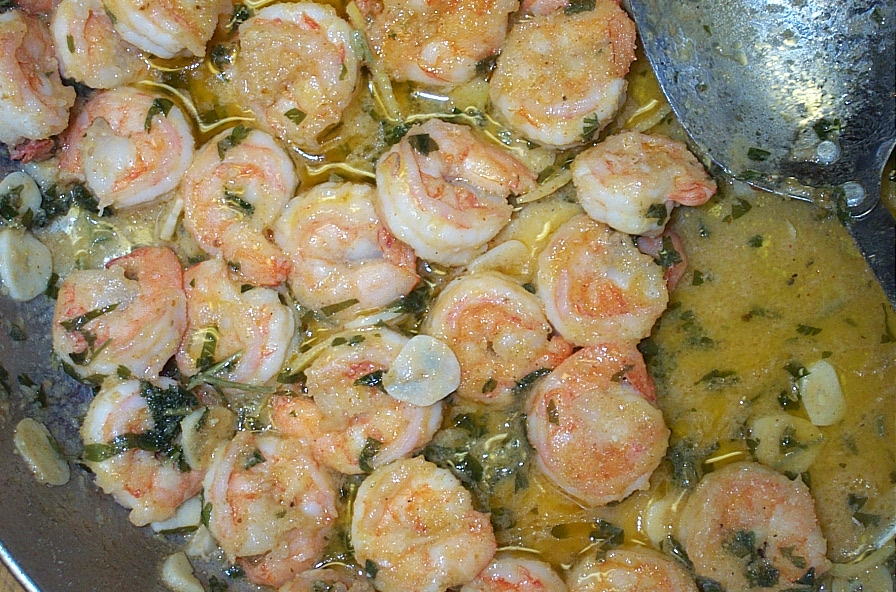
Shrimp Scampi is no different. Ironically, the name is a redundancy because scampi means shrimp, so we’re really saying Shrimp Shrimp. That fits, though, because it implies an abundance, and the number of different types  of recipes that exist for scampi is quite abundant. Do you want prefer olive oil or butter? Do you like only garlic or garlic and onions? Do you want a thick sauce to coat the shrimp or a thinner sauce to run over noodles? Do you even want noodles or do you prefer scampi plain or with rice? Do you coat the scampi with bread crumbs? Do you want to season it with basil or thyme or something completely different? Do you like a lemony sauce or more of a white wine taste or a balance? However you answered each of these questions, I guarantee you, you’ll find a recipe to match your palate.

I have a simple recipe I use which you can vary to your hearts content….

Shrimp Scampi

Ingredients:

  • Shrimp, 12 to 16 ounces (Decide whether you want to use raw shrimp or cooked shrimp. Raw means you usually have to peel and devein the shrimp. If you have cooked shrimp you can usually just throw them into the sauce at the end. Either way, about 12 to 16 ounces of shrimp is usually a good amount for dinner for four with leftovers.  If you use raw shrimp, you’ll simmer the shrimp midway through the recipe. If you use cooked, you’ll just add the shrimp at the end.)
  • Olive oil or butter, 2 tsp (Do you prefer a buttery sauce or an olive oil sauce? I usually use a combination where I saute with olive oil in the beginning and then add vegan butter at the end.)
  • Aromatics: Garlic Cloves, thinly sliced – 1/4 to 1/2 cup; Onions, diced, 2 tbsp to 1/4 cup (Think about the taste you’re going for: Do you want a deeper, mellow garlic flavor in which case you should roast the garlic before preparing your scampi.  Or do you want more of a garlic bite which means you should saute fresh garlic as you begin preparing the scampi. Do want just a garlic taste or do you  like onions, too. How much of one or the other or both flavors do you want? Vary the combination and amounts to match your tastes.)
  • Flavorings: White wine or chicken broth or a “shrimp” sauce, 1 cup (What is your taste preference? Some folks like a wine sauce; others prefer just to use broth. Many folks want the broth to taste “shrimpy”, in which case you should use raw shrimp and simmer the shrimp in wine or broth to flavor it.)
  • Seasoning: Basil, thyme, oregano? 1 tsp dried or sprigs of fresh; red pepper, black pepper? 1/4 to 1/2 tsp (What do you like for seasonings? If you prefer one over another, choose that. If you use dried, you should begin the scampi with the dried herbs. If you use fresh, don’t add the herbs until midway. Do you like the bite of red and black pepper? How much? Vary the additions and amounts to your liking.)
  • Lemon juice, 2 tbsp to 1/4 cup (Do you like a lemony sauce? if so, how lemony? Vary the amount to your liking or omit altogether.)
  • Cornstarch, 2 tsp (If you want a thicker sauce, you should mix 2 tsp of cornstarch with the lemon juice or if you’re omitting lemon juice, with the same amount of water.  If you like the sauce to be more of a liquid, then omit the cornstarch and simply cook down the sauce until it’s reduced.)
  • Vegan Butter, 1 to 2 tbsp (If you want a buttery sauce, you can add butter at the end. Many recipes will call for 1/4 cup or more of butter. I find that one to two tablespoons is more than sufficient.)

Cooking Instructions:

  1. Prepare shrimp if raw by peeling and deveining. If using cooked shrimp, make sure it’s defrosted and tails are removed.
  2. Put olive oil or vegan butter into a large pan, along with the chosen aromatics (garlic, onions or both) and seasonings if they are dry (basil or thyme or oregano). Saute over medium low heat for one to two minutes if the garlic is roasted and if onions are frozen, two to three minutes if using fresh garlic and onions, stirring continually.
  3. Add the flavoring (white wine or broth). If using raw shrimp, add the shrimp and cover the pan. If using already cooked shrimp, simply simmer the liquid. Either way, you’ll simmer for about five minutes. If using fresh herbs, add them now to the simmering sauce. If using raw shrimp, remove the now cooked shrimp from the liquid before proceeding with the next step.
  4. Mix the lemon juice, cornstarch, red pepper and black pepper and add to the liquid. Stirring continually, cook until the sauce begins to thicken. This will only take about a minute or two. If you’re going for a buttery sauce, as soon as the sauce thickens, add the pat of vegan butter and stir until it dissolves.
  5. Add the cooked shrimp to the sauce and coat them well.
  6. Serve the scampi over broccoli, rice, or pasta, or serve it as is.


Cooking Inspiration: Korean Scallion (Green Onion) Pancakes

“You want to eat pancakes, not Buddha.”

According to my parents, when my brother and I were little, we would mix up the Korean words for Buddha and pancakes. To be fair to us, the words are extremely close — buchini (boo-chin-nee) versus buchimi (boo-chim-mee) — and for Korean celebrations such as a 100 days birthday or New Year’s, the tradition is to make pancakes, some of which you place before a statue of Buddha with the hopes of bringing good luck. and the rest of which you eat.

As a grown-up in the United States, I don’t make pancakes for Buddha, but my daughters and I really enjoy eating Korean Scallion (green onion) pancakes. They’re usually made with mung beans which is similar to a yellow split pea, and sometimes people actually use yellow split peas instead. Fortunately for me, I can find mung beans at my local grocery store and don’t even need to go to an Asian store to find some.

As I thought about this new year — 2016 — I remembered a conversation I had with a friend who was in turn remembering meals his wife had made him during their first year of marriage. His comment was that over the years, their meal plan had become a rut, and he missed the different experimental dishes she made that first year.

Often, that’s exactly what happens to families. Busy schedules, finicky children’s palates, frugal living, and lack of inspiration can all lead to meals being the same week after week, and when a friend emailed me yesterday asking about something to serve which was different, I thought about Korean Scallion Pancakes. What I like about them is that they’re fairly easy to make, are made with protein (beans), that you can make them with vegetables, and they’re tasty.

What’s important to know is that the mung beans need to soften, so you do need to give them time to sit in water. A couple of hours is normally fine. I often soak them in the morning and just let them sit until when I need them in the evening. You simply put enough water to cover the beans and then add water as needed.

The other thing to know is that you don’t want to skimp on the green onions. A mung bean batter is simply there to hold all the wonderful, tasty green onions, and if you choose to add them, other vegetables. I usually make mine with green onions and thinly sliced sweet white onion. Sometimes, I also add thinly sliced carrots and red pepper. My mom makes hers with Korean kimchee, which is basically hot, fermented cabbage or spinach or any other type of vegetable she’s chosen to make kimchee out of.

Another consideration is that you do need to bind the beans to keep them from being too grainy. Recipes online will often call for you to mix the mung beans with some rice and soak the two together. I’ve found it’s easier to just mix in rice flour after the beans soak. At the stores, you can find white rice flour, brown rice flour, and sweet rice flour. My mom prefers the sweet rice flour, and that’s how I’ve always made them over the years.

A final thought is that there are two ways to make the pancakes when you cook them. After you’ve pureed the mung beans and added the rice flour and seasonings, you have to choose how you want to make the pancakes. My mom’s preferred method is to ladle some of the mung bean batter onto the pan, artistically arrange the green onions, onions and vegetables onto the batter, and then add a little bit more of the mung bean batter on top of the vegetables. This is very pretty, but takes time. Because I’m often in a hurry, wanting to make a lot and get them onto the table for dinner, I choose to mix all the green onions, onions, and vegetables directly into the mung bean batter and then ladle the batter and cook the pancakes. The pancakes aren’t as beautiful but they’re still tasty, and this way fits my more time-pressured schedule.

So, if you’re looking for something new and different to try in this new year, I have a recipe below. No quantities, because it all depends on how much you want to make, but if you purchase an 8 ounce bag of mung beans and let them soak, you’ll make enough pancakes for a family of four.

Happy New Year!

Korean Scallion Mung Bean Pancakes

Ingredients:

Yellow Split Mung beans

Water

Salt

Black pepper

Sesame oil

fresh ground ginger (optional)

Fish powder (optional)

Sweet rice flour

Green onions (chopped into longer pieces, about 2 inches — you want a lot!)

Sweet white onions (chopped into thin, long pieces, about 2 inches)

Vegetables (optional: very thinly sliced – carrots, peppers, etc…)

Cooking Instructions:

  1. Cover mung beans with water and let it sit for several hours during the day or overnight. Check the beans occasionally, and add water as needed. You want the beans to become soft enough to puree. You’ll see that the beans are absorbing the water and swelling and becoming softer.
  2. Use a food processor or blender to puree the mung beans with some sweet rice flour to make a smooth, slightly thick batter. You don’t want the batter to be too think but neither do you want it to be too thick. You can add more water as needed to think the batter or more rice flour to thicken it.
  3. Season the batter with salt and pepper, a small amount of sesame oil, and ginger and/or fish powder (if you choose). The flavor for the pancakes comes from the green onions and the mung beans themselves, so you don’t want to add a lot of the seasonings.
  4. Slice lots of green onions and mix into the batter with slices of sweet white onions and other vegetables if you choose.
  5. Over medium high heat, in a pan seasoned with sesame oil, pour batter into round pancake shapes. Cook on one side until browned and crispy, and then turn over and cook the second side. Serve with soy sauce.

Holiday Traditions: Allergy Friendly “Sugar Cookies”

website sugar cookies

“Well, they have to be the same….”

When you marry into a family who makes literally the best sugar cookies you’ll ever eat in your life, you must tread carefully about trying to revamp the recipe to be allergy friendly.

“Honey, I was thinking….”

“Yes.”

“Well, I’d really like to be able to have some sugar cookies this year… I think I could revamp the recipe to be dairy and gluten free….”

“No.”

“But what if they tasted the same?”

“Not possible.”

“Well… I think it could be possible….” I give my husband my most pleading, puppy-dog sweet face, and add… “If they don’t taste just like your family’s recipe, I’ll make another batch the “right” way.”

“Well, okay, I guess you could try….”

In the end, I only made one batch of sugar cookies because my husband and my children declared my recipe to be a success, which was good because we spent many hours baking very large batches of three different type of allergy friendly cookies this weekend, and I didn’t want to have to make any more!

So below are some hints for cut-out cookies which I’ve shared previously and my revised recipe for rolled, cut-out sugar cookies. (We’ll keep the original a family secret… *grin*)

Tips for Making Rolled, Cut-out Cookies

1.  Use wax paper to roll out the dough.  Simply cut a sheet that overlaps around a large cutting board or piece of cardboard and tape it down.  Then when you sprinkle your flour over the wax paper, your dough won’t stick to the board.

2.  Use sifter to put flour onto your cutting board and rolling pin.  If you sprinkle it on with your fingers, you’re more likely to clump the flour in places which then get stuck to your cookie dough.

3.  Use a long, thin metal spatula to periodically release your dough from the board while you’re rolling it, and before you use your cookie cutters, be sure to go completely under the entire rolled out piece of dough so that your cookies won’t stick to the board when you’re cutting the shapes.

4.  Invest in some smaller cookie shapes which you can use to cut little cookies from the dough left after you cut out the big cookie shapes.  This cuts down on the amount of dough you need to re-roll.  Put one cookie sheet aside specifically for the little cookies, which you fill up as you go along and then bake at the end.

5.  Make sure your dough for rolling is very cold and firm.  Most recipes will tell you to chill for an hour, but in reality you’re better off planning ahead and chilling your dough for several hours or overnight.  When you’re making the cookies, be sure to put the dough back into the fridge in between scooping out new dough to roll.

6.  Put all your re-roll dough into a small bowl which you then put into the freezer while you’re finishing up the regular dough.  This will make the dough firm enough for you to re-roll immediately as opposed to having to wait for it to firm back up again.

7.  Make your own colored sugars.  Put 1/4 cup of sugar into a bowl and add two to four drops of food coloring.  Carefully work the color into the sugar, using the back of a spoon to continualy “spread” the color completely into the sugar.  You can store extra, leftover sugar in a sandwich baggie for a very long time!

8.  Use parchment paper to line your cookie sheets.  Your cookies will never stick. You won’t have to clean the cookie sheets.  And you won’t have to worry about cross-contamination of your cookies.  I usually use the If You Care brand.  The parchment sheets can also be re-used over and over again on one cookie sheet.

9.  Be sure to completely cool your cookie sheets before putting new cookie dough shapes onto them.  I usually pop my cookie sheets into the freezer for a minute or two after removing the cookies.  Works like a charm.

10.  Invest in metal cookie cutters which you can use year after year. When you’re cutting out the shapes, put a pan of flour in the center which you can dip the cutters into so the cutters won’t stick to your dough.

11.  When you’re done with your cookie cutters, fill the sink with hot, soapy water and just let them sit for a while.  You’ll be able to simply rinse them off without having to try to “clean” the crevices.  Then pop them (as long as they’re metal) onto one of your cookie sheets and place the cookie sheet in the oven which is turned off and cooling down.  The residual heat will evaporate all the water, and your cutters will be sterilized and ready for next year’s use.

Allergy Friendly Rolled, Cut-Out Sugar Cookies

(This makes a lot of cookies; if you want less,

cut the recipe into thirds)

Ingredients:

3 cups sugar (This is the only time I ever use sugar because a sugar cookie just has to have sugar!)

2 cups Tofutti sour cream

2 cups Earth Balance soy free vegan butter

3 eggs, room temperature

1 tbsp ground nutmeg

6 Gluten Free Flour Blend (you’ll need just enough flour to make a soft dough – I used 6 cups of Authentic Foods brown rice gluten free blend)

Baking Instructions:  (The dough needs to chill so make the dough up the night before or several hours ahead of when you want to bake the cookies.)

1.  Mix the sugar with the sour cream and butter until well blended.

2.  Add the eggs, one at a time, and blend well.  Add the nutmeg.

3.  Add in the gluten free flour, a cup at a time, only as much as you need to make a soft dough.  Blend well.

4.  Cover the dough tightly with plastic wrap and chill overnight, or at least for several hours.

5.  Preheat the oven to 350 degrees.  Line cookie sheets with parchment paper.

6.  Line a board with wax paper.  Sprinkle the board and a rolling pin with flour of your choice (I used brown rice flour), and roll out small amounts of dough to a very thin thickness – thin enough to make a crispy cookie but not so thin that you can’t actually move the cut out dough to the cookie sheet.

7.  Cut out shapes with cookie cutters and place on the prepared cookie sheets.  The cookies will not spread a lot so you can put them fairly close together.

8.  Decorate the cookies with colored sugar and/or currants. (You can also just bake the cookies and then decorate them with icing when they’re cooled.)

9.  Bake in the preheated oven for 8 to 12 minutes.  Start with 8 minutes and then go up by 1 minute increments. (It really depends on how thin you are able to roll them in terms of how long the baking time needs to be.)  The cookies should be dry, crisp and slightly puffed.

10.  Let the cookies cool for a minute on the cookie sheet, and then move the cookies to a wire cooling rack and cool them completely. Once cooled, they’ll be nice and crispy sugar cookies.  If you eat them while they’re warm, they’ll be chewier.

11.  When the cookie are completely cooled, store them in a tightly covered container.  They’ll last for a few weeks, though after a couple of weeks, they’ll get a bit softer.


Holiday Traditions: Allergy Friendly “Fruitcake”

“How many fruitcakes does it take to hammer in a nail?”

You’ve probably heard all the fruitcake jokes which tend to make their round this time of year…. I personally think we should be applauding the folks who invented fruitcake, because it’s a rather ingenious cake. In a time when there is no refrigeration, people figured out how to use dried and candied fruits and nuts and alcohol to create a longer-lasting festive dessert.

While there does seem to be a lot of folks who won’t even try fruitcake, a substantial number of people do actually enjoy and make fruitcakes as part of their holiday tradition. An older gentleman emailed me a couple of weeks ago because he’s now gluten sensitive, and his wife told him he couldn’t have fruitcake anymore. He wanted to know if I could help….

Fortunately for him, I like fruitcake. I even like the versions with the traditional candied lemon and orange peels, cherries and citron. Fruitcake, however, doesn’t have to include these. I often make a fruitcake with just dried fruit like apricots, prunes, dates, and currants. What’s lovely about fruitcake is that you can do just about anything you want.

Some things to keep in mind:

The Batter:

Traditional fruitcake is basically a butter cake recipe. You can choose between a light cake recipe or a dark cake. Light means you’re using “light” sweeteners like white sugar, honey and/or corn syrup and usually lighter dried fruits and nuts (macadamia nuts, apricots, etc…); dark usually uses sweeteners like brown sugar and molasses and darker dried fruit and nuts (walnuts, pecans, currants, etc…).

Since I try to avoid refined sugars a much as possible, I tend to use a combination of coconut sugar, Agave, and date molasses because I can use much less than the sugar amounts normally called for in fruitcake. This means my fruitcake tends to be a “darker” recipe. I also cut the quantity of butter because traditional butter cake recipes use a lot of butter. And of course, because of my dairy allergies I’m really using a vegan “butter” instead of cow’s milk butter.

Fruitcake recipes also call for a lot of eggs. One, because fruitcake is really a lot of fruit and nuts with just enough batter to hold it together, so eggs are very necessary to the binding and baking process. Two, fruitcake is normally made in large quantities which requires a lot of eggs. To minimize the cholesterol, I use half egg whites and half whole eggs. You can use all egg whites but it will make for a drier fruitcake.

Whatever you decide to do for a batter, make it to your liking. Since I like spice cakes, I make my fruitcakes with spices like cardamom, cinnamon and nutmeg. If you like more of a yellow cake, use vanilla. If you like fruit, use orange or lemon peel.

The Dried Fruit and Nuts:

Traditional fruitcake has candied peels, cherries, and citron with nuts like walnuts and pecans. If you don’t like those, you don’t have to use them. You can use any type of dried fruit you prefer and any type of nuts you prefer. I omit nuts because I’m allergic to them. For the fruits I use a combination of the traditional and the non-traditional. Dates, dried plums, apricots, and currants are my favorite dried fruits to mix with the candied peels, cherries and citron.

A tip: I have found that what most people don’t like about fruitcake is that the fruit and nuts are too large. I use a food processor to chop everything into tiny pieces so they’re evenly distributed throughout the cake to give flavor without the chunkiness. Paradise also makes an Old English Fruit and Peel mix which has everything already chopped into tiny pieces.

The Alcohol:

Alcohol was traditionally used in fruitcake to keep the cake from getting moldy and stale in addition to adding flavor and moistness. The most common alcohol for fruitcake is either rum or brandy. Recipes vary as to how the alcohol is used. Some will tell you to soak the dried fruits and nuts in alcohol. Most, however, soak the cake in alcohol after it’s been baked. Many recipes do a combination of the two. Others simply put alcohol in the cake batter.

The main difference between which versions you choose is exactly how much of the “boozy” taste you want. Alcohol cooked into the batter will not be as strong as if you soak the fruits and nuts and/or the entire cake in alcohol. Another difference is time. Soaking fruits and nuts usually takes some hours before you can make up the fruitcake. Soaking the entire cake usually requires days.

I don’t use alcohol in my fruitcake recipes. One, I don’t particularly care for rum or brandy. Two, I don’t have the patience to wait for anything to soak. Three, we have refrigeration which keeps my fruitcake from getting moldy and stale. Instead I like to use unsweetened orange use or apple cider. Makes for tasty cakes without the alcohol.

The Baking:

Fruitcake needs to cook at a lower temperature to prevent the cake from becoming too dry, so usually it requires several hours to bake. I cut the time by baking my fruitcake in smaller mini-loaf pans or only filling regular size pans half full. Then instead of a couple of hours, the cakes cook in about one hour which fits with my schedule much better.

Cooking in the mini pans also means they’re a good size for gifting. I make a lovely chocolate fruitcake which I have given to neighbors for the holidays for years and which they actually really enjoy and look forward to each year. What’s nice about fruitcakes is that they store well if you wrap them well in plastic wrap and then aluminum foil.

Many recipes will tell you to cook the fruitcake at 250 or 275 degrees. I find that 300 degrees work just as well, allowing the cook time to be slightly less. If, however, you do choose to make a large fruitcake in a bundt or tube pan, you should opt for the lower temperatures to ensure even cooking throughout.

A Recipe:

My favorite fruitcake recipe is the chocolate fruitcake I mentioned above. I use a combination of two gluten free flour blends – one which is a lighter brown rice flour blend like King Arthur’s; the other a more high fiber/high protein blend like Bob Red Mill’s garbanzo bean blend. I use unsweetened cocoa powder and add allergy friendly chocolate chips to the dried fruit blend. If I use the candied peels and citron, I usually just add dried dates and plums. If I opt to use only dried fruit, I like to combine dried dates, plums, apricots, currants, and unsweetened coconut. Both versions make for tasty fruitcakes.

Allergy Friendly Chocolate Fruit Cake

(This recipe makes 12 mini 4 x 8 loaves)

Ingredients:

7 cups favorite dried fruits, nuts, and/or candied peels, cherries and/or citron, chopped into tiny pieces

1 cup Enjoy Life miniature chocolate chips

1 1/2 cup vegan olive oil “butter”, melted

2 cups coconut sugar

1/4 cup date molasses

3/4 cup Agave

1 cup unsweetened orange juice

1 cup liquid egg whites

4 eggs

2 cups high protein/high fiber gluten free flour blend (like Bob Red Mill’s garbanzo bean flour)

2 cups brown rice flour blend (like King Arthur)

1 cup gluten free oat flour

1 tsp cardamom

1 tsp cinnamon

1/2 tsp nutmeg

1/2 cup unsweetened cocoa powder

2 tsp baking powder

2 tsp baking soda

1 tsp salt

2 tbsp apple cider vinegar

Baking Instructions:

  1. Preheat the oven to 300 degrees. Arrange your oven racks so they are evenly spaced so you can cook on both racks at teh same time. Line 12 mini loaf pans with parchment paper so the paper hangs over the side like wings. This will make it easier to pull the cake out of the pans. Arrange the pans on two cookie sheets so they have some space around each pan for air to circulate.
  2. Mix the dried fruit, nuts, and/or candied peels and fruit with the chocolate chips. Set aside
  3. Mix the melted butter with the coconut sugar, date molasses, agave, orange juice, egg whites, and eggs. Set aside.
  4. Combine the two gluten free flour blends with the oat flour, cardamom, cinnamon, nutmeg, cocoa powder, baking powder, baking soda, and salt.
  5. Stir the wet ingredients well before adding the dried fruit mixture to it. Carefully add the dry ingredients, along with the apple cider vinegar.
  6. Mix the batter well until all the dry ingredients are thoroughly moistened.
  7. Divide the batter evenly among the 12 loaf pans. The pans will be only 2/3 full. (If you’d like to make these in larger 9 x 5 pans, fill the loaf pans only half full.)
  8. Bake the loaves for about 30 minutes and then switch the cookie sheets between the two racks for even cooking of both trays of mini-loaves. Bake for another 20-30 minutes until the fruitcakes are puffed, pulling from the sides, and a toothpick inserted into the center comes out clean.
  9. Remove the cookie sheets from the oven and put the mini loaf pans onto a wire cooling rack. Cool for 10 minutes, and then carefully remove the cakes by lifting the parchment paper wings. Cool the cakes completely on the wire racks.
  10. To store the cakes, wrap them tightly in plastic wrap and then in foil. They store in the fridge for about a week or you can double wrap them with foil and freeze them for a couple of months.


Holiday Traditions: Allergy Friendly “Stollen”

Yay! It’s Advent….

My son has been counting down to Advent since mid-October. Because we have a tradition of taking time as a family every evening of Advent to read one of the many books we’ve collected over the years, sing a song, and pray, Advent is one of his most favorite times of the year. And with our oldest at college these past two Christmas seasons, it’s meant he gets more turns in the rotation to pick books and songs….

As with my son, the traditions people have are one of the many reasons they look forward to the holidays, and it can be disappointing if a tradition can no longer be held.

I received an email this week from someone whose family always makes stollen for Christmas. Stollen is a traditional German fruit bread. Original stollen is a dry, not sweet yeast bread. Versions one finds in the stores these days tend to be much sweeter, drenched in butter and sugar.

This particular woman has developed sensitivities to wheat and yeast and was wondering if there was a way to make something similar to the stollen of her family traditions. The challenge was to keep the dry texture without being a yeast bread and to make something with no sweetener other than the dried fruit. In the end I created something which had a similar texture to stollen though not the shape.

For the flours, I blended garbanzo bean, sorghum, coconut, and arrowroot. This created the drier, crumbly texture we wanted. For the dried fruit, I opted for dates and raisins because they are always easy to find in the stores. To keep the cake from becoming too dense because of the lack of sugar, I made a “buttermilk” using soy milk and lemon juice and used eggs. Then I added spices – cinnamon, ginger, nutmeg and cloves – for flavor. I decided not to top the cake with butter and powdered sugar in favor of making a healthier, no sugar topping, but others can feel free to shake powdered sugar on top instead.

When I served the new creation to tasters, the folks who have had traditional stollen declared it to be similar in taste and texture, so I’m going to call it a success.

For folks who may not eat stollen regularly, this is definitely a dry, not sweet cake. So, don’t make it if you want something dense, moist and sweet. It does go very well with coffee if you drink yours with cream and sugar. I like eating it just as it is.

“Stollen”

Ingredients:

8 oz pitted whole dates

1 cup raisins

1 teaspoon baking soda

1 cup boiling water

3 cups of the gluten free flour blend (see below)

1 tsp cinnamon

1/2 tsp ground ginger

1/2 tsp ground nutmeg

1/4 tsp ground cloves

1/2 tsp salt

1 tsp baking powder

1/2 cup  soy milk with 1/2 tbsp lemon juice (can substitute any type of “milk”)

2 eggs

3 tbsp safflower oil

1 tsp vanilla

1 cup soy milk

2 5-6 inch bananas

1/2 tsp cinnamon

2 tbsp garbanzo bean flour

2 tbsp coconut flour


Flour Blend:

1 1/2 cup garbanzo bean flour

1 1/2 cup sorghum flour

1 cup arrowroot starch

1/2 cup coconut flour


Baking Instructions:

  1. Preheat the oven to 350 degrees. Line two 9 inch round cake pans with parchment paper.
  2. Mix the dates and raisins with the baking soda. Chop them up in a food processor to make small pieces which will evenly disperse throughout the stollen.
  3. Pour the boiling water over the dried fruit, and set it aside.
  4. Mix the garbanzo bean flour, sorghum flour, arrowroot starch, coconut flour, cinnamon, ginger, nutmeg, cloves, salt, and baking powder.  Set aside.
  5. Blend the milk with lemon juice with the eggs, safflower oil, and vanilla.
  6. Combine the dried fruit, dry ingredients, and wet ingredients until everything is moistened and well blended together.
  7. Divide the batter evenly between the two cake pans, and bake for 25-30 minutes until the cakes are puffed, golden, pulling away from the sides of the pan, and a toothpick inserted in the center comes out clean. (Depending on your stove, you may want to set the timer for 20 minutes and keep checking.)
  8. When the cakes are done, cool for about five minutes in the pans, and then removed them to a wire cooling rack to cool completely.
  9. In a food processor or blender, puree the bananas with the milk. Stir in the cinnamon, garbanzo bean flour and coconut flour. (The 4 tbsp of flour makes for a thick, spreadable topping. If you want a thinner, runnier “sauce”, reduce each of the flours by half.)
  10. Over a double boiler (I use a make-shift one by fitting one pan into a second one) heat the milk mixture, stirring constantly, until it begins to thicken. Spread over the cakes and enjoy. (If you don’t want the topping, just shift powdered sugar over the tops of the cakes while they are still warm. This will make for sweet version of the stollen.)