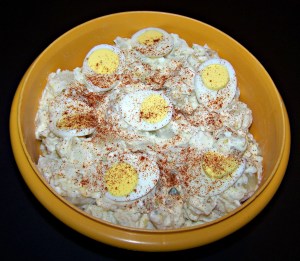
Cooking Techniques: Potato Salad

website potato salad

“I’m turning into you!”

A couple of weeks ago, my oldest was home from college, so I asked her to help me at a concert my middle child was performing in. At the end of the concert she came to me in the concession kitchen and said, “I’m turning into you! I just did a sweep of the auditorium, cleaning up everyone else’s trash, and now I’m behind the counter serving cake to everyone!”

A parent who overheard my daughter’s remarks, commented on what she had said, and it sparked a conversation among a few parents about the types of folks who helped behind the scenes. At one point, someone said, “No one thinks much about the custodian until he’s out sick, and the trash isn’t emptied.”

I was reminded of that comment this weekend as I prepared food for a cookout we were going to have. I had asked my middle child what she thought I should make to go with the burgers, hot dogs and chicken, and she replied, “Potato salad.” Her answer surprised me because she doesn’t like potato salad.

When I questioned her about her reply, she said, “It’s a barbecue. If you don’t have potato salad, people will ask where it is.” As I thought about what she said, I realized, she was right. No one has ever asked me to actually make potato salad, but there have definitely been plenty of times when I’ve had a barbecue without potato salad where someone has said something like, “Oh, no potato salad, huh?”

It may be because people are just used to potato salad being at barbecues. It may be because potatoes have always been a tasty complement to meat, which is what usually serves as the main course at barbecues. Whatever the reason, potato salad is the humble dish, which like the sick custodian is usually only noticed if it’s missing.

Potato salad, however, is a dish which folks should consider with more thought. Potatoes are high in fiber if you eat the skin, have nutrients like potassium and vitamin C, and are a good source of complex carbs. Potato salad in particular is nice because it can be inexpensively made, easily stretched to feed a crowd, and can be made in a variety of ways to suit different tastes. Potato salad is also very allergy friendly because unless you’re allergic to potatoes, how you choose to dress it and what additions you add can easily be done around any food allergies you might have.

Potato Salad Tips:

1. Type of potato: The choices abound for potato salad. Traditionally, potatoes are categorized as starchy (think Idaho potatoes), waxy (think red potatoes) or all-purpose (think Yukon-Gold potatoes). Starchy potatoes fall apart easily, so if you prefer a creamier, more mashed type of potato salad, these work best. Waxy potatoes hold their shape well, so if you prefer a firmer potato salad with squares of potato to bite into, you’ll want to use these. If you’re looking for something in between, all purpose potatoes are just the thing. You can also mix different types of potatoes which is what I do, because the starchier potatoes form a creamy base for the firmer waxy potatoes which provide something to bite into.

2. Potato cooking method: There are basically three ways to cook potatoes for potato salad – boiling, baking or high heat roasting. If you prefer your potatoes to be a little wetter, boil them. If you want them to be fluffier, bake them. If you want a concentrated potato flavor, roast them.

If you want your potatoes to have a firmer texture while boiling, mix the water with vinegar, about 2 tbsp for every 2 cups of water you’re using. If you bake the potatoes, you can choose whether you want to scoop the insides out of the skin or make the potato salad with the skin. If you roast the potatoes, the crunchy skin adds a nice complexity to the potato salad.

3. Additions to potato salad: Anything goes with potatoes. You can add vegetables of any type – celery, zucchini, carrots, cucumbers, tomatoes…. You can add meat – sausage, bacon, chicken, eggs…. You can add fruit – apples, pears, mangos…. You can add cheese. The only limit is your imagination. Experiment and see what you prefer taste-wise.

4. Seasonings: Potatoes are versatile. You can flavor them as you’d like. Dill, oregano, thyme, rosemary are more traditional. Cumin or coriander or turmeric add a new and different taste. Paprika and black pepper and parsley and dry mustard are always good favorites. As with the additions, experiment and see what your taste buds like. Adding leeks or chives or garlic punches up the flavor. Sticking with just salt and pepper allows more of the potato to come through. Adding something like a zucchini relish adds a twist to the flavor. What’s great is that you can choose.

5. Dressing: Dressing the potato salad is always fun. You can make a creamy dressing which usually utilizes ingredients like mayonnaise or yogurt or cream cheese or creamy salad dressings or sour cream. You can also make a vinaigrette dressing which uses plant-based oils like olive oil or safflower oil mixed with vinegars like red wine or apple cider or white. Sometimes I like to simply add fresh lemon juice to slightly mashed potato salad, and it’s quite lovely.

Dressings can be tangy or sweet or zesty or mild. You choose and change it up as you want. What’s important is to mix your dressing with the potatoes while they’re still slightly warm so the flavors will meld with the potatoes while the potato salad is cooling in the fridge. If you making a creamy dressing with yogurt or mayo, let the potatoes cool slightly longer so the dressing doesn’t melt and separate.

6. Garnishes: When you’re ready to serve your potato salad, it’s always nice to add a little something because the flavors, though, they meld in the fridge, do tend to flatten out a bit. So, give your potato salad a good mixing after you remove it from the fridge, and add a little something to freshen the flavor, whether it’s a little bit of mint or chopped up pieces of bacon or a little more dressing or a drizzle of fresh lemon juice. And then enjoy!


Spice Suggestion: Ginger

“You’re a gook.”

A recent event brought back some memories of my youth….

Growing up in the 70’s was not the best time to be Asian. It would be many years before I’d be old enough to understand the politics of Vietnam and the generalizing that strengthened the animosity aimed at me; so I remember being confused as to why people kept calling me a vulgar name for being Vietnamese when I was Korean.

As I grew up, I rebelled not only against the prejudice in general but the idea that there weren’t any differences among the various Asian ethnicities.

In some ways, I feel the same today about the spice, ginger. Too often when I mention using ginger, people will say something like, “Oh, it makes sense that you’d like ginger, being Asian and all.”

And when they do, that rebellious feeling sweeps over me again, and I find myself wanting to argue against the notion that ginger is somehow the spice of Asians and should only be relegated to Asian foods….

From medicinal to cooking uses, ginger has been a staple of Greek, Middle Eastern, and European countries for as many centuries as Asian countries. Even in the United States people have used ginger without considering it an “Asian” spice. Colonial recipes for gingersnaps and gingerbread and ginger teas and ginger ales abound as well as records of its use as medicine for upset stomachs.

Admittedly, ginger can be strong, so sometimes folks who are used to bland foods might find it a bit much, but a little can add an abundance of flavor.

In this day and age, ginger comes in a variety of types: fresh, dried, candied, crystallized, freeze dried, pickled, as a paste, and grated in a tube or container for the refrigerator. Fresh ginger obviously is the strongest in terms of flavor, but the convenience of the options with a longer shelf life is not to be underestimated.

If you’re using fresh ginger, you want look for ginger root with a nice, tan color which is firm to the touch and has smooth ends. If it looks dried out or moldy or is soft to the touch, don’t buy it. To use, simply peel and chop as desired. Ginger keeps for a good few weeks in the fridge, and you can even freeze it for several months.

Obviously the more you use, the stronger the ginger flavor, and fresh ginger will have a stronger taste than the other varieties. Ginger is like garlic and onions, and the more ginger cooks, the mellower its flavor becomes, so if you prefer the spicy, pungent taste, add the ginger near the end.

Some ways to use ginger:

1. Homemade ginger tea: The way my mom makes it is to put some fresh ginger root and cinnamon sticks into a pot of water and just let it simmer and steep for a while. Add a little bit of honey, and it’s quite delicious plus has added health benefits.

2. Vegetables: Grated fresh ginger root or ground ginger adds a bit of zest to sauteed vegetables.

3. Omelettes and Egg dishes: Make a paste of ginger and garlic to add a little zing which is quite tasty.

4. Baked goods: Add dried ginger or chopped crystallized ginger to muffins, pancakes, scones, waffles, cakes, cookies, pies, for a new taste.

5. Meats, chicken and fish: Add grated or chopped fresh or freeze dried ginger or ground ginger to any entree to add another flavor dimension to the dish.

6. Soups and dressings: Ginger adds a nice tang to soups and homemade dressings, whether for salad or entrees.

On this site there are already recipes for ginger snaps and a ginger cake and gingerbread, but I’ll add another couple below for a ginger cheesecake which is creamy and spicy and yummy and pumpkin custard squares which my kids love and which are great when you don’t want to take the time to make a pumpkin pie. Both recipes are dairy, gluten, nut and mostly refined sugar free.

Pumpkin Custard Squares

1. Preheat the oven to 350 degrees. Grease an 8.5 x 11 pan with your preferred method.

2.  In a large bowl, mix 1 can of pumpkin with 2 eggs, 1/2 cup agave, 2 tbsp melted butter, 1 cup soy or flax milk, 1 cup water, 2 tsp cinnamon, 1 to 2 tsp ground ginger (if you love ginger, use the higher amount; if not use the smaller amount), 1/2 tsp nutmeg, 1/2 tsp salt, and 1/4 tsp ground cloves.

3. Mix in 3/4 cup Gluten Free Bisquick until the batter is smooth and creamy with no lumps.

4. Pour into prepared pan and bake for 50-55 minutes. The custard will be stiff and dry on top and the custard will be slightly puffed.

5. Cool completely on a wire cooling rack. Cut into squares and serve.

Ginger Spice Cheesecake

(Be sure ALL ingredients are at room temperature for best results!)

1. Preheat the oven to 350 degrees.  Grease a 10 inch springform pan with your preferred method.

2. In a food processor pulse one 8 ounce box of gluten, nut and dairy free gingersnaps until you have crumbs. Mix well with 1/4 cup melted vegan butter. Spread evenly onto the bottom of the prepared springform pan and bake for 10 minutes. Remove from the oven and cool on a wire cooling rack. Decrease the oven temperature to 325 degrees.

3. When cool, carefully cover the outside of the springform pan with aluminum foil and put the pan into a larger pan. Begin to boil some water, enough to fill the pan at least halfway up the springform pan but no more than 3/4 way up (this you’ll do after you put the cheesecake batter into the springform pan).

4. In a mixer, cream four 8 ounce room temperature Tofutti cream cheese packages until smooth and creamy. Use a rubber spatula to scrape the cream cheese down from the sides.

5. Slowly drizzle in 1/2 cup Agave while mixing the cream cheese on low.  Once incorporated slowly mix in one 12 ounce package Tofutti sour cream.

6. Blend in 1/2 cup liquid egg whites. Then 2 whole eggs, being careful to mix them in one at a time.

7. Mix in 1/4 tsp salt, 1/2 tsp nutmeg, 1 tsp cinnamon, and 1 to 2 tsp ground ginger (choose the amount based up on your preference for mild or strong ginger taste).

8. In a food processor chop up crystallized or candied ginger so you have at least 2 tbsp (you can use more if you want). Add to the cheesecake mixture and blend only until the ginger is incorporated.

9. Carefully pour the cheesecake batter into the springform pan. Place the larger pan with the springform pan into the oven. Very carefully pour the boiling water in the larger pan until it’s at lease halfway up the springform pan. You can go as high as 3/4 way up.

10. Bake for one hour and 30 minutes. When done, the cheesecake will be firmer around the edges, the batter won’t be jiggly, and the cheesecake will be slightly puffed.

11. Remove the cheesecake from the oven and from the larger pan. Remove the aluminum foil, and cool for 15 to 30 minutes on a wire cooling rack. Run a knife around the edge of the springform pan and remove the outer side of the pan.

12. Cool the cheesecake completely in the fridge for several hours.


Recipe Revamping: Coffee Cake

“It’s different but also the same.”

We were fortunate this past weekend to attend the world premiere of an orchestral piece by a composer from Singapore. My oldest was playing her French horn in the orchestra so my other daughter and my son drove with me to watch the performance.

For the selection, the composer began with an opera by Beethoven and imagined a different way of composing the piece. As the orchestra played his version, speakers placed at the four corners of the the building piped singing from the original opera piece. The conductor invited the audience to experience the “difference” and “sameness” by moving around the room. The conductor also asked the audience to add to the entire experience by downloading different variations of Beethoven’s work onto our phones and to play those, too, as we listened and walked around.

One would imagine this would be cacophonous but it was not, and in fact, the experience was quite pleasing and delightful; and we were glad we had been able to attend and participate.

As I thought about what the composer did – taking something known and creating something different, all the while keeping the essence of the original – I realized that this is precisely what I did when I set about perfecting a healthier and allergy friendly coffee cake. I wanted to create a coffee cake which I could eat but also which was better than traditional coffee cake.

Coffee cake is one of those foods which everyone enjoys but which truly is quite awful for your body, because it’s mostly white flour, butter and sugar. To create a coffee cake which kept the essence of what folks liked about it but which was allergy friendly and healthy was a very tall order.

But I like a challenge, so I created a recipe the other day which hit a home run the first time out….

Revamping Coffee Cake:

1. The butter: With a dairy allergy I obviously wanted to substitute the butter with a vegan version, but I also wanted to cut how much butter is usually in a coffee cake. I thought about what makes coffee cake most appealing and realized it’s really that streusel topping. As such, I didn’t want to get rid of the butter in topping which meant I needed to get rid of it in the cake part.

To substitute for the butter, though, I needed to find a perfect substitute which would mimic what butter does for the flavor and texture of coffee cake.  Simply substituting a healthy plant oil wouldn’t work. Neither would using mashed fruit or vegetables. I finally decided to use a combination of tofu sour cream and frozen bananas. The tofu sour cream would add some fat without adding as significant an amount as butter, especially if I used half the amount I might otherwise have by mixing it with bananas. I wanted something which had the texture of butter, though, so I froze the bananas and pureed it with the tofu sour cream which mimicked the texture of soft butter.

2. The flour: Besides having gluten which I can’t have, white flour also adds nothing nutritionally to one’s body. I needed to substitute a gluten free flour, but I also wanted to use flours which protein and fiber. This meant foregoing the usual gluten free blends which use rice flours which are just carbs. I didn’t want to use the heavier blends, either, though, with the garbanzo and fava bean flours because the texture would be compromised.

In the end I made my own blend which was a mixture of 1/2 cup quinoa flour, 1 1/2 cup gluten free oat flour, 1/4 cup coconut flour, 1 1/4 cup sorghum flour, 1 cup potato starch, and 2 tsp xanthan gum. The oat and sorghum flours have low glycemic indexes with high fiber. The oat and quinoa flour have a good amount of protein, and the quinoa and coconut flours add nutty lightness to the heavier oat and sorghum flours. The potato starch is necessary for binding and adds smoothness to the flour blend.

3. The sugar: Since refined sugar is poison to one’s body, I wanted to get rid of it altogether in the coffee cake. Agave would affect the texture of the coffeecake, and Stevia would affect the flavor. So, I opted to use coconut sugar which has a very low glycemic index and which would not affect the texture of the cake.

4. The eggs: Coffee cake usually utilizes a generous amount of whole eggs. To keep the cake healthier, I used liquid egg whites instead.

5. The cake pan: Since I wanted the cake to be healthier, I wanted to use less streusel topping than regular coffee cake recipes call for, but I still wanted a nice topping to cake ratio. As such, I opted to put my coffee cake batter into a larger 11 x 15 pan instead of the usual 9 x 13. This made for a slightly thinner coffee cake which meant the thinner layer of streusel was perfect.

6. The additions: One of the fun things about coffee cake is that there’s a variety one can purchase or make, so I wanted to experience with flavor. What I found worked well was to drop small dollops of Polaner’s All Fruit on top of the batter before I sprinkled on the streusel topping. The all fruit would melt while cooking and spread but then re-solidify with the streusel when cooling to mix the flavors.

7. The streusel: To make the streusel topping I decided to use garbanzo bean flour because it would add protein and fiber. Also, it is a heavier, denser flour which would make for a thicker streusel topping. I blended the flour with coconut sugar and added some cinnamon and nutmeg for flavoring. For the butter, I substituted a vegan butter which worked really well.

Allergy Friendly Coffee Cake

Ingredients:

1/2 cup garbanzo bean flour

1 cup coconut sugar

1 tsp cinnamon

1/2 tsp nutmeg

1/2 cup vegan butter

3 cups Paula’s flour blend**

2 cups coconut sugar

4 tsp baking powder

1 tsp baking soda

2 tsp cinnamon

1/2 tsp nutmeg

1/2 tsp salt

1/2 cup vegan tofu sour cream

2 frozen bananas (medium 5-6 inch in length)

1/2 cup soy milk mixed with 1/2 tbsp lemon juice

3/4 cup liquid egg whites

1/2 cup Polaner All Fruit

Baking Instructions:

1. Preheat the oven to 350 degrees. Grease 11 x 15 pan with favorite method or line with parchment paper.

2. Combine the garbanzo bean flour with the coconut sugar, cinnamon and nutmeg. Using a pastry knife cut the vegan butter into the flour mixture until coarse crumbs form. Set the streusel topping aside.

3. Mix the gluten free flour blend with the coconut sugar, baking powder, baking soda, cinnamon, nutmeg and salt. Set aside.

4. In a food processor or blender, blend the tofu sour cream with the frozen bananas until thick and creamy. You should have 1 1/4 cup yield to use for the recipe.

5. Mix the sour cream-banana mixture with the soy milk mixed with lemon juice. Blend well, and then add the liquid egg whites.

6. Quickly mix the liquid ingredients with the dry ingredients and spread the batter evenly into the prepared pan.

7. Drop small dollops of the Polaner All Fruit onto the cake batter so they’re evenly spaced on the surface. You won’t cover the entire surface of the cake.

8. Evenly distribute the streusel topping over the cake batter.

9. Bake in the preheated 350 degree oven for about 30 minutes. The cake will puff and be golden brown and a toothpick inserted into the center will come out clean.

10. The cake is delicious warm. It’s also good at room temperature after it’s cooled a little bit.

** Paula’s coffee cake gluten free flour blend: 1/2 cup quinoa flour, 1 1/2 cup gluten free oat flour, 1/4 cup coconut flour, 1 1/4 cup sorghum flour, 1 cup potato starch, and 2 tsp xanthan gum. You’ll only use 3 cups of this which will leave you with some leftover flour which you can use for something else.


Cooking Techniques: Popovers

“But that’s not appropriate.”

A friend from the city was visiting and heard my son hysterically laughing while reading our local newspaper. She commented that he must really enjoy the comics.

“Oh, he’s not laughing over the funnies,” I said. “He’s reading the police log.”

The look on my friend’s face was priceless! She clearly was wondering whether she had misjudged me as being a sound parent and how best to tell me that my son was going to grow up to be a psychopath if he found the police log funny!

So, I showed her the paper. Examples of true police log reports from papers in my local area:

“Goat running loose ate a pair of pants. Owner of pants declined pressing charges against goat.”

“Man waiting in line for Cabela’s to open cut in line. He was spoken to. All was well.”

“Report of annoying phone call. Mother-in-law was calling. Police explained they could do nothing about it.”

“Road blocked by 14 chickens. Traffic was backed up for 20 minutes until chickens finished sunbathing.”

“Unsecured trash barrel taken. Discovered in back yard of a neighbor. Child using it as a horse.”

“Back porch light went out. Al Qaeda suspected.”

Once my friend read that week’s police log, she understood why my son was laughing, and we had an interesting discussion afterwards about the difference between “crime” in the city and where I live.

I was reminded of this conversation recently as my son and I made popovers this weekend. Popovers are a wonderful addition to meals which people don’t often think about, because their perceptions of them aren’t always in line with reality.

There’s a myth out there that popovers are difficult to make, and if you google popovers, many sites talk about the “secrets” to making perfect popovers. This, I believe, feeds into the perceptions that people hold, so then folks opt to make muffins instead or to purchase bread from the store.

The truth is that popovers are ridiculously simple to make, and you can adapt them to make a variety of popovers for any occasion. Plus they’re fun. Children love them because they literally pop-over from the pan.

What’s important to know about popovers:

1. Cooking: You want a hot oven temperature so I always preheat the oven to 450 degrees. Once you put the popovers into the oven, you don’t want to open the oven until they are done which is always 30 minutes in a regular sized muffin tin. When they’re done, just remove the popovers from the tin and if not eating immediately put them onto a cooling rack so moisture won’t condense on them. If eating immediately, you can put them into a nice bowl lined with a pretty towel.

2. Mixing: You want to mix the eggs together before adding the other ingredients, but you simply blend them with a fork for a minute or less until the eggs are mixed. No need to make them fluffy or frothy or airy. Just a nice uniform color to the eggs, and then you add the rest of the ingredients.

3. Measuring: I find the best way  to make popovers is to transfer the batter into a large spouted measuring cup so I can easily pour the batter equally among the muffin tins.

4.  Ingredients: A popover is just eggs, milk and flour. For a muffin tin that makes 12 popovers, you’ll always use an equivalent to one cup of eggs, 2 cups of milk, and 2 cups of flour. Since I like to be a bit healthier, instead of 4 large eggs (which should yield a cup) I opt to use half whole eggs and then add enough liquid egg whites to make a full cup. For the milk I’ve used soy, flax, and rice milk without any issues. For the flour, to be gluten free, I either use sorghum flour, arrowroot flour, or a mixture of both. For seasoning, I use 1/2 tsp of salt and then depending on the type of popover, an additional herb or spice.

5. Pan: A simple muffin tin is all you need whether it’s a 12 muffin one or two six muffin ones. It’s important to grease the muffin tins. You can use butter, oil, spray, shortening – it doesn’t matter what, but you must grease the pan so the popovers can rise and pop without sticking to the pan.

6. Variety: Popovers can be adapted. You can add any herb or spice. You can add cheese. You can add finely grated vegetables. My kids really like it when I make the popovers with pureed vegetables or fruit. I used puree squash or pumpkin or applesauce or bananas in place of some of the milk, and they come out quite delicious.

For eating, you can top the popovers with butter or jam or fruit butters. You can also cut them open and fill them with food like chicken salad which is incredibly tasty in a popover!

Below I’ll include two recipes I make often for the family. Enjoy!

Squash Popovers

Instructions:

1. Preheat the oven to 450 degrees and grease either a 12 muffin tin or two six muffin tins.

2. Whisk 2 cups of flour of choice (I like 1 cup of sorghum flour with 1 cup of arrowroot flour) with 1/2 tsp salt and 1/2 tsp cardamom. Set aside.

3. Using a fork mix the equivalent of 1 cup of eggs (4 large whole eggs, 1, 2, or 3 whole eggs plus enough liquid egg whites to make 1 cup) just until the eggs are light and uniform in color.

4. Add 1 1/4 cup milk (I prefer flax or soy milk) and 3/4 cup cooked, pureed squash to the eggs. Whisk just until blended. There will be lumps, and that is how you want it.

5. Transfer the batter (which will be thin and runny) to a spouted measuring cup large enough to hold all the batter. Evenly divide the batter among 12 muffin tins.

6. Put the muffin tin into the oven and bake for 30 minutes. Do not open the oven door at any time during the 30 minutes. After 30 minutes, you can pierce the popovers to release the steam and then remove the popovers to a wire cooling rack or towel-lined bowl or directly to the plates.

Tarragon Popovers

Instructions:

1. Preheat the oven to 450 degrees and grease either a 12 muffin tin or two six muffin tins.

2. Whisk 2 cups of flour of choice (I like to use 2 cups of sorghum flour for this recipe, but mixing half sorghum and half arrowroot or using all arrowroot is fine, too) with 1/2 tsp salt and 1 tsp dried tarragon. Set aside.

3. Using a fork mix the equivalent of 1 cup of eggs (4 large whole eggs, 1, 2, or 3 whole eggs plus enough liquid egg whites to make 1 cup) just until the eggs are light and uniform in color.

4. Add 2 cups milk (I prefer flax or soy milk) to the eggs. Whisk just until blended. There will be lumps, and that is how you want it.

5. Transfer the batter (which will be thin and runny) to a spouted measuring cup large enough to hold all the batter. Evenly divide the batter among 12 muffin tins.

6. Put the muffin tin into the oven and bake for 30 minutes. Do not open the oven door at any time during the 30 minutes. After 30 minutes, you can pierce the popovers to release steam and then remove the popovers to a wire cooling rack or towel-lined bowl or directly to the plates.


Recipe Makeover: Lemon Cheesecake

“Why a Meyer?”

As my mother tells the story, sucking on lemons was the only thing which helped with the morning sickness she had while pregnant with me. Interestingly enough — for those who believe the studies which say that children get their tastes from what their mothers eat during pregnancy — I am rather fond of the taste of lemon, and though I didn’t eat a lot of lemons while my son was in utero, he, like my mother, loves to suck on a fresh lemon.

When we had company last weekend, I wanted a dessert which would complement the tastes in the Moroccan chicken with figs I was making as the main entree. As I considered and discarded several options, I came across a recipe for a Meyer lemon raspberry cheesecake. My son, of course, was all for the idea, though he did inquire what a Meyer lemon was.

For folks who might not be familiar with them, Meyer lemons are lemons which have crossed with mandarin oranges. As such, while still lemony, they’re not as sour as a true lemon. The resulting taste is really quite nice if you like lemons but aren’t fond of the pucker.

The original recipe, though, needed some tweaking if our family was going to be able to it, and the result was a delicious cheesecake which even my daughter who doesn’t like cheesecake found herself enjoying.

Original Recipe for the Crust:

1 box quadruple chocolate chunk cookies, 1 box pure butter shortbread lemon thins, 2 tablespoons sugar, 4 tablespoons butter

Revamping the Crust:

1. The cookies: Here’s my thinking on crusts for cheesecake: The crust it there as a contrast to the cheesecake. The cheesecake is the glory. So, I decided there was no reason to use such decadent cookies and opted for simply graham crackers instead. Also, because I needed the crust to be gluten free, I used Smoreables gluten free version.

2. The sugar: If you’re using cookies or graham crackers which already have a sweetener in them, why would you add more sugar? I simply omitted it altogether.

3. The butter: Since I needed the crust to be dairy free, I opted to use the Earth Balance vegan, soy free version.

Original Cheesecake Recipe:

4 8 oz blocks of cream cheese, 1 cup sour cream, 4 large eggs, 1 cup sugar, 2 tbsp Meyer lemon zest, 1/2 cup Meyer lemon juice, 1/4 tsp salt

Revamping the Cheesecake:

1. The cream cheese: Since I don’t have a soy allergy, I chose to simply substitute the cream cheese with the Tofutti soy cream cheese which works rather well in cheesecake.

2. The sour cream: Again, not having a soy allergy, I was able to use the Tofutti brand sour cream.

3. The eggs: Since whenever possible, I like to cut back on fat and cholesterol, I opted to use 2 eggs and 4 egg whites instead of four whole eggs.

4.  The sugar: Since I don’t use sugar when I bake, I decided to use Agave instead which meant I could cut back on the sweetener by half the amount.

5. The lemon zest and juice: I’m not actually all that fond of zest in my cheesecake, because I don’t like how it looks, so I omitted the zest and only used freshly squeezed Meyer lemon juice. The recipe said 3 to 4 lemons would be needed for 1/2 cup, but my husband got a whole cup’s worth out of four lemons, which worked out since I then used the other half in my Moroccan chicken recipe.

Original Topping:

10 oz fresh or frozen raspberries, 1/4 cup sugar, 1/4 cup water.

Revamping the Topping:

Okay, I’ve already confessed that I don’t like to make more work for myself than necessary. When I looked at the recipe, telling me to cook the raspberries for 15 minutes and then push the sauce through a sieve, only to have to bring the sauce to a boil again, I decided then and there that I wasn’t doing any of that.

Instead, I decided that good ol’ Polaner All Fruit was going to do the trick, and as I looked at my selection, I actually decided that I’d rather have the combination of blueberry and lemon over raspberry and lemon, so I simply microwaved some blueberry Polaner All Fruit and drizzled it over the top of the cheesecake.

The end result, as I already mentioned, was a huge hit with our guests and with our family. My son is already asking that I make it again!

Gluten, Dairy Free Lemon Blueberry Cheesecake

Ingredients:

one 8 oz box of gluten free graham crackers

1/4 cup vegan butter

four 8 oz containers vegan cream cheese, at room temperature

1/2 cup agave

1 cup vegan sour cream, at room temperature

2 eggs plus 4 egg whites, at room temperature

1/2 cup Meyer lemon juice, squeezed fresh from 2-4 lemons

1/4 tsp salt

blueberry Polaner All Fruit

Cooking Instructions:

1. Preheat the oven to 350 degrees, and grease the bottom of a 10 inch springform pan with favorite method of greasing. Cover the outside of the pan well with aluminum foil.

2. Pulse the graham crackers in a food processor until you have graham crumbs. Mix the crumbs with the butter and pat into the bottom of the springform pan.

3. Bake the graham crust for 10 minutes and remove to a cooling rack to cool.  Lower the oven temperature to 325 degrees.

4. Boil water and get out a pan which is large enough to hold your springform pan, which you’ll immerse in water halfway for the cooking.

5. In a mixer, whip the cream cheese just until smooth.

6. With the mixer on low, slowly drizzle in the agave until it’s all incorporated into the cream cheese.

7. Add the sour cream and mix only until blended.

8. Add the eggs and egg whites, one at a time, blending after each addition just until incorporated.

9.  Scrape down the sides of the cheesecake batter, and add the lemon juice and the salt.  Combine well.

10. Scrape the cheesecake batter into the prepared springform pan and smooth the top.

11. Put the springform pan into the larger pan and put the pan into the oven. Carefully pour the boiling water into the larger pan until the water is halfway up the springform pan.

12. Bake the cheesecake for an hour and a half.

13. Remove the cheesecake from the larger pan and put onto a cooling rack to cool for 15 minutes. Remove the foil.

14. Gently run a butter knife around the end of the springform pan to loosen the cheesecake from the pan and remove the outer edge of the springform pan.

15. Cool the cheesecake in the fridge for at least six to eight hours or overnight.

16. Remove the cheesecake from the fridge and put onto a larger platter. Microwave 1/4 cup to 1/2 cup of the blueberry Polaner All Fruit and drizzle it prettily over the cheesecake so the all fruit runs down the sides.


Menu Suggestion: Oatmeal Pancakes

website oatmeal pancakes

“What do you mean it’s blue and black?”

There’s an experiment making it’s rounds on the internet these days which is a picture of a striped dress, partially in shadow and partially in light. The question asked is “What color is the dress?” What’s interesting is that a percentage of folks will say the dress is white and gold striped, while another percentage will say it is blue and black striped.

According to the explanation given, the two different answers represent how people’s brains process information. If your brain sees the dress only, regardless of the shadow or light around it, you will see the dress as blue and black (which it actually is). If your brain looks at the picture as a whole, incorporating the shadows and light around it, then you will see the dress as white and gold.

Interestingly enough, my husband and middle child, who lean toward more big picture, conceptually-minded thinking, see the dress as white and gold, while my oldest and youngest and I, who are extremely detailed-oriented thinkers, see the dress as blue and black. And of course, both sides think the other is nuts for seeing as they do!

I was reminded of this experiment when my son asked yet again for chocolate chip pancakes. Whereas I view food as fuel for my growing son which needs to be healthy and thought out, my son sees food only as an opportunity for gluttonous pleasure. On this particular occasion he and my middle child both had friends sleeping over, and my son thought it would be a valid argument in favor of chocolate chip pancakes – “But mama, don’t you want to serve our guests something they’d like to eat?”

I personally thought the kids wouldn’t care what I served them, but I decided in the interest of the dress experiment, that maybe I should work out a compromise with my son. Yes, to chocolate chip pancakes in deference to his view of food, but also yes to the pancakes being healthy to stay true to my food views. The result was a gluten, dairy, egg free oatmeal pancakes with both blueberries and mini chocolate chips.

Below is the recipe for folks interested in trying them out. You can make them without the chocolate chips and only blueberries; you can omit the blueberries and make them only chocolate chip; you can omit both. Your choice.

Gluten, Dairy, Egg Free Oatmeal Pancakes

(Makes a lot; may want to half the recipe for a small family)

Ingredients:

4 cups “milk” of choice (soy, flax, rice, cow, etc….)

4 tbsp lemon juice

2 cups gluten free quick oats

2 tbsp ground golden flaxseed

6 tbsp water

2 cups favorite Gluten Free flour blend (I used a garbanzo and fava bean blend for the protein and fiber)

1 cup sorghum flour

1 cup gluten free oat flour

4 tsp baking powder

1 tsp baking soda

1/2 tsp salt

2 tsp cinnamon

1 cup Enjoy Life allergen free mini chocolate chips (can use regular mini chips if you aren’t allergic to them)

1/3 cup melted “butter” of choice (vegan, soy-free, or cow)

1/4 cup Agave

1 tbsp safflower oil

12 oz frozen wild mini blueberries

Cooking Instructions:

1. Mix the milk with the lemon juice. Add the quick oats, blending well, and let sit.

2. Mix the flaxseed with the water, and let sit.

3. Combine the gluten free flour blend, the sorghum flour, the oat flour, baking powder, baking soda, salt, and cinnamon. Add the chocolate chips.  Set aside.

4. Mix the melted butter, agave and oil. Combine this with the milk/oat mixture and flaxseed mixture, and add the blueberries.

5. Combine the wet ingredients with the dry until everything is well blended. Let sit while the griddle or pan heats.

6. Heat a pancake griddle to 350 degrees or a pan over medium heat. Grease with favorite method (oil, spray, butter).

7. Ladle pancake batter by 1/4 cups and let cook until the pancakes begins to bubble and get dry around the edges (usually just a minute or two). Flip and cook on the other side another minute or two.

8. Serve and enjoy! (I found them to be sweet enough without anything, but the kids still poured maple syrup on top!)

Recipe Makeover: Ginger Snaps

“What do you mean they aren’t new?”

You know you’re getting older when your childhood comes back in style. First, it was the clothes. That bell bottoms actually became the rage again is beyond comprehension. Then my husband’s high school students began to talk about Bruce Springsteen as if they had discovered him. Finally, my children’s cartoons and toys gave deja vu a whole new meaning. Holly Hobbie, Transformers, Power Rangers, Strawberry Shortcake and Gang… though more hip than the ones I grew up with, they are familiar nonetheless.

For the most part, nostalgia has made these returns good things, but when my daughter and my niece came to me with the Strawberry Shortcake Berry Yummy Cookbook, I knew that whatever recipe they wanted to make would not bring immediate joy to my heart.

Sure enough, they wanted to make Ginger Snap’s Gingersnaps. For folks who might be unaware, there is a difference between gingersnaps and the ginger cookies most people make these days. Ginger cookies are thick, soft, gingery, molasses cookies. Gingersnaps are thin, crisp cookies flavored by ginger. Essentially, the difference is in the molasses to flour ratio, but that difference creates two very distinct cookies.  Gingersnaps are so-called because they are supposed to literally snap when you break them in half, and they were very popular when I was a child.  How to substitute gluten free flour and replace the sugar and dairy without sacrificing the “snap” of the cookie was going to be tricky.

We put our brains together, though, and in the end we created a rather pleasing gingersnap cookie which all the cousins enjoyed immensely.

The original recipe:

2 cups flour, 2 tsp baking soda, 1/2 tsp salt, 2 tsp ground ginger, 2 tsp cinnamon, 3/4 cup butter, 1/2 cup white sugar, 1/2 cup brown sugar, 1 tsp vanilla, 1 egg, 1/4 cup molasses.

Revising the recipe:

1. Flour: The types and variety of gluten free flours abound, and finding the right combination, along with whether to use potato or arrowroot or tapioca starch, took some work. We finally decided that a mixture of gluten free oat flour, sorghum, and coconut flours with potato starch and a bit of xanthan gum worked the best.

So, I made up a large batch of the following which would yield enough flour to make two batches of the cookie recipe: 1 1/2 cup gluten free oat flour, 1 1/2 cup sorghum flour, 1/2 cup coconut flour, 1 cup potato starch, 2 tsp xanthan gum.

2. Sugar: Usually I like to use Agave because I can use so very little of it. For one cup of sugar, I could use a scant 1/4 cup of Agave. Agave, however, would provide moistness which we wanted to avoid for gingersnaps. My second choice would normally be to use stevia, but stevia has a distinct flavor which wouldn’t combine well with the ginger. In the end we decided to use coconut sugar because we were already using the coconut flour, and it would complement the ginger well. In addition, the glycemic index of coconut sugar is very low.

3. Butter: Normally I would replace the butter with a plant-based oil because it’s healthier, but we would have the same problem of adding unwanted moisture. Since we were using the coconut sugar and flours, it might make sense to use coconut oil, but coconut oil wouldn’t provide the spreading of the batter which is necessary for a gingersnap to be thin and crispy. So, finally we decided simply to stick with “butter” and use the vegan, soy-free version offered by Earth balance.

4. Molasses: Since I try to reduce sugars as much as possible, we opted to replace the regular molasses with date molasses. It’s still higher in sugars than I’d like but it has less than regular molasses and at least has the advantage of being made with dates. Plus it’s only a scant 1/4 in the recipe, so overall what we’re adding per cookie isn’t much.

5. Egg: Since we don’t have an issue with eggs (currently) we opted to leave it as is for our version, but I tried making it with ground flaxseed mixed with water as an egg substitute, and the batter worked just as well.

Gluten and Dairy Free Gingersnaps

(makes about three dozen cookies)

Ingredients:

2 cups gluten free flour blend*

2 tsp baking soda

1/2 tsp salt

2 tsp ground ginger

2 tsp cinnamon

3/4 cup vegan butter

1 cup coconut sugar

1 tsp vanilla

1 egg or 1 tbsp flaxseed mixed with 3 tbsp water

1/4 cup molasses

Baking Instructions:

1. Preheat the oven to 350 degrees and line cookie sheets with parchment paper.

2. Mix together the flour, baking soda, salt, ginger and cinnamon.

3. Cream the butter. Add the coconut sugar and vanilla. Mix well.

4. Add the egg (or flaxseed mixture) and beat well.

5. Slowly add the molasses while mixing on low.

6. Gradually add in the flour in small increments and beat until well combined.

7. Drop dough by level tablespoons onto the cookie sheets, making sure to leave space for them to spread.

8. Bake for 15-20 minutes until the cookies have browned and spread.

9. Let the cookies cool for a minute or two on the cookie sheet. Then remove them with a spatula to a wire cooling rack to cool completely. It’s important that they cool completely, because that’s what will harden them and give you the “snap”.

* Gluten Free Flour Blend:1 1/2 cup gluten free oat flour, 1 1/2 cup sorghum flour, 1/2 cup coconut flour, 1 cup potato starch, 2 tsp xanthan gum. (Will make two batches of cookies)  


Menu Suggestion: Reusable Rice

website rice

“Do you want to learn?”

I was 22 when my husband decided to teach me how to ski. He bought me the perfect ski bunny suit in my favorite color – purple – and made sure I had lessons before attempting any hill of substance. Unfortunately, the lessons I learned didn’t transfer well once I took to the bunny slope and started going faster than I was able to control.

Within a few minutes I was careening past children and their parents, unable to recall any of the lessons about how to slow myself down. I tried to turn my skis, which caused me to tumbled head over heels and landed in a heap off to the side. Fortunately, no bones were broken in my fall, and all might not have been lost if it weren’t for that one young man….

As I laid there on the snow, wondering whether I would even be able to get myself up without any help, a young gentleman, I think about my age, came to a stop next to me, pushed up his ski goggles and laughed. Truly. He laughed at my plight, and then he sped off down the hill.

By the time my husband caught up to me, I had worked myself into a rather fine tizzy, and I’m sorry to say that I refused to go back on the slope and try again. My pride had been bruised, and at the young age of 22, I hadn’t learned yet that I might regret making decisions in haste for the wrong reasons.

When I received an email today from a woman who was tired of making mistakes in her cooking, I thought about my skiing experience. I was quick to give up, and as a result I lost out on the opportunity to join my husband in an activity he really enjoyed. More than that, my husband eventually lost out on something he really liked doing, too, because as the years went on, he would want to do something with me as opposed to without, which resulted in him skiing less and less.

This particular woman wanted to give up cooking because she felt she was wasting food every time it came out wrong. In this case, she’d made mushy and overcooked rice which her children refused to eat as it was. As I thought about how to respond, it occurred to me that she needed more than me simply giving her instructions on how to cook the rice correctly. She needed ideas which could “redeem” the “failure”. So I told her that she hadn’t failed but that she now had perfect rice for dishes she could make later in the week for the family to eat.

For example:

1. Rice Parmigiana: If you have rice which is overcooked or even simply leftover from another meal, it’s perfect for making a parmigiana. Simply whisk a couple of eggs or egg whites with a little bit of milk and herbs like oregano and basil and mix in your leftover rice with real or vegan parmesan cheese. In a greased deep dish layer the rice alternately with thinly slice tomatoes and real or vegan mozzarella, ending with the tomatoes and mozzarella. Put the dish into a larger dish and pour hot water halfway up the casserole dish. Bake at 350 degrees for half an hour or so until the cheese is melted and browned and the casserole is hot and bubbly.

2. Rice Pudding: If you’re looking for something warm and creamy on a cold night, chocolate rice pudding is just the dish. If you’ve overcooked your rice, so much the better. For six cups of cooked rice, I mix in a shallow pan 2 cups of “milk” (cow, soy, flax, rice, etc… all work) with 2 tsp cinnamon, 1 tsp nutmeg, 1 tsp vanilla, and 2 tbsp cornstarch. Cook the mixture over low heat, stirring constantly until the mixture thickens. Usually only about five minutes. Stir in 1 cup mini chocolate chips (I use Enjoy Life allergen free ones.) Stir in the rice and mix until the milk mixture is fully soaked into the rice.

3. Rice cakes: If you want a side dish which is slightly different, take your overcooked rice, mix it with green onions or leeks, garlic powder, black pepper, and ground ginger. Finely chop veggies like peppers, zucchini, carrots, squash, etc… and add them to the rice. Whisk together a couple of eggs or egg whites and add them to the rice mixture, and make little rice patties. Cook them in a shallow pan in some olive oil until they’re browned on both sides.

If you want to make the cakes with protein, mix in canned crabmeat or tuna or salmon or chopped up pieces of ham, chicken or beef.

4. Chicken Rice Soup: When making soup with rice, the problem you normally run into is that your rice is too hard because it didn’t cook long enough in the soup or it becomes more and more overcooked as the soup is reheated. If you have overcooked rice, freeze it in batches of 1/2 to 1 cup, and then when you make your famous chicken soup, before you’re about to serve it, drop in the frozen rice and let it warm up in the soup. The rice will be just right.

5. Rice crusts: Overcooked rice is perfect for making a rice crust. I often make a rice crust for quiche. Simply mix your rice with a beaten egg or egg whites and herbs and, if you like, real or vegan cheese. Pat the rice mixture into the grease bottom of your pan and pour your quiche mixture over the top and bake as you normally would.

Rice crusts are also good for meat dishes. I will make a rice crust and fill it with the filling I normally use for chicken pot pie or shepherd’s pie and bake it in the oven until bubbly.

In addition, rice crusts are great for tomato tarts. Mix real or vegan ricotta with eggs or egg whites and herbs to the consistency you like. Spread the cheese mixture over your rice crust, top with fresh tomatoes and fresh basil and bake for about 30 minutes in a 350 or 375 degree oven.

6. Stuffing: Overcooked rice is wonderful as a stuffing for your favorite veggies. Mix the rice with chopped up veggies and/or meat and/or cheese with herbs of your choice and stuff into zucchini or squash or peppers or pumpkin or eggplant or artichokes or tomatoes or cabbage or mushrooms or kale or etc….


Cooking Techniques: Entree Souffles

website souffles

“I’m afraid I’ll make it and it will deflate.”

I’ve never quite understood the fear and awe people have about and for souffles. One, a souffle is simply an egg bake. It’s a vertical, airy one, but it’s an egg bake nonetheless, which if you think about it, isn’t really all that special. Yes, it looks pretty when it’s puffed, but if I had a dime for the number of times people have eaten a souffle for the first time and been disappointed because it’s just an airy egg bake, I’d be quite wealthy.

Two, somewhere along the line the myth arose and has been perpetuated that only the best of the best can keep a souffle from deflating and that if your souffle deflates, you are somehow a failure as a cook. The factual truth is that a souffle is going to deflate, no matter what you do or how good a cook you are. Julia Child’s souffles deflated. Really, they did. You can’t defy gravity, especially if you’re making an egg bake vertical instead of horizontal. You just can’t.

Why do you think the restaurants always bring souffles out immediately, straight from the oven and make the first cut into it within literal seconds of presenting the dish? Because they know it’s going to deflate, and they only have a few minutes to showcase it! I know, because I worked in restaurants and brought out those souffles!

Honestly, souffles are not difficult to make. They simply require some time and patience. A couple of hints to help with the cooking process, though:

1. Having your ingredients at room temperature: The airy texture of a souffle is achieved through the use of whipped egg whites, and egg whites whipped the best when they are warm, and the whipped eggs incorporate better into the other ingredients when they are warmer as opposed to cold.

2. Use the right baking dish: In order for a souffle to rise, a round, glass casserole dish which has a good depth to it with a straight edge is the best. Your souffle needs to rise upwards, so you don’t want to use a dish that is shallow or too long in diameter; and you want the dish to have a straight edge so the souffle has the support it needs while it rises. If you have a dish which is the right dimensions but doesn’t have a straight edge, you can insert parchment paper into the dish to create the straight edge you need.

I use a casserole dish which is 7 inches in diameter and 3 inches in depth/height to make a souffle which feeds a family of four to five. Often you’ll find that recipes call for you to use individual dishes, 6 or 8 ounces in size, because the smaller the souffle, the easier it is to rise. If you have enough little dishes, then by all means, use them. If you don’t, though, using a dish like the above works well.

3. Be sure to prepare your pan as needed: Because a souffle needs to rise, it is important that you provide something for the souffle to stick to as it rises. Most of the time, your recipe will call for you to grease the pan and then coat it with an ingredient like bread crumbs. This is because the bread crumbs are coarse enough to provide texture for the souffle to cling to as it rises.

4. Keep your ingredients lightweight, small and dry: If you are making a vegetable souffle, it is best to finely chop your ingredients so they can easily incorporate into the eggs without weighing them down. I often make a souffle when I have leftover cooked vegetables and/or meats I want to use up. I simply plop the leftovers into my food processor and chop them into small pieces for use. If your ingredients are excessively wet, squeeze the liquid out, because wet ingredients are heavier than dry.

5. Be creative with your spices and herbs: Souffles are simply eggs mixed with whatever your filling is, so any flavor you want will come from the spices and herbs you add. Sometimes people are hesitant to try something besides salt and pepper with their eggs, but the addition of chives or tarragon or nutmeg or thyme creates a savory taste which complements eggs really well.

6. Use cream of tartar: When whipping egg whites, a little bit of cream of tartar goes a long way. Cream of tartar is an acid which helps your whipped egg whites to hold their proper form and shape as needed. Many times if folks have a problem with their souffles it is because they overwhipped their eggs, and the eggs began to lose their hold. The cream of tartar helps to prevent that loss of hold if you do accidentally overwhip. If cream of tartar isn’t something you have on hand, lemon juice or vinegar will do the same trick.

7. Use equipment properly: When whisking egg whites, you need to make sure your bowl is absolutely clean and dry. Even a tiny amount of water or stuck on food can make a difference in how well your eggs beat up. Also, if your mixer has a special wire whisk attachment for eggs, use that instead of the regular beater. The wire whisk allows for more air to be incorporated into the egg whites.

8. Know when to stop: When you begin whisking egg whites, they will be liquidy and clear. As the eggs begin to incorporate air and the protein strands begin to uncoil, your eggs will turn white and foamy, will double in size and will become stiffer. When you can lift your whisk and the egg whites stick out at a 45 degree angle like a little wave, your eggs are done.

9. Be patient with the egg whites: When you incorporate the egg whites into your vegetable mixture, you want to take your time. Add the egg whites a little at a time, and gently fold the whites into the mixture, using a simple S method: You gently run a curved spatula around the sides of the bowl, gathering up a bit of the egg whites and gently scoop down the center to mix the egg whites into the mixture. You repeat this slowly until all the egg whites are incorporated into the mixture.

10. Think lighter: The one thing about souffles is that they often use a lot of eggs, and as we all know, too many yolks are not always the healthiest for us to eat. I usually use just a couple of whole eggs and the rest is liquid egg whites, and the result is still a nice souffle which has less cholesterol and calories and fat.

11. Don’t skip the sauce: Most souffle recipes require that you mix your vegetable and/or meat ingredients into a cream sauce. Folks can be tempted to skip this to save on calories or because of worry about allergies. Don’t. The sauce coats the vegetables and allows it to incorporate more easily into the egg mixture. I have found that you can use any type of milk that works for you and that you can lighten the sauce by omitting the use of oil.

12. Be realistic: If you follow all the tips, your souffle will puff up beautifully while cooking and will come out of the oven nice and tall, but know that within minutes, gravity will take over and slowly the souffle will fall. Just enjoy those few moments and the taste of the dish itself as you eat!

Vegetable Souffle

Ingredients:

1 cup cooked, finely chopped mixed vegetables, drained or squeezed of any excess liquid (I use leftovers from other meals like spinach, zucchini, mushrooms, etc…)

1 tbsp minced onions

2 eggs, at room temperature

1/2 cup liquid egg whites, at room temperature

1 cup “milk” (soy, flax, rice, cow: all work)

2 tbsp “flour” (sorghum, oat, garbanzo bean, whole wheat, etc…)

1 tsp mixed herbs and spices (I like to mix tarragon, thyme, black pepper, and nutmeg – 1/4 tsp of each)

1/4 tsp cream of tartar

Cooking Instructions:

1. Preheat the oven to 350 degrees. Grease a casserole dish 7 inch in diameter and 3 inch in height with your favorite method (olive oil, vegan butter, etc…) and coat the dish well with bread crumbs. (I use Ian’s gluten free bread crumbs or make my own in the food processor with Udi’s gluten free bread.)

2.  Mix the finely chopped vegetables with the minced onions and set aside. (Be sure to squeeze out any excess liquid from the vegetables.)

3. Separate the yolks from the whites of the two whole eggs, and add the yolks to the vegetable mixture.  Add the whites to the liquid egg whites. You should have 3/4 cup of egg whites for your use.

4.  In a large, shallow pan, mix the milk with the flour and herbs and/or spice choices, whisking well to incorporate the flour and seasonings into the milk.

4. Cook the milk mixture over medium low heat, stirring continually, until the mixture begins to thicken.  Should only take about five minutes in a large, shallow pan.

5. Stir the vegetable mixture into the sauce and allow the mixture to cool slightly.

6. Put the liquid egg whites into a clean mixing bowl and stir in the cream of tartar. Using the wire whisk attachment to your mixer, whisk your eggs until the whites  double in size, are foamy and white, and when you pick up the whisk, the eggs are stiff, tilting to a 45 degree angle.

7. Slowly add the egg whites to the vegetable mixture, incorporating a little at a time, using a curve spatula and moving gently in an S motion, around the edge, down the center, until all the egg white is mixed into the vegetables.

8. Gently spoon the souffle mixture into your prepared dish, and carefully tap the dish once or time to level it.

9. Bake in the preheated oven for about 40 minutes. The souffle will have risen and be puffed, dry and firm, no longer wet.

10. Remove and serve immediately.


Simple Pleasures: Chocolate Chip Muffins

website choc chip muffins

“Well, can you make it a junky, healthy snack, then?”

My son has a sweet tooth – there is no doubt about that – and every day he looks for a way to finagle a treat. For a mom who’s trying to feed her children healthy foods, it can become tiresome to always be “fighting” about what is good and what it isn’t. So, I’m always creating recipes which can be a compromise between what my son considers a treat and what I think is healthy.

The other day, my son really wanted something “junky” as he called it, and I advocated for something healthy. When he asked me for a “junky, healthy snack” I laughed, but then I got to work. After all, if I could create something he thought was “junky” but it really wasn’t, then we’d both be happy.

I asked my son what he wanted, and he replied that he wanted a chocolate chip muffin. He, of course, meant one of those monstrosities they sell at the store which is all white flour and butter and huge chocolate chips, a lot of them. I wasn’t going for that, but it did give me an idea, and the result was a low fat chocolate chip muffin which was full of potassium from bananas, antioxidants and fiber from dates, and protein (and fiber) from oat and garbanzo bean flour – plus the muffins were free of dairy, soy, gluten, eggs, nuts, and refined sugar. What more could a mother ask?

And my son plus my daughters, and later, my writing group, all enjoyed the muffins immensely.

Chocolate Chip Muffins

Ingredients:

8 ounces of pitted, chopped dates

1 cup gluten free rolled whole oats

1 cup boiling water

2 tbsp ground golden flaxseed

6 tbsp water

1 cup gluten free oat flour

1 cup garbanzo bean flour

2/3 cup potato starch

1/3 cup arrowroot starch

2 tsp baking powder

1 tsp baking soda

1/2 tsp salt

2 tsp cinnamon

1 tsp nutmeg

1 tsp ginger

1 cup Enjoy Life mini chocolate chips

Four 6 inch bananas (comes to about 1 1/4 cups mashed)

1/4 cup safflower oil

2 tbsp apple cider vinegar

Baking Instructions:

1. Preheat the oven to 400 degrees and line 24 muffin cups with cupcake liners or grease them so the muffins won’t stick to your pan.

2.  Use a food processor to finely chop your dates into tiny pieces. (This will distribute the dates throughout your batter.)

3. Mix the finely chopped dates with the oats in a bowl, and pour the boiling water over them, pushing the dates and oats down into the water so they are covered. Let sit.

4. Whisk together the flaxmeal with the water, and set aside.

5. Whisk together the oat flour, garbanzo bean flour, potato starch, arrowroot starch, baking powder, baking soda, salt, cinnamon, nutmeg, and ginger.  Stir in the chocolate chips and set aside.

6. Mash the bananas and mix with the oil and the dates and oatmeal mixture and the flaxmeal mixture.

7. Make a hole in the center of the dry ingredients and pour in the wet ingredients along with the apple cider vinegar. Mix up quickly just until the dry ingredients are moist.

8. Evenly scoop the muffin batter among the 24 muffin cups and bake for 15 minutes or until the cupcakes are golden and puffed and a toothpick inserted in the center comes out clean.

9. Remove the muffins to a wire rack and cool completely.  These keep well in a tightly covered tupper ware container.


Simple Pleasures: Blondies

“I’d rather be a stromboli.”

My son loves pizza, and if he had his way, he’d eat pizza morning, noon, and night, seven days a week. His great sadness in life is that he only gets pizza every couple of months. The nice thing is that he doesn’t care what type of pizza it is – whether it’s frozen from the grocery store or fresh from a pizza parlor or homemade; so occasionally I’ll also make a pizza stromboli where I roll the dough like a cinnamon bun with the tomato sauce and cheese and filling wrapped up inside.

The other day I was teasing him that he’d turn into a pizza if he wasn’t careful, and he responded by saying that he’d rather be a stromboli because it’s neater, easier to pack for his lunches at school, and that people ask questions about it.

As I thought about our conversation, I started thinking about blondies. Blondies are to brownies what stromboli is to pizza. It’s similar but different enough that people don’t often associate the two. Simply put, blondies are brownies which aren’t chocolate. They have the same fudgy texture and are made just like brownies, and if you’re feeling like something just a little bit different, these are just the thing.

My family loves them, and when I make them for company, they love them, too. When it came to revamping a recipe, though, it took a little bit of creativity because blondies usually get their rich, caramel and butter taste from butter and sugar, both of which we don’t use, plus we were making them gluten and egg free. We found a recipe on the back of an Enjoy Life package, and after tweaking it a bit, we were able to create a recipe that is quick and easy to make and delicious.

Blondies

Ingredients:

1/4 cup ground golden flaxseed

3/4 cup water

2/3 cup safflower oil

1 tbsp gluten free vanilla

2 cups coconut sugar

1 cup Gluten Free flour blend (we use Authentic Foods brown rice version)

1 cup sorghum flour

1/4 cup gluten free oat flour

1 tsp baking soda

1/2 tsp baking powder

1/2 tsp salt

2 cups allergen free chocolate chunks (we use Enjoy Life)

Baking Instructions:

1. Preheat the oven to 350 degrees and lightly grease an 11 x 15 pan. (Can use whatever you prefer.)

2.  Mix the flaxseed with the water and let it sit while mixing the other ingredients.

3. Mix the oil, vanilla and coconut sugar. Stir the flaxseed mixture to be sure it’s thickened and looks like beaten eggs, and add it to the we ingredients.

4. Whisk together the gluten free flour blend, the sorghum flour, the oat flour, the baking soda, the baking powder, and the salt.

5. Add the dry ingredients into the wet ingredients, along with the chocolate chunks, and mix quickly until the batter is well mixed.

6. Spread the batter evenly into the prepared pan and bake for 20 to 25 minutes until the blondies are a golden brown. The batter will have puffed and be slightly firm to the touch.

7. Cool completely on a wire rack before cutting into pieces to be eaten. (You can certainly cut them while warm, but like brownies they won’t cut as well.)

Simple Pleasures: Oatmeal Raisin Cookies

website oatmeal cookies

“It’s a peanut!”

Of all the gifts we received as the family, the one which gave the children most delight was one of the simplest gifts given. A neighbor and her children had gotten the idea from Pinterest to paint peanuts in their shells, attach acorn caps to the top, and turn them into ornaments by attaching little hooks. The effect was absolutely adorable, and it was a gift made with love as well as enjoyment.

In much the same way, oatmeal raisin cookies are a simple pleasure in life one can enjoy. While chocolate chip cookies make one think of mom, oatmeal raisin cookies usually bring images of grandma. They’re made with simple ingredients people usually have on hand, oats and raisins, and biting into the crunchy sweetness is like receiving a little hug in a hectic day.

My children and I created a dairy, gluten and soy free recipe last week which we really liked which I’ll share below.

Oatmeal Raisin Cookies

Ingredients:

1 1/2 cup Bob Red Mill Gluten Free Flour (the one made with garbanzo bean, not brown rice flour)

1/2 tsp baking soda

1/2 tsp baking powder

1/2 tsp salt

1/2 tsp cinnamon

1/2 tsp cardamom (optional: only use this if you like unusual spices, which we do)

1 1/2 cup whole grain gluten free rolled oats (you really want the whole rolled oats, not the flaked, instant oats)

1 to 2 cups raisins (if you like more cookie to raisin ratio, use the lesser amount; if you prefer a raisin in every bite, use the larger amount)

1/2 cup vegan soy free butter (we used an Earth Balance variety)

1/2 cup coconut sugar

1/4 cup Agave

1 egg

1/2 tbsp gluten free vanilla

1 tbsp flax milk

Baking Instructions:

1. Line cookie sheets with parchment paper and preheat the oven to 350 degrees.

2. Whisk together the gluten free flour, baking soda, baking powder, salt, cinnamon and cardamom, if using. Add the whole oats and raisins, and set aside.

3. Cream the vegan butter in a mixer until light and fluffy. Add the coconut sugar and mix well.

4. Slowly pour in the agave while the mixer is churning on low and incorporate all of the agave. Add the egg and vanilla and mix well.

5. Add the dry ingredients along with the flax milk and mix just until the dry ingredients are incorporated into the moist.

6. Use a tablespoon to drop level tablespoon sized amounts of dough onto the lined cookie sheets. Be sure to leave at least an inch between the cookies because the cookie dough will spread while cooking.

7. Bake for six minutes and then turn the cookie sheet around. Bake for another six minutes and remove the cookies. They will larger, golden brown and mostly hardened but soft to the touch.

8. Let the cookies cool for a minute or two on the cookie sheet. Carefully remove them to a wire cooling rack. The cookies will continue to harden a bit as they cool completely.

9. These cookies store well. Simply put them into a tupper ware container lined with a paper towel and keep the container tightly closed when not eating the cookies.