New Year Visions: Vegan Spanakopita

Happy New Year!

A friend of mine wrote in on December 31, 2017, that this was a day where all the adults living (as in over 18) were born in the 20th century (1900s) and all the minors (under 18) were born in the 21st century (2000s). It made me think about the changes I’ve seen in life from the 1970’s until now and also consider what I’d like to see going forward into 2018. The result was an ABC’s of wishes I wrote. If folks are interested in reading it, feel free to click here: Wishes

In addition, I thought about all the ways food has changed from the 70’s until now.  Cheese Whiz to organic, artisan cheeses… Chef Boyardee ravioli to whole wheat, butternut squash, kale ravioli…white flour noodles to gluten free quinoa pasta… Nestle Tollhouse chocolate chip cookies to Enjoy Life cookies free of 12 major food allergens. The list goes on, and the point is the same: what we consider to be “normal” eating conventions is different going into 2018.

This was evident in our home as we were deciding what to make for a New Year’s dinner we were hosting with some friends. Between food allergies and vegan children, coming up with a satisfying entree wasn’t easy. In the end we opted to make a vegan spanakopita which would have protein, fit dietary needs, and be a satisfying holiday-ish entree for the folks who neither have food allergies or are vegan. To make the dish, though, required work, specifically how best to alter a “normal” spanakopita recipe.

For folks not as familiar with spanakopita, it is a traditionally Greek dish which mixes spinach and feta cheese as a filling to go between layers of phyllo or filo dough which are thin sheets of a low-fat flour dough. Folks with gluten or wheat issues cannot use the filo dough found in stores, and folks with dairy issues cannot eat the cheese, so in the past, these folks could not have spanakopita, but those days are now gone.

How to make spanakopita:

  1. The filo dough: Folks with no wheat or gluten issues can purchase filo dough at the store. A variety of companies sell them in sheets of 20 which is what you usually need (10 sheets for the bottom and 10 sheets for the top). If people want to make their own, The Spruce has a good recipe: Filo Dough Recipe.  If folks have allergies, though, the only option currently is to make your own gluten free filo sheets.  Gluten Free on a Shoestring has the best recipe that I have tried: Gluten Free Filo Dough Recipe . It is not really all that hard, and it is worth the work.
  2. The cheese: Traditionally, spanakopita uses feta cheese. Some folks combine feta and ricotta. Others combine feta and cottage cheese, but feta is always a key ingredient. If there are no food restrictions, there are plenty of recipes online using feta which one can follow. If dairy is an issue or one is vegan, there are basically two options for replacing the cheese: nut or tofu, both of which require making your own “cheese”. For folks who might be allergic to both nuts and tofu, I have not tried any of the cheese, but One Green Planet has “cheese” recipes made from other food like zucchini and hemp and paprika which might be worth trying: Nut and Dairy Free Cheese Recipes
    1. Nut “feta”: Folks who do not have nut allergies can consider making “feta cheese” out of cashews. You simply soak cashews overnight, drain them, and crumble in a food processor with lemon juice, salt and nutritional yeast to your taste and liking and to a feta consistency.
    2. Tofu “feta”: Folks with nut allergies can crumble firm tofu into a bowl to resemble feta chunks, and mix with lemon juice, nutritional yeast, white miso and/or apple cider vinegar, and salt to your taste and liking. I have found that to get the most “feta-like” texture, that it also helps to add a little bit of “milk”. (I usually use soy milk.)
    3. “Ricotta”: If you want to have the texture of “feta” with the texture of “ricotta” in your spanakopita, you can make your own ricotta, too. For tofu ricotta, puree tofu with lemon juice and nutritional yeast to taste and until smooth. For cashew ricotta, soak cashews overnight and then puree with lemon juice, water or “milk”, and nutritional yeast to taste and liking.
  3. The filling:  Usually spanakopita is a mixture of the cheese with cooked spinach which you combine with just enough beaten eggs to hold it together. You can saute fresh spinach. You can use thawed frozen spinach. Your choice. If using frozen spinach, it is best to squeeze out as much of the excess liquid as possible.  When I made our spanakopita, however, I wasn’t going to be using eggs because I needed it to be vegan, so I used a combination of thawed frozen spinach and kale and didn’t squeeze out the liquid. Instead, I added extra nutritional yeast as well as ground flaxseed to absorb the liquid and help bind the “cheese” and veggies which worked incredibly well.
  4. The seasonings: Spanakopita traditionally uses garlic and onions to season the dish. Recipes will vary as to what else is added. Oregano and basil and black pepper are common but it really depends on your tastes and liking. You can experiment and see what you prefer.
  5. Assembling the dish: To make spanakopita, you layer the filo sheets on the bottom of your dish (at least a 9 x 13; I use an 11 x 15 pan) by brushing the dish with olive oil or melted butter, layering on a sheet, brushing the sheet with olive oil or melted butter, and repeating until the top of the last sheet has been brushed with oil or butter. (Olive oil is a healthier fat and you can brush a thinner layer of it than butter so you end up using much less than you would of the butter.) Then you spread the spinach-cheese mixture onto the filo layers and begin the process of layering filo dough on top of the spinach mixture. If your filo dough is larger than your pan, simply tuck the excess into the sides. It is important to be sure to brush the top and final sheet of filo dough with oil or butter.
  6. Baking the dish: Because the filo dough crisps and fluffs up, it can be difficult to cut after it is cooked, so it’s best to cut through the top layers before you put the spanakopita into the oven. Don’t cut through to the bottom, though. Just the top. Then when it cooks, it puffs up around your cuts and makes it easy for you to cut the final slices after it is done. You can bake the spanakopita at any temperature between 325 degrees and 375 degrees. Depending on the temperature you choose, it will take between a half an hour and a hour usually to brown and crisp.

Paula’s Vegan Spanakopita Recipe:

Ingredients:

Tofu Ricotta: 14 oz firm tofu, 1 tsp lemon juice, 1/4 cup nutritional yeast

Tofu Feta: 14 oz firm tofu, 2 tbsp nutritional yeast, 2 tsp lemon juice, 2 tsp apple cider vinegar, 1/4 cup soy milk, 1/4 tsp salt

Seasonings: 1 tbsp minced garlic, 1/2 cup chopped onions, 1 tsp oregano, 1 tsp basil, 1/2 tsp black pepper

Veggies: 10 oz thawed frozen chopped kale, 32 oz thawed frozen chopped spinach

Filling Binders: 1/4 cup nutritional yeast, 1/4 cup ground flax seed, 8 oz Daiya mozzarella

Olive oil

20 sheets preferred type of filo dough

Cooking Instructions:

  1. Make the tofu ricotta by pureeing all the ingredients together in a food processor. Set aside.
  2. Make the tofu feta by crumbling the tofu into feta size chunks and mixing it with the rest of the ingredients in a bowl. Set aside.
  3. In a small pan, saute the seasonings with a small amount of olive oil just until fragrant. Set aside to cool.
  4. In a small bowl, mix the filling binders together and set aside.
  5. In a large bowl, combine the thawed kale and spinach with the ricotta and feta and seasonings. Add the filling binder.
  6. Preheat the oven to 350 degrees.
  7. Brush an 11 by 15 pan with olive oil. Just enough to very lightly coat it.
  8. Layer a filo sheet and lightly brush the layer with olive oil. Repeat until ten sheets have been done.
  9. Spread the spinach mixture atop the filo layers.
  10. Layer a filo sheet and lightly brush the layer with olive oil. Repeat until ten sheets have been done. Be sure to brush the top layer.
  11. Cut the spanakopita into slices, slicing only through the top layers of filo dough and not the bottom.
  12. Bake in the preheated oven 30 minutes, then turn the spanakopita around and bake for another 15 to 30 minutes, until the top has browned and crisped and the filling is hot.

Holiday Happenings: Holiday Dried Fruit Cake

“I just don’t understand why….”

Recently I picked up a Cooking Light magazine which had slow cooker recipes. (If you’ve followed my blog for any length of time, you know how much I love my crock pots!) To my disappointment, the recipes only proved how crazy this world is when it comes to healthy eating.

Cooking Light is a magazine which focuses on healthier eating, so can someone explain to me why their recipe for apple cider, which has a lot of natural sugars from the apples, tells you to add brown sugar?! Or why a recipe for green beans calls for sugar in the balsamic glaze when balsamic vinegar is usually used by chefs precisely for its sweetness?! Or why a pork chop recipe uses a can of Coke?! Coke!!

This is a perfect example of how the world falls into the trap of compartmentalizing. Cooking Light‘s idea of healthier eating is focusing on reducing fat and introducing more whole grains, which does add to healthier eating but it’s not the whole story. Similarly, folks who buy store bought products will find reduce fat food with higher levels of sugar or sugar free foods with higher levels of fat.

Healthy eating is about moderation in all respects. That doesn’t mean giving up all foods which might not be the best for you. It just means doing what you can to make those foods healthier for you when you do eat them.

Several weeks ago, someone asked me about fruit cake. She wanted to know if it was possible to make one without all the sugar usually in fruit cake and whether it could be made “vegan” and gluten free. Since she asked, I decided to try, and the result was actually such that a person at a recent workshop I came up to me at the end and said, “You shouldn’t call it fruit cake.”

“Why,” I asked, “it is fruit cake.”

“Yes, but I wasn’t going to try it because it said, ‘fruit cake,’ but I did and it’s so good.”

And it is good. For folks who like fruit cake or for folks who would like to try a vegan, gluten free, reduced sugar fruit cake, the recipe follows below. This version has no added white refined sugar because the fruit and peel mix has more than enough! It does use natural sugars from bananas and other dried fruit to give it a sweetness which is just enough but not overpowering. In addition, I chose some higher fiber and protein flour to add to its nutritional heft to help counter some of those natural sugars, and I reduced the fat to just 1/2 cup and used a healthier plant based oil at that.

Holiday Dried Fruit Cake

Ingredients:

1 1/2 cups ripe, mashed bananas

1/2 cup avocado oil

3 tbsp ground flax seed mixed with 6 tbsp of water

16 oz pkg of Paradise Old English Fruit and Peel mix

1/2 cup currants

3/4 cup dried chopped dates

2 cups boiling water

2 cups gluten free flour blend (I used King Arthur’s whole grain version)

1 cup gluten free oat flour

2 tbsp Hershey’s Special Dark unsweetened cocoa powder

1 tbsp ground cinnamon

1 tsp baking soda

1 tbsp apple cider vinegar

Baking Instructions:

  1. Preheat the oven to 350 degrees and line eight 4 x 6 pans with parchment paper so you have wings on all four sides to pull the breads out at the end.
  2. In a large bowl mix the mashed bananas and oil.
  3. In a small bowl mix the ground flax seed and water.
  4. In a medium bowl mix the Old English mix, currants, dates, and boiling water.
  5. In another medium bowl, mix the gluten free flour, oat flour, cocoa powder, cinnamon, and baking soda.
  6. To the large bowl with the bananas and oil, add the flax seed mix, the dried fruit mix and the dry ingredients, along with the vinegar, and blend really well until everything is moist and incorporated.
  7. Divide the batter evenly among the eight pans and put them onto a cookie sheet large enough to hold all eight pans.
  8. Slide the cookie sheet into the oven and bake the breads for 20 minutes. Then turn them around and bake for another 20 minutes. When the breads are done they’ll be slightly puffed and a toothpick inserted in the center will come out clean.
  9. Remove the breads to a cooling rack by pulling them out of the pans by the wings you created.
  10. Let the breads cool for about 15 minutes before removing the parchment paper and allowing them to cool completely on the wire racks.
  11. The breads can be stored by wrapping them well in plastic wrap and putting them in the fridge. They also freeze well if you then wrap them again in aluminum foil and put them into the freezer.

Holiday Happenings: Chocolate Mousse and Chocolate Pudding Pies

“Well, I prefer chocolate….”

Thanksgiving is just around the corner, and that means pies. If your family is like ours, everyone has a different favorite. My husband prefers apple pies. My son and mom like pumpkin. My dad wishes folks would go back to making traditional minced meat pies. I enjoy experimenting and making pies like pear-cranberry or sweet potato. My oldest will eat any pie. For my younger daughter, however, who is a chocoholic, there’s nothing like a chocolate pie.

For folks who are in agreement with her, there are two different ways that I make a chocolate pie, one version uses my dark chocolate mousse recipe which is made with tofu. The other adapts a chocolate pudding recipe because some folks are allergic to soy.

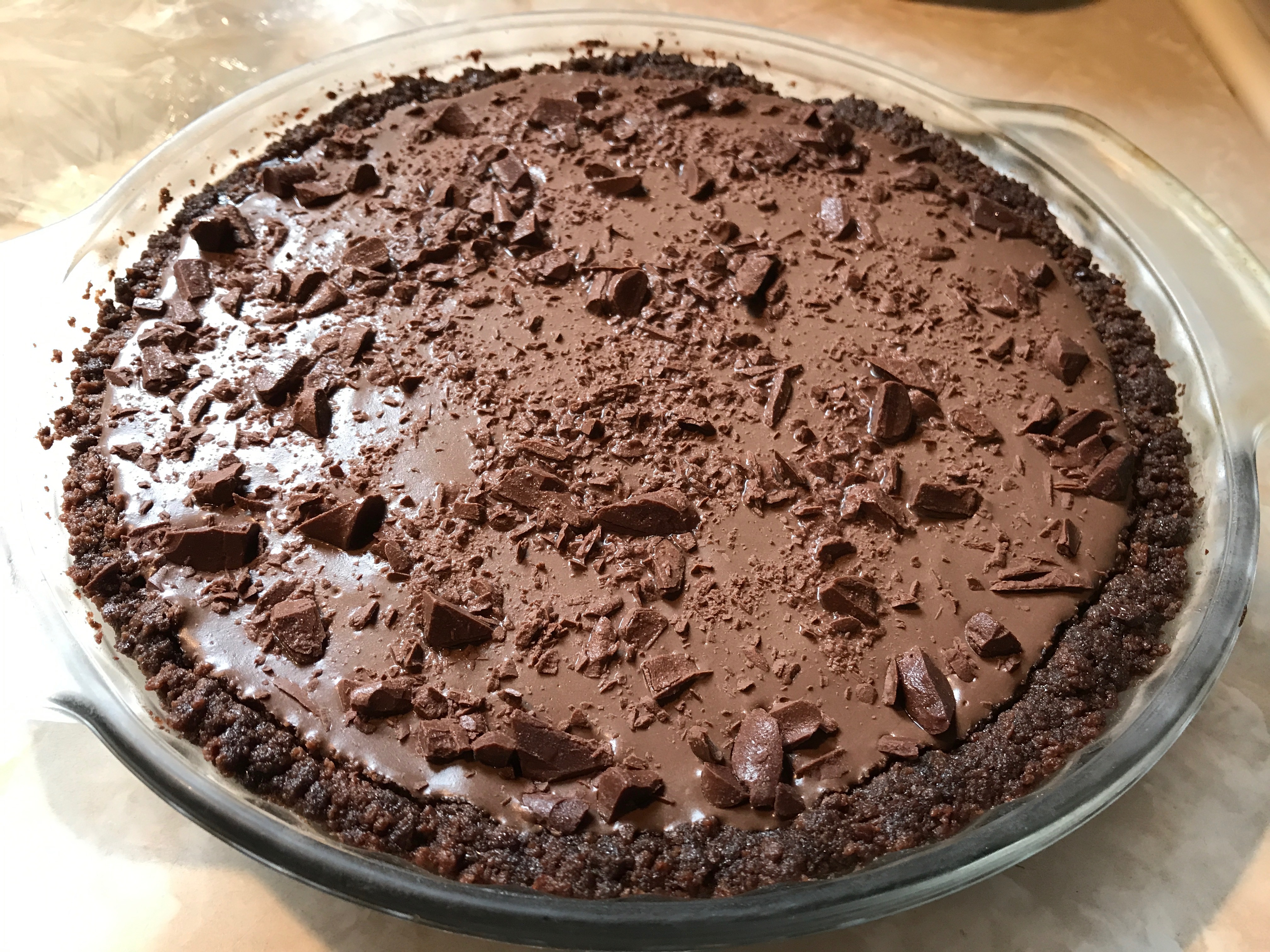
For both I make a chocolate cookie crumb crust. Often I make my own chocolate cookies but when I’m pressed for time I like to use Enjoy Life’s chocolate or chocolate mint cookies because they are free of 12 of the major food allergies.  Most recipes call for 1 1/2 cup to 2 cups of crumbs mixed with 1/3 cup to 1/2 cup butter.  Since I tend to use a 10 inch pie pan, I process enough chocolate cookies to make 2 cups of crumbs but I have found that 2 tbsp of a fat is all you really need. So, choose a plant based oil or melted vegan butter or coconut oil and mix it well with the crumbs. Press the crumbs into your pan to cover the bottom and all the way up the side. Then you can choose to either bake the crust in a preheated 325 degree oven for 10 to 15 minutes to set the crust or you can simply freeze it for half an hour which will also set it.

To make the first version of the chocolate filling, you make the dark chocolate mousse recipe and then sprinkle two teaspoons of unflavored gelatin or agar powder or Vegan Jel over 2 tbsp of cold water. Let it sit for a couple of minutes to soften, then dissolve with 2 tbsp of hot water. Mix well into the mousse and then pour the mousse filling into your prepared pan and put it in the fridge for several hours to set.

To make the second version of the chocolate filling, you make the dark chocolate pudding recipe with whatever “milk” suits your allergy need, only before you thicken the pudding, add 1/4 to 1/2 cup of dark chocolate or mini chocolate chips and stir until they’re melted to make for a richer-tasting pudding and increase the cornstarch to 4 to 5 tbsp to make a thicker pudding. Then pour the pudding into the prepared cookie crust, cover with plastic wrap to prevent a skin from forming, and put into the fridge for several hours to set.

You can leave the pies as they are, or to make them prettier, you can sprinkle chopped dark chocolate over the top. Then enjoy!


Autumn Appetites: Fruit Butter Muffins

“But it doesn’t look like butter….”

When my oldest was in preschool, I asked if she wanted to try apple butter on her toast, and when I placed it on the table, I could tell by her face that she was confused. “But it doesn’t look like butter,” she said.

For folks who haven’t enjoyed the taste of a fruit or vegetable butter, it’s basically a spread like jam or jelly, only with a softer, more paste-like consistency, and it is extremely easy to make your own, especially if you own a crock pot. You simply slowly cook the fruit for a long time so that it breaks down completely. And homemade fruit or vegetable butters are very allergy friendly because you control what goes into the recipe.

Folks who have been reading my posts for a while know that I like recipes which require little work, and making fruit or vegetable butter in the crock pot fits the bill perfectly. And this time of year, when I’m looking for a myriad of ways to use apples and pumpkin, making them into “butters” is ideal, though fruit and vegetable butters can be made with just about any fruit or vegetable… apples, plums, pumpkins, squash, peaches, mangoes, strawberries, turnips, cherries….

You simply chop the fruit or vegetable into pieces which you place into your crockpot. For fruit like apples, pears, plums, etc… I don’t even peel the fruit. I simply core and slice, because the nutrients are in the skins, and you’re cooking the fruit for so long that the skins break down. Vegetables with hard rinds like pumpkin and squash, though, you’ll want to peel.

Once the fruit or vegetables are in the crock pot, you can decide if you want to make the butter plain or spice it up. Adding spices like cinnamon, nutmeg, ginger, coriander, cloves, etc…, or flavors like lemon or vanilla or orange peel, etc… adds dimension to the flavor. For folks who want a sweeter butter, you can add some agave or truvia or coconut sugar (or sugar if you use it). Unless my fruit is very tart, however, I don’t add any sweetener.

Then you just turn your crock pot to low and let the fruit break down over a long period of time. How long will depend on the amount you’re making and the thickness of your fruit or vegetable, anywhere from 6 to 12 hours. You want to cook the fruit or vegetables long enough that the consistency is very thick, way past applesauce consistency. Some folks recommend propping the top of your crock pot lid to help with evaporation. I’ve never done that and haven’t had any problems with the fruit being too watery, but you can choose which way you’d like to try.

Once your fruit or vegetables are completely cooked down, you can cool them and have a chunky butter or you can puree the fruit or vegetables with a food process or blender into a smoother butter. Your choice. The butters will keep well in the fridge for a couple of weeks, or you can freeze them for several months. If you want to extend the life of the fruit butter in the fridge, you can add sugar and lemon juice which help to preserve the fruit and keep mold from growing. And of course, you can always can the butters if you are one the type to can, which I am not. *grin*

Fruit butters can be used in place of butter and jams on toasts, muffins and scones. It can be used in place of applesauce in recipes. It can be used to thicken sauces. It can be added to cookies and pies for a richer flavor. The list is endless. For myself, I like to make muffins with the butters, and below I’ve pasted in recipe that is one of my favorite creations. I have used apple butter, pumpkin butter, winter squash butter, and strawberry butter so far, and I can’t wait to try some others!

Fruit Butter Muffins 

Ingredients:

8 ounces of chopped dried fruit, your choice

1 cup gluten free instant oats

1 1/2 cup boiling water

2 tbsp ground golden flaxseed

6 tbsp water

3 cups gluten free flour blend (I like to use a garbanzo bean, sorghum, and oat flour blend)

2 tsp baking powder

1 tsp baking soda

1/2 tsp salt

2 tsp cinnamon

1 tsp nutmeg

1 tsp ginger

3/4 cup plant base oil (extra light olive, safflower, avocado, etc…)

1/2 cup fruit or vegetable butter

2 tbsp apple cider vinegar

Baking Instructions:

1. Preheat the oven to 350 degrees and line 24 muffin cups with cupcake liners or grease them so the muffins won’t stick to your pan.

2. Mix the chopped dried fruit with the oats in a bowl, and pour the boiling water over them, pushing the dates and oats down into the water so they are covered. Let sit.

3. Whisk together the ground flax seed with the water, and set aside.

4. Whisk together the flour, baking powder, baking soda, salt, cinnamon, nutmeg, and ginger. Set aside.

5. Mix the oil with the fruit butter, oatmeal mixture, and the flax meal mixture.

6. Make a hole in the center of the dry ingredients and pour in the wet ingredients along with the apple cider vinegar. Mix up quickly just until the dry ingredients are moist.

7. Evenly scoop the muffin batter among the 24 muffin cups and bake for 15 minutes or until the cupcakes are golden and puffed and a toothpick inserted in the center comes out clean.

8. Remove the muffins to a wire rack and cool completely. These keep well in a tightly covered tupperware container.

Creative Cooking: Dried Plum Muffins

“It’s the bacon song….”

Last night we discovered that our fridge is not working as it ought. Specifically, the refrigerator part (but not the freezer) is not staying as cold as it needs to be to keep meat from being spoiled, and when I went to start dinner, I learned that the ground turkey I had bought had gone bad. Since it was close to dinner time, I opted to do what I usually do in a crunch… we had breakfast for dinner.

The children love when we have breakfast for dinner. Pancakes, waffles, sausages, bacon, eggs… these are some of their favorite foods. Given what we had in the pantry and the freezer, last night ended up being pumpkin pancakes and turkey bacon with salad as our veggies. This, of course, meant there were pancakes and bacon available for the children to eat again this morning for breakfast.

When our son went to get bacon to eat, he began to sing. It turned out it was the “bacon song” he was making up and singing. When we laughed, he switched to the “apple doesn’t fall far from the tree” and reminded my husband and me that we do strange things all the time!

In fact, I was just accused of oddness last week when I made dried plum muffins. Someone thought it weird that I would even use dried plums. Another wondered why I did not call them prunes. I explained that dried plums have a lot of fiber, potassium, good vitamins like K, A and B, and are naturally sweet so you don’t need to add sugar. The reason I call them dried plums is because that is what prunes are, and I find people react oddly when you say you’ve made something with prunes. Of course, I discovered that dried plum muffins received the same reaction, so it may not be the name!

The fact, though, is that the muffins I made are healthier muffins with rolled oats and flax seed and garbanzo bean flour, so in addition to having no sugar, they are higher in fiber and protein. The version below have mini chocolate chips because I was making them for a children’s party, but you can omit the chocolate chips and then serve them as a breakfast muffin!

Dried Plum Muffins

Ingredients:

7 ounces of pitted, chopped dried plums (prunes)

1 cup gluten free rolled whole oats

1 1/2 cup boiling water

2 tbsp ground golden flaxseed

6 tbsp water

1 cup gluten free oat flour

1 cup garbanzo bean flour

1/3 cup potato starch

2/3 cup arrowroot starch

2 tsp baking powder

1 tsp baking soda

1/2 tsp salt

2 tsp cinnamon

1 tsp nutmeg

1 cup Enjoy Life mini chocolate chips

1 cup mashed, ripe bananas

1/2 cup safflower oil

1/2 cup water

2 tbsp apple cider vinegar

Baking Instructions:

1. Preheat the oven to 350 degrees and line 24 muffin cups with cupcake liners or grease them so the muffins won’t stick to your pan.

2. Mix the chopped dried plums with the oats in a bowl, and pour the boiling water over them, pushing the dried plums and oats down into the water so they are covered. Let sit.

4. Whisk together the ground flaxseed with the water, and set aside.

5. Whisk together the oat flour, garbanzo bean flour, potato starch, arrowroot starch, baking powder, baking soda, salt, cinnamon, and nutmeg.  Stir in the chocolate chips and set aside.

6. Mash the bananas and mix with the oil and the dried plums and oatmeal mixture and the flaxseed mixture.

7. Make a hole in the center of the dry ingredients and pour in the wet ingredients along with the apple cider vinegar. Mix up quickly just until the dry ingredients are moist.

8. Evenly scoop the muffin batter among the 24 muffin cups and bake for 15 minutes or until the cupcakes are golden and puffed and a toothpick inserted in the center comes out clean.

9. Remove the muffins to a wire rack and cool completely.  These keep well in a tightly covered tupper ware container.

Creative Cooking: Gingerbread Cupcakes

“It’s about coming together as a community….”

Some friends of mine decided recently that we should put all the walking we have been doing to good use, specifically, I walked my first 5K last weekend, and we did another this weekend.  The first supported community living in general and raised funds for a local community initiative; the second was to help raise awareness and aid for cancer research and care for children.

Not having done a 5K before, I did not know what to expect, and I was surprised by the diversity that one finds at such events. Race, politics, religion, lifestyles, level of health, even reasons for doing each of these particular 5K races varied from person to person. Something about participating in a 5K transcends everything other than the fact that everyone is there, which seems to make you automatically a part of a special group.

I was also marked by the optimism and positive vibes which steep such events. People cheer you on from the get-go and continue to encourage you the entire way, and even if you are last, you receive the same accolades as the person who was first, sometimes even more so! Whether you run, walk or are in a wheelchair, you are accepted and permitted to do the race at your own pace in the manner which works best for you. Best of all, though, is that you become a part of a community as opposed to being alone.

People I did not know felt comfortable chatting with me before, during and at the end of the races because of that common bond, which was that we were all participating in the 5K. We were all part of “the group”.

I thought about this yesterday as a mom told me about her worries for her middle child who just started her first year of college. The daughter has a lot of food issues but has difficulty watching what she eats because she does not want to be different from her friends; she does not want to miss out on the foods they are eating… pizza, pasta, desserts. She just wants to “be a part of the group,” as she tells her mother quite frequently.

We all want to be a part of something bigger than just ourselves. Being a part of a community that runs and walks and wheels together for the good of community and humanity is a good thing to be a part of. Being a part of a close-knit group of friends is also a good thing. Sometimes, however, that community we are choosing to join needs some education, and sometimes we have to remember that we can be a part of community life and still be different, and more than that, our differences are what most of the time make for a more vibrant community life. As with the 5K, we should be able to be accepted and permitted to do the same thing differently.

This week, I had a workshop with a very large group of much older folks who had never considered trying to eat healthier or allergy friendly… ever. They wondered, as they rightly should have, whether it was even possible to make the foods they loved in the manner which I promised them they could. As such, I had my work cut out for me to create desserts which fit their expectations. To that end, one of the items I made was gingerbread cupcakes.

The folks had indicated that they loved gingerbread, and how could I possibly make gingerbread without using at least two cups each of molasses and sugar and without white flour and butter. It simply would not be the same! Well, I am happy to say that they loved the gingerbread cupcakes so much that they took all my leftovers home, leaving nothing for me to share with the family after! Fortunately, the family had been able to taste test a couple before!

So, below is a recipe for gingerbread cupcakes which is dairy, gluten, soy, and egg free. I did opt to use coconut sugar to get the texture that I needed for the gingerbread but any folks with a coconut allergy can feel free to use the traditional brown sugar or substitute agave, using half the amount you would for the coconut sugar. The coconut milk can also be changed to any type of milk that best suits one’s food needs. I also used date molasses instead of regular molasses which is made entirely from dates but if you cannot find that, you can use regular molasses.

Gingerbread Cupcakes

Ingredients:

3 cups gluten free flour blend (I used King Arthur’s Whole Grain version)

1 cup coconut sugar

2 tsp baking soda

2 tsp cinnamon

2 tsp ginger

1 tsp nutmeg

1 tsp salt

1/2 tsp cloves

1 cup date molasses

1 cup coconut milk

1 cup safflower oil

2 tbsp apple cider vinegar

Baking Instructions:

  1. Preheat the oven to 350 degrees and line 24 muffin tins with cupcake liners
  2. Mix together the flour, coconut sugar, baking soda, cinnamon, ginger, salt, nutmeg and cloves. Set aside.
  3. Blend together the date molasses, coconut milk, and oil.
  4. Add the dry ingredients to the wet with the apple cider vinegar. Blend quickly just until the dry ingredients are moistened.
  5. Divide the batter evenly among the cupcake tins.
  6. Bake for 20 to 25 minutes until the cupcakes are puffed and dark golden and a toothpick inserted in the center comes out clean.
  7. Allow the cupcakes to sit for five minutes and then remove them to a wire cooling rack to cool completely.
  8. These cupcakes are extremely flavorful and need no frosting at all. If you would like to frost them, though, as I did for the workshop, the frosting I used is below.

“Cream Cheese” Frosting

Ingredients:

1/4 to 1/2 cup vegan butter (how much you choose to use depends on how buttery tasting you want your frosting versus cream cheese tasting)

agave (I suggest starting with one tablespoon and tasting to see if you need more sweetness)

4 oz to 8 oz tofu cream cheese (how much depends on how much butter you used, how much of a cream cheese taste you want and how thick you want the frosting; if you don’t have a dairy allergy and want to use real cream cheese instead of the tofu version, you may)

cinnamon, nutmeg, ginger and/or cloves (add to your tastes, starting with 1/4 tsp of your choice or choices.

Frosting Instructions:

  1. In a mixer, mix the butter until smooth.
  2. Slowly drizzle in the agave with the mixer on low to blend the agave in with the butter until creamy. Taste to see if you need to add any more agave.
  3. Add the tofu cream cheese and blend well until the frosting is to the desired thickness for easy spreading.
  4. Add the spices to your liking. I use all four for a nice spice frosting.
  5. If the frosting is too thick, you can thin it with milk of your choice. If it is too runny, thicken it with a little powdered sugar, using only 1 tsp at at time.

Fruitful Flavors: Peach Pie

“It won’t come off the pit….”

One of the many enjoyments of summer is eating a freshly picked, sweet and juicy peach. We have a farm down the road which grows peaches, and it is always a highlight of our summer when the peaches are ripe and ready for us to purchase and eat. The other day, though, someone asked me how I get peaches off their pits for making pies and cobblers, and I explained that I didn’t.

Peaches come in two varieties, clingstone and freestone. Both yellow and white peaches can be either. The irony is that the variety which is most difficult to remove from the pit, the clingstone, is the sweeter and juicier of the peach varieties. The peaches which fall off their pits, the freestone, are not as sweet and juicy. Most of the peaches one finds at the grocery stores are the clingstone variety because they are sold for taste. Hence, my friend’s frustration with removing the peach slices for baking.

If folks want to make peach pie or cobbler or crisp or muffin or cake using fresh peaches, the best option is to purchase freestone peaches which easily twist off the pits if the peach is ripe. If using clingstone peaches, then folks need to resign themselves to cutting the peach slices off the pit which means the slices won’t be pretty.

I don’t tend to do either, because as anyone who has followed my blog for a while knows, I am lazy and like to cook food as easily and quickly as possible. So I keep frozen, no sugar added peaches in my freezer and just pull them out when I have a hankering to bake with peaches. The fresh peaches, I just eat as a snack, enjoying their flavor as is.

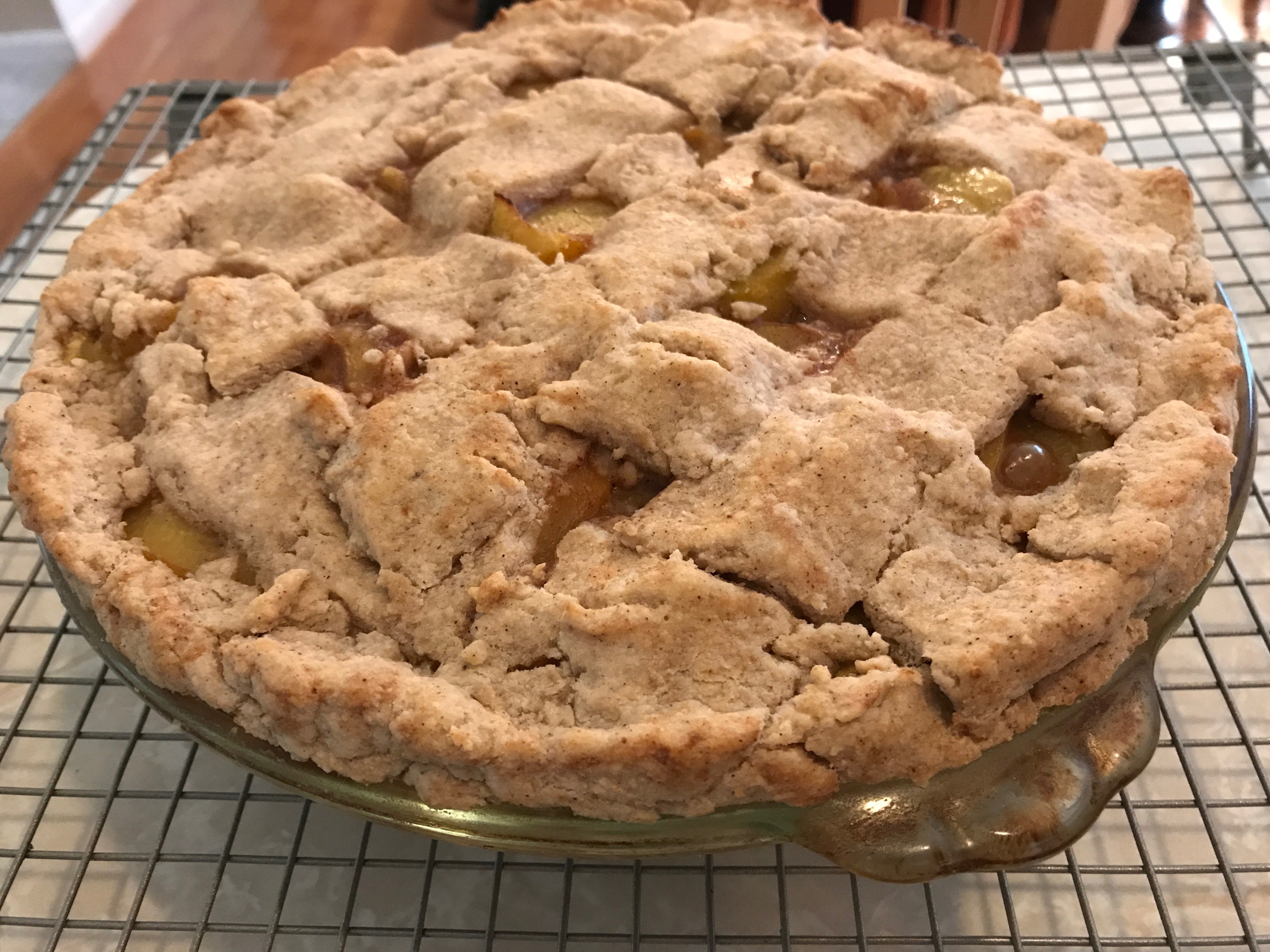
The conversation with my friend of course gave me a craving for peach pie, so I went ahead and baked one yesterday which I’ll share below. You’ll note that there’s no sugar and very little sweetener at all because the flavor and sweetness comes from sauteing the peaches to concentrate the flavor and sweetness. Folks can also switch up the spices to your own tastes. Sometimes I like to use cardamom and ginger instead of cinnamon and nutmeg.

Some thoughts on pie crusts, too.  I made my own, but folks can use a store bought pie crust, whether gluten free or wheat. If you choose to make your own, you can follow a favorite recipe. Otherwise, some information for your use to to make your own pie crust.

Pie crusts are basically flour, fat and water. For every one cup of flour, whether wheat or gluten free, you will usually use 3 to 6 tbsp of a fat, whether butter, shortening or oil, or a combination of the three, and for every cup of flour you usually need 1 to 3 tbsp of water. Depending on tastes, some recipes call for a little bit of salt; others call for the addition of a little bit of sugar. I tend to use neither, opting instead to flavor my crust with spices like cinnamon, cardamom, nutmeg, ginger, cloves, etc….

Tips for making “from scratch” crusts:

  1. If using solid fats, the colder the better: Put your butter and/or shortening into the freezer for ten minutes before cutting it into your flour. This is especially good for dairy free versions of butter which tend to be softer in texture. You want the fats to slowly melt in the oven while cooking, not become soft while you’re still preparing the crust.
  2. If using oil, the milder the better: Plant oils are great for crusts because they have healthy fats and you don’t have to cut the fat into the flour. You can simply stir the fat into the flour. You want, however, to use mild tasting oils like safflower, sunflower, canola, etc… because otherwise the oil flavor overpowers everything else. If you are using an oil for the fat, be sure to decrease the amount of water because you only want enough liquid to moisten the crust enough to hold together.
  3. The colder the better for the water: Recipes for crusts will call for ice water. This means literally putting ice into the water, because you want to prohibit gluten development. Now, if you’re making a gluten free crust, that isn’t an issue but if you’re using solid fats, the cold water will help keep the fats cold until the pie goes into the oven. Use just enough water, though, to moisten the flour enough to hold together.
  4. If you want tender, flakier crusts, use acids or alcohol: Acids like lemon juice or vinegar or an alcohol like vodka cook off in the baking process but react with the other ingredients to make for a flakier crust by tenderizing the dough. You only need to replace one to two tablespoons of the ice water.
  5. If want tender, flakier crusts, use lower protein flours: The lower the protein, the flakier the crust, but of course, that makes for a more delicate crust and one which is more carb intense. Find a balance. For example, use a whole wheat pastry flour which has less protein than 100% whole wheat flour but which is a sturdier flour than all purpose white flour. If using gluten free blends, choose a combination of brown rice flour and sorghum or oat which combines a lighter flour with a protein flour.
  6. If you want a crust that is easier to handle: Adding an egg yolks makes for a more pliable, sturdier dough to work with. It also makes for a richer tasting crust.
  7. For easier rolling and handling, cold is better: It is a good rule of thumb to put your crust into the fridge for half an hour to an hour because rolling soft dough makes it more likely that the dough will stick, causes the fats to melt before their time, and will be harder to transfer to the pie plate.
  8. For easier rolling and handling, paper is better: When rolling out the dough, if you don’t want the crust to stick and want an easier way to transfer the crust, use wax paper or parchment paper which you sprinkle flour onto. After putting the dough down, sprinkle it with flour and top with a second piece of wax or parchment paper. Then roll. The papers prevent sticking, and when you’re ready to transfer the crust, you can just pick up the paper and flip it onto the pie plate.

Peach Pie

Ingredients:

3 pkg 16 oz thawed frozen peaches, no sugar added or 6 to 7 cups sliced fresh peaches

1/2 cup water

1/4 cup agave

1 to 2 tsp cinnamon

1/2 to 1 tsp nutmeg

3 tbsp cornstarch or arrowroot starch or tapioca starch

Pie Crusts

Cooking Instructions:

  1. Preheat the oven to 400 degrees.
  2. In a shallow pan mix the water with the agave, cinnamon, nutmeg and starch.
  3. Add the peaches and stir to coat well.
  4. Continue to stir as the mixture comes to a slow boil and begins to thicken.
  5. When the mixture has become glutinous and is sticking to the peaches, turn off the heat and let the peaches cool.
  6. Line the bottom of a 9.5 inch glass pie plate with a pie crust.
  7. Fill the crust with the peaches, layering the peaches individually into the crust, using your clean fingers.
  8. Top the peaches with the top crust and make slits or create a lattice crust to cover the peaches.
  9. Bake for 15 minutes. Cover the entire pie with aluminium foil and bake for 20-25 minutes. Remove the foil and bake for another 10-15 minutes until the crust is golden brown and the peaches are bubbling.
  10. Remove the pie from the oven to a cooling rack and allow it to cool at least an hour before slicing into it.


Shortcut Cooking: Oatmeal Date Cookies

“We haven’t made cookies in a while….”

My husband had some errands to run, and my high school daughter was playing with the band at an event. So, this left my son and I to occupy our time together. Since I had a workshop coming up, I suggested that we do some baking.

The problem was deciding what to bake. I’d had a series of workshops recently and done a lot of baking so I was a bit tired of the same ol’, same ol’, which were a stock series of recipes which I usually make for the workshops because they’re quick and easy in addition to representing the various different substitutions I teach about in the workshops.

My son’s suggestion was that we make cookies because we hadn’t made them in a long, long time.

There was a reason for that…. I have found that cookies take longer to make, both in the assembling and in the baking. But my son was correct, that we hadn’t made any in a while, and they would be something different. So, we went to work creating a recipe.

I decided that if we were going to bake cookies, I wanted to make something that would be quick. This meant beginning with what we had in the pantry and not creating everything from scratch. So, we opted to use a gluten free flour blend that I had already made up for another item and had leftovers of in the pantry. We also decided to use pre-chopped, store-bought dates which we found in the pantry as well. Because I’m always trying to be healthy, we chose to make oatmeal cookies with whole rolled oats, also in in the pantry, and to use coconut sugar instead of white sugar so I could use half the amount I’d have to use of white sugar.

Using the mixer sped the assembling process up, and because we decided to make oatmeal cookies, we could simply drop the batter onto the parchment paper and flatten them without any rolling or forming. By using vegan butter, I minimized the spreading so I could put 16 cookies (the 1 tbsp size) instead of 12 to a cookie sheet which meant all the cookies fit onto just four cookie sheets, so I could bake two sheets at a time in the oven, resulting in only 20 minutes of baking time.

The result was that from when we started rummaging in the pantry to when the second batch of two cookie sheets came out, it was less than 45 minutes. Now, those are cookies worth making!

Oatmeal Date Cookies

(These make about 60 small cookies or 30 large cookies.)

Ingredients:

1 1/2 cup Gluten Free flour blend (I used a homemade blend of garbanzo bean and sorghum flours mixed with tapioca and potato starch)

3 cups Gluten Free whole rolled oats

1 tsp salt

2 tsp baking powder

2 tsp cinnamon

8 oz pkg pitted, dried, chopped dates

1 cup vegan soy free butter or coconut oil or natural shortening

1 cup coconut sugar

2 tbsp ground flaxseed mixed with 6 tbsp water (Mix ahead of time and let it sit)

2 tbsp additional water

Baking Instructions:

  1. Preheat the oven to 350 degrees and line cookie sheets with parchment paper.
  2. Mix together in a bowl the flour, oats, salt, baking powder and cinnamon. Stir in the dates. Set aside
  3. In a mixer, cream the butter with the coconut sugar.
  4. Add the flaxseed mixture with the dry ingredients and the additional water. Mix until well combined.
  5. On the prepared cookie sheets, drop the cookie batter by 1 tablespoon-full for smaller cookies (2 inch diameter) or 2 tablespoons-full for larger cookies (4 inch diameter). Leave about an inch in between the cookies.
  6. Press the dough down with a fork in both directions and bake in the preheated oven for 8-10 minutes for the small cookies until the cookies are puffed, golden and stiff to the tough. For the larger cookies, turn the pan around after 8-10 minutes and bake for another 8-10 minutes.
  7. Allow the cookies to cool for a couple of minutes on the cookies sheets before moving them to a wire cooling rack with a spatula to cool completely.

Healthy Habits: Quinoa Black Bean Salad

“It’s a bit difficult to avoid all of nature….”

Recently my health insurance provider decided that they wouldn’t cover allergy medications any more which is a big blow to my health. When one goes to an allergist for the first time, the allergist will test you for 80 most common allergens. I am allergic to 78. Have been since I was a child, and they haven’t changed in over 40 years, despite repeated testing every seven years.

For the first thirty years of my life, I coughed, hacked, and sniffled my way through life, never without huge wads of tissues in hand and rarely able to breathe through my nose. The advent of new medications, specifically nose sprays, seemed an opportunity for relief. True to my life, though, it turned out I was allergic to most of the new medications. Go figure! But there was one which actually worked, and for the past 15 years, I was able to breathe through my nose, divest down to one tissue a day, and only hack, cough and sniffle two or three times a year when the allergy seasons were at their worst.

Now, though, I’ve slowly begun a descent back to what I had forgotten, not being able to breathe unless completely upright, blowing my nose so often that it’s red and raw, once again needing to invest in my own tissue company, and finding myself at the doctor’s more than I’d like to be for antibiotics for sinus infections.

On the plus side, I’ve been so sick at times that I’ve been forced to stay at home which is an unusual opportunity for me because I suddenly have time which I wouldn’t have had if I were out at my usual meetings and running of errands. It has also meant I can see firsthand which parts of my life really must be attended to and which can survive without me.

On the downside, feeling unwell makes me tired which stimulates cravings for food which aren’t always the healthiest of choices. Since I always have to watch my weight and my sugars, I have been trying to create comfort foods which curb my cravings but which are healthy.

One such recipe is for a quinoa salad. If you are unfamiliar with quinoa, it is essentially a seed which is a good protein source.  Because it cooks similarly to rice, folks tend to eat it like a grain, and folks who are diabetic or needing to watch carbs should know that quinoa is high in carbohydrates. Since quinoa is also high in protein and fiber, though, eaten judiciously, quinoa is a great comfort food.

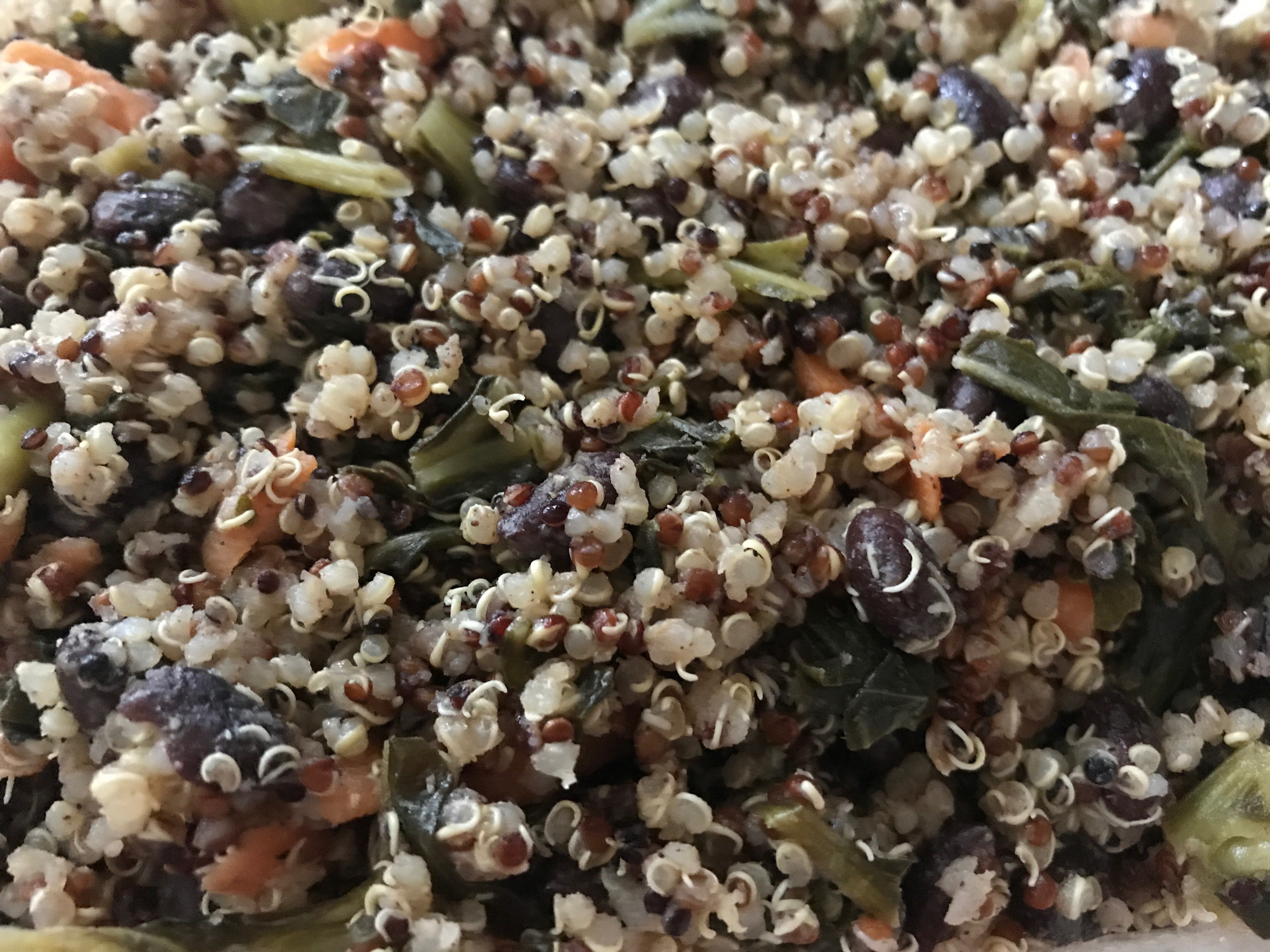
I make a quinoa salad which I and my family really likes which uses multi-colored quinoa, black beans, kale and carrots. The quinoa and black beans provide the carbs which are filling but also fiber and protein. The kale and carrots provide nutrients gained from vegetables and cuts the amount of quinoa (and hence the carbs) in a cup serving.

Quinoa Black Bean Salad

Ingredients:

2 cups water

1 cup multi-colored quinoa

2 cups frozen, chopped kale

1 cup thinly sliced baby carrots

16 oz can of no salt, no sugar added black beans, rinsed well and drained completely of all water

3 tbsp olive oil

1 tbsp apple cider vinegar

1/4 tsp salt

1/4 tsp black pepper

3/4 tsp ground cinnamon

3/4 tsp ground cardamom

1-3 tsp honey (optional; use desired amount of sweetness if using; if making for just the family, I omit; if making for company, I use 2 tsp)

Cooking Instructions:

  1. In a medium saucepan, pour the water and add the quinoa. Bring the water to a boil, then lower the heat and simmer until the quinoa has plumped, is showing white rings, and has absorbed all the water. This will take anywhere from five to 15 minutes, depending on how vigorously you are simmering the water. I find that it’s helpful to stir the quinoa every so often.
  2. Once the water is absorbed, remove the pan from the heat, cover the quinoa and let it sit. You want the quinoa to be completely dry before you mix it with other ingredients. This can take anywhere from 10 to 30 minutes, depending on how much of the water was actually absorbed into the quinoa before you removed it from the heat.  When it’s completely dry, you will be able to fluff the quinoa with a fork. If the quinoa clumps together when you try to stir it, then it’s still a bit damp.
  3. While the quinoa is drying, thinly slice baby carrots to make a cup. You can use regular sized peeled carrots but then you’ll want to cut the thin slices in half because you are only cooking the carrots a short amount of time in the microwave with the kale, and you don’t want the carrots to be hard. Once you have a cup’s worth chopped, put it aside for the moment.
  4. Put 2 cups of frozen, chopped kale into a microwave safe bowl.  Follow the instructions for cooking, only halfway during the cooking time, remove the bowl, stir the kale and add the cup of chopped carrots. Finish cooking the kale in the microwave.
  5. Add the kale, carrots and black beans to the quinoa and mix well.
  6. In a measuring cup, whisk together the olive oil, apple cider vinegar, salt, pepper, cinnamon and cumin and honey, if using.
  7. Drizzle the dressing onto the quinoa salad and use a spoon to incorporate the dressing into the quinoa salad.
  8. Salad can be served warm or cold. Can store in the fridge for a long time.

Vegan Veggin’: Chickpea Curry

“Life should be more than simply surviving successfully….”

For anyone keeping track, my usual every two to three weeks posts have not appeared for the past six weeks. Unexpected events pushed aside time I might have used to post. Some were unplanned but pleasant surprises such as an opportunity to write a song and create a video, a blast of inspiration for a new play, a push to apply for a writing fellowship, bookings for eight workshops in eight weeks, trips to see family and do college touring with my middle child. Others were not as welcomed occurrences. Friends and friends’ children struggling with depression and needing support, making time to visit a special family friend who may not be with us on this earth much longer, our oldest wrestling with issues requiring parental wisdom, extra responsibilities because of difficulties in the lives of others, our middle child being in a car accident.

Last night, a friend asked if I wanted to cancel and reschedule a get-together we had planned a couple of months ago for this coming week with a group of moms I know.

“Why?” I asked.

“Because there’s so much going on for you right now. You’re just trying to survive, aren’t you?”

“No, no I’m not,” I said.

And it’s true. I don’t believe in survival mode. The more difficult life is, the more likely I am to get together with a friend for lunch, take my son on a trip to a museum, go out to dinner as a family, dance with my daughter in the living room, or help a friend with a book edit even though someone might argue my time would be better spent elsewhere.

Life is short, and life can turn on a dime. I’ve been to enough funerals to attest to both facts, and I have now had two of my three children in car accidents which could have taken them from me without any warning. Life is not meant to be survived. It is meant to be lived. Every minute, every day, because you don’t know what you’ll have for time.

And that may be why I invest so much of my time helping people with their food issues. Physical necessity dictates not only that we have to eat but that we need to do so at regular intervals throughout the day. This means part of our “living” time is thinking about what to eat, making what we’ll eat, and eating. So, food, too, should not just be about surviving but about enjoyment and benefit, just like everything else we do in and with our lives.

This year my oldest decided she would become vegan, and recently my husband’s sister’s family decided to do the same. For my daughter, eating vegan means doing her part to make the world a better place to live. For my brother-in-law and nephews and niece, it’s about embracing a better, healthier lifestyle. For both, they are making choices to live lives which are not just about surviving but about being happy with the decisions they make about what to eat.

Given my dairy allergies and my son’s egg allergies as a child, a lot of what I make was already vegan, but I’ve begun experimenting with more recipes of late to expand my repertoire. Last month I made a vegan chickpea curry which the family really liked and which is so easy because it just cooks in the crock pot. I will share it below.

Chickpea Curry

Ingredients:

Two 16 cans no salt, no sugar chickpeas, drained and rinsed (you can save the liquid and use the aquafaba as an egg substitute or to make meringues or mousse or another recipe)

16 oz package thawed frozen cauliflower

16 oz package thawed frozen carrots

20 oz package thawed frozen chopped butternut squash

16 oz package frozen chopped kale

10 oz package frozen chopped red peppers

1 tsp olive oil

1 tbsp minced garlic

1-3 tbsp curry powder (if you like your curry very mild, use the smaller amount; if you like a stronger flavor, use 2 or 3 tbsp)

2 tsp paprika

one 14 oz can of petite diced no salt no sugar tomatoes

one 14 oz can of coconut milk or 1 1/2 cup preferred other type of vegan milk

1/4 cup gluten free flour

Cooking Instructions:

  1. In a 6 quart crock pot mix together the chickpeas, cauliflower, carrots, squash, peppers and kale.
  2. In a shallow pan, heat the olive oil for a minute, then add the garlic, curry powder, and paprika. Heat for a minute, stirring continually.
  3. Add the tomatoes and bring to a simmer, about 3-5 minutes.
  4. Add the “milk” and bring to a slow boil.
  5. Stir in 1/4 cup flour and whisk well, stirring continually until the mixture is smooth and begins to thicken.
  6. Pour the sauce over the ingredients in the crock pot and blend well.
  7. Cook on low for 6 to 8 hours or high for 3 to 4.
  8. Serve by itself or with rice or with bread.


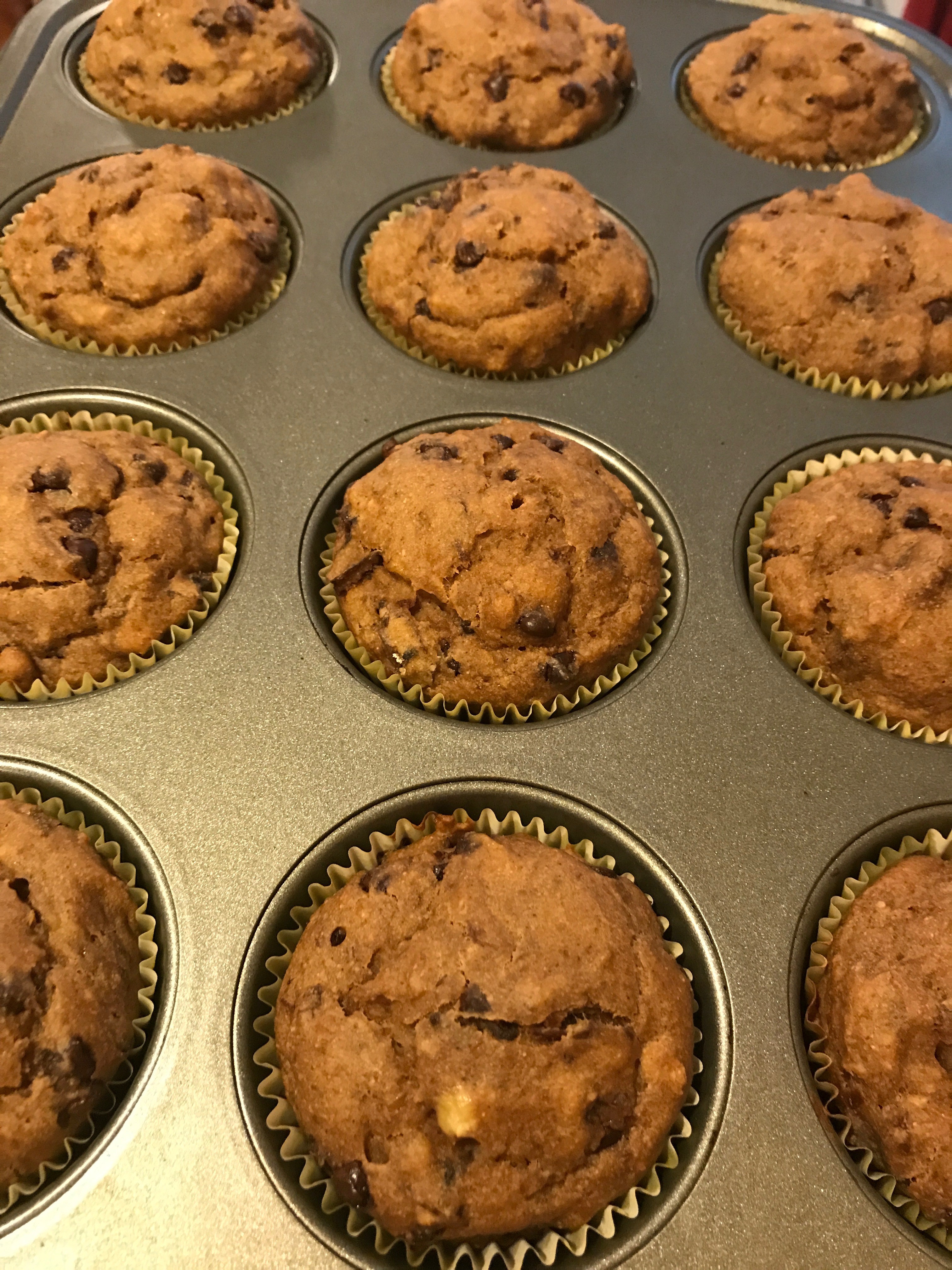
Creative Cooking: Partial Chocolate Chocolate Chip Banana Muffins

“I told him you could probably do it….”

Last week on the drive home from church, my son told me that he’d told his Sunday School leader that I could probably make banana muffins for his group this week but that I needed to confirm for the leader that I could.

“Of course,” I said. After all banana muffins aren’t all that difficult.

Well, lesson learned: Always make sure to get all the facts before you agree to anything! It turned out that among all the boys in my son’s group, there were allergies to nuts, peanuts, wheat, eggs, soy, and dairy. The allergies wouldn’t be that difficult, given what I do, which is to make allergy friendly baked goods. But then I learned that one boy doesn’t like banana chunks; another boy will only eat chocolate muffins; a third prefers chocolate chips in a muffin versus being completely chocolate; and a fourth has to limit his sugar intake because it makes him bounce off the walls.

Any other person might have decided that there was no way to accommodate everyone, but I was determined to not be that person. So, I went to work….

Removing chunky bananas was easy. I simply pureed the bananas and no chunks! To make the muffins gluten free, I used Cup4Cup whole grain gluten free mix which was also dairy, nut and soy free. To replace the eggs, I only needed to increase the baking soda and use vinegar because the bananas would act as a binder, so we only needed to help it rise. For the liquid ingredients, I used safflower oil instead of butter and water instead of a milk product or substitute which would have had soy or nuts. In place of the sugar, I used Agave which allowed me to use only 1/3 the amount that the recipe would have called for sugar.

The question I was left with was how best to make a muffin that was chocolatey enough for the one boy but not too much for the other. After pondering for a while, I hit upon a solution. I stirred Enjoy Life allergy friendly mini chocolate chips into the dry ingredients and then poured boiling water on top before adding the wet ingredients and the vinegar. The result was that the hot water began to partially melt the chips which turned the batter chocolately but not completely so and left enough chips intact for the muffins to be banana chocolate chip muffins.

The result seemed to be a hit.

Partial Chocolate Chocolate Chip Banana Muffins

Ingredients:

2 1/2 cup pureed ripe bananas (I needed four)

1/2 cup safflower oil

1/2 cup Agave

3 cups gluten free flour blend (I used Cup4Cup whole grain dairy, nut, soy free blend)

2 tsp baking powder

2 tsp baking soda

2 tsp cinnamon

1/2 tsp salt

10 oz package Enjoy Life mini chocolate chips

3/4 cup boiling water

2 tbsp vinegar (I used apple cider vinegar)

Baking Instructions:

  1. Preheat the oven to 350 degrees and line 24 muffin tins with liners.
  2. Mix the pureed bananas with the oil and agave. Set aside.
  3. Blend together the gluten free flour blend, baking powder, baking soda, cinnamon and salt.
  4. Stir in the mini chocolate chips.
  5. Pour the boiling water on top of the dry ingredients.
  6. Pour the wet ingredients on top of the boiling water.
  7. Add the vinegar and then stir until the dry ingredients are completely moistened. Your batter will turn chocolately but a majority of the chips will remain intact.
  8. Divide the batter evenly among the 24 tins. The tins will be filled to the top.
  9. Bake for 15 to 20 minutes until the muffins have risen, are firm to the touch and a toothpick inserted in the center comes out clean.
  10. Enjoy!


Healthy Habits: Aquafaba

website souffles

“What?”

I travel to libraries to give workshops on allergy friendly and healthier baking. Last weekend, at a workshop, I spoke with a group of about 30, and I received an email this week with a follow up question about aquafaba.

If you have not heard about the new rage, aquafaba, it’s apparently the words for water and beans and refers to the liquid you find in a can of chick peas or after you cook dry chick peas.  The chemistry of the liquid is yet to be determined but what is known is that it makes for a wonderful egg and dairy substitute. You can whip it like eggs to make meringues or replace eggs in baked goods or mayo or waffles and more.  You can whip it like heavy cream to replace dairy in whipped cream, mousse, or ice cream and more.

For my workshops, I always bring samples so folks will know that I’m telling the truth about being able to “have your cake and eat it, too”, and I try to provide a variety of desserts which are gluten, dairy, nut, peanut, soy and egg free. Depending on the season, the particular items I bake vary. For this workshop, I made meringues with the aquafaba and a chocolate cream pie with an aquafaba topping so folks could see how the aquafaba worked as both an egg and a heavy cream substitute.

The participant in the workshop who had emailed me did so because she was looking for the meringue recipe which wasn’t actually on this site. So, I’m remedying that situation by including it below. *grin* I’m also including some other tips for how you can use aquafaba in recipes.

Tips for using aquafaba:

  1. Purchase no salt, no sugar added versions of the chick peas if you are using canned chick peas. This helps you to control the sodium and sugar levels. You simply drain the liquid into a bowl and use your chick peas for another recipe at another time. If you prefer to use dry beans, soak them until doubled in size, bring the water to a boil, then simmer until the beans are soft. Drain the liquid into a bowl for your use and save the chick peas for another recipe.
  2. To use the aquafaba as a regular egg sustitute, simply measure out 1/4 cup per egg needed and whisk the egg with a fork just until frothy. Then use in your recipe as you would an egg. Works well for baked goods and French toast.
  3. To use the aquafaba as eggs which need to be whipped for angel food cake or Belgium waffles, start with room temperature aquafaba, add between 1/4 to 1/2 tsp cream of tartar and whip with the whisk handle of your mixer until stiff peaks form (as pictured above). Fold into your mixtures are indicated in your recipes.
  4. If you want to whip the aquafaba for a meringue topping or meringue cookies or to use as a whipped cream topping or as a substitute for heavy cream in ice cream, when you add the cream of tartar to the room temperature liquid, you should also add your sweetener at the same time. If you try to fold in the sweetener after you’ve whipped the aquafaba, it will deflate and soften. I find that powdered sugar works the best because it’s the lightest weight. Depending on how sweet you like your foods, 1/2 cup to 1 cup of powdered sugar per 15 oz can of liquid works well for most recipes. After you have added both the cream of tartar and powdered sugar, then you can whip the aquafaba to the desired stiffness. It’s best to check if the sweetness is to your liking when soft peaks have begun to form so you can add more if needed before you reach the stiff peak stage.

How to Make Aquafaba Meringues:

To make the aquafaba meringues you simply need a 15 oz can of chickpeas.  Drain the liquid into your mixing bowl and put the chickpeas in the fridge for another use.   Add at least 1/4 tsp and up to 1/2 tsp of cream of tartar.  Then add powdered sugar to your liking.  Start with 1/2 cup to 1 cup of powdered sugar. You can always add more later if you find it’s not sweet enough for you. Add 1 tsp of vanilla alone or with 1/4 cup of unsweetened cocoa powder if you want vanilla or chocolate flavor.

After you’ve put everything into your mixer, use the wire whisk handle to whip the aquafaba until it looks like the picture above.  It usually doesn’t take very long.  (When the peaks are still soft, check the sweetness to see if you need to add any more before whipping to stiff peaks.)

After it’s whipped to stiff peaks, put some into a gallon zip lock bag and snip off the end.  Preheat your oven to 250 degrees and line a cookie sheet with parchment paper. Using the ziplock bag, pipe meringues onto the parchment paper.  I usually make them about tablespoon size. I also like to make the meringues pretty by sprinkling a mixture of unsweetened cocoa powder and powder sugar on top of each meringue before putting them into the oven.

Once you’ve filled the cookie sheet with your meringues, pop them into the oven and bake them for at least an hour.  Then check them.  When they are done, they’ll be hard and dry.  If they’re not quite done, cook them longer for 15 minutes at a time until they are.  (If you make them tablespoon size, they’ll be done after an hour.  If you made them larger, they may take more time.)

Once they’re done, turn off the oven and let them cool in the oven for half an hour.  Then take them out and let them cool completely on a wire cooling rack.  When you go to take them off the parchment paper after they’ve cooled, carefully lift them off and place them into a tupperware, using parchment paper or plastic wrap to layer them.  They’ll keep for a good while in the tupperware.